Revision 2
21
ALS-1306 Functional Overview
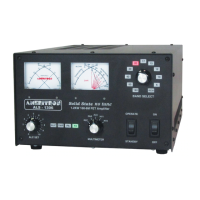
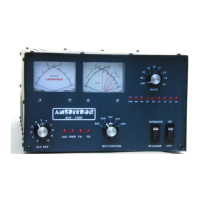
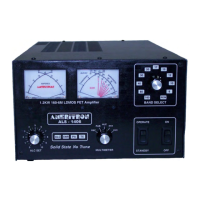
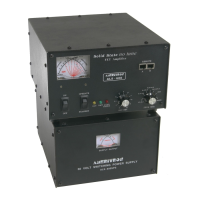
The ALS-1306 is an amateur radio multiband radio frequency linear power amplifier. This
device complies with technical standards of CFR Title 47 part 97.317(a) and (b).
General Operation
This linear amplifier covers the 160, 80, 40, 30, 20, 17, 15, 12, 10, and 6-meter amateur bands.
Up to 100 watts exciter power is applied to relay RLY1 on circuit board RLY. When power is on
and the standby switch is in the operate position, and when the rear panel RELAY control line is
held low (below 1 volt), exciter power is routed through RLY1 to the PD8 power divider board.
Power Division
The PD8 power divider board splits the signal path equally between two 600-watt power
amplifier modules. The PD8 circuit board consists of a conventional magic-T power divider,
components T2 and R7. This T splits drive power into two equal power signals. Each signal path
has a 5 dB attenuator consisting of high power resistors R1 through R6. The 5 dB attenuators on
each output port terminate the T in 50-ohms and provide an additional 10 dB of input port
isolation between the two PA modules. With a 50-ohm source, in excess of 30 dB port-to-port
isolation occurs between PA module inputs. A minimum of 16 dB isolation occurs regardless of
input port termination. The attenuators also work in concert with the magic-T to provide a 50-
ohm input termination for each PA module. The 50-ohm termination and input port isolation
results in unconditionally stable PA modules.
PA Amplifiers
Power amplification comes from two 600-watt power amplifier modules. Each PA module
(PAM-606) uses four MFR-150 field effect transistors. Each MRF-150 has between 100 mA to
300 mA quiescent current. Transistor conduction angle is slightly over 180-degrees, providing
linear class-AB operation. Normal dc drain operating voltage is approximately 50-volts.
Unlike standard Motorola based modules, the PAM-606 modules use two diametrically opposed
push-pull pairs. The push-pull pairs drive balanced striplines. The balanced striplines combine at
a matching transformer. The linear RF power FETs mount on a forced-air-cooled aluminum
heatsink.
Two dc fans cool each PAM-606 module. Two thermistors (PAM-606 R2) sense the power
amplifier transistor temperature. Transistor temperature thermistor R2 regulates bias voltage,
reducing bias voltage as transistor temperature increases. This bias feedback system keeps
transistor quiescent current stable independent of transistor junction temperatures. PAM-606
thermistors R2 also feed a comparator that removes drive when transistor temperatures approach
unsafe levels.
A second set of thermistors (PAM-606 R1) monitor heatsink temperatures. Voltages from
thermistors R1 regulate fan speed, increasing fan speed and airflow as the heat sink warms.
Bias for the PAM-606 modules comes from the CB-2 control board assembly. Each transistor
has an individual bias adjustment, with minimum bias counter-clockwise from the top view. This
is opposite the control function in CB1 assemblies. The PAM-606 modules employ significant
negative feedback to reduce gain, improve gain flatness, improve linearity, and ensure stability.
The FETs have direct resistive voltage feedback across each individual transistor from drain-to-
gate, as well as push-pull transformer (T2) coupled feedback common to the push-pull circuit.



 To Next Page