Revision 2
9
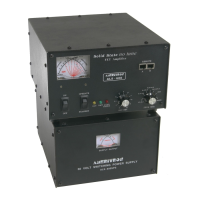
An external 50-volt 50-ampere regulated power supply powers the ALS-1306. The supply is
wired for 240 VAC (200-260 VAC, 50-60 Hz, 15 amperes), but can be rewired for 120 VAC
operation for lighter duty operation.
Power Supply
The external power supply for the ALS-1306 is a voltage-regulated current-limited switching
supply. It contains 14-volt positive and negative supplies, as well as dual 50-volt 25-ampere
continuous (30-ampere peak) fully current-limited supplies. Each PA (power amplifier) module
in the ALS-1306 operates from independent 50-volt modules, giving a total dc supply rating of
2500 watts average power and 3000 watts peak power to the power amplifier modules.
Power supply to amplifier interconnections are through a heavy-duty cable using a large Cinch
Jones connector.
Power Line Requirements
This amplifier ships wired for a nominal mains voltage of 230 Vac. Maximum average power-
line current at full power output is 12 amperes at 240 volts. Two 250-volt 15-ampere fuses fuse
the power line. The switching power supply automatically adapts to any mains voltage between
200 Vac and 260 Vac, and does not require adjustments or tap changes within that range.
Note: 120-volt power mains operation is possible with a reduction in CW or RTTY power.
Because average power is very low, SSB operation is unaffected by 120-volt operation. 120-V
fuse size is 25-amperes maximum.
Power Supply Features
• Efficient operation from 200-260 volts ac (12 amperes typical at full output power).
• Low standby and receive power drain, typically less than 100-watts.
• Generator and inverter friendly with acceptable power line frequency range 40 to 400 Hz.
• Fully regulated current-limited outputs.
• Step-start to limit stress on power supply components.
• Exceptional filtering and RFI suppression eliminates receiver birdies common to most
SMPS.
• Compact light weight design.
Power Supply Location
Locate the power supply in a convenient ventilated area near the amplifier location. Avoid
placing the power supply next to sensitive equipment, such as audio processors, transceivers, or
microphones. For safety, ground the wing nut stud on the supply rear to the station ground buss.
The station ground buss should comply with National Electrical Codes. NEC and fire protection
codes mandate directly bonding of station grounds to the power-line entrance ground. If station
ground rods are not bonded to the utility entrance ground, likelihood of equipment or property
damage and personal risk increases.



 To Next Page