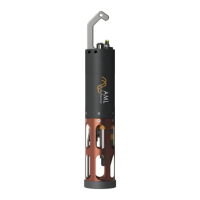
The AML LGR series, encompassing the AML-3 LGR and AML-6 LGR, are highly configurable multiparameter sondes designed for a wide range of data collection applications. The '3' and '6' designations refer to the number of sensors that can be simultaneously installed on the instrument's endcap, with additional external sensors allowing for a total of 4 and 8 sensors, respectively. These instruments are self-powered via a rechargeable internal battery and feature a mechanical on/off switch. They are primarily designed for internal logging of sensor measurements and post-deployment data transfer, commonly used for multiparameter profiling such as CTD (Conductivity, Temperature, Depth) and SVP (Sound Velocity Profile).
Function Description:
The AML LGR instruments are designed for autonomous data logging. They automatically create a new log file and begin recording data upon water detection, typically by monitoring Sound Velocity or Conductivity sensors. The instrument's indicator LED flashes when in water and recording data, confirming operation. After deployment, when retrieved from water, the instrument closes its log file and automatically re-enables its WiFi. Data can then be downloaded, viewed, plotted, and exported using the Sailfish software. For 500m rated instruments, on-board GPS + GLONASS functionality is included, automatically powering up and attempting signal acquisition upon bootup. GPS lock is not required for data logging, but location data will be absent without it. Sailfish also offers an "Offline Assist" feature to improve GPS lock times by transferring satellite data files to the instrument.
Important Technical Specifications:
- Models: AML-3 LGR and AML-6 LGR.
- Sensor Capacity: AML-3 supports 3 on-endcap sensors (up to 4 with auxiliary), AML-6 supports 6 on-endcap sensors (up to 8 with auxiliary).
- Depth Rating:
- 500m Variants: 500 meters [1640 feet].
- 6000m Variants: 6000 meters [19685 feet].
- Material:
- 500m Variants: AML-3 and AML-6 use Acetal pressure cases.
- 6000m Variants: AML-3 uses a Titanium pressure case, AML-6 uses an Acetal pressure case with internal metal reinforcement.
- GPS Capability: Yes for 500m variants; No for 6000m variants.
- Data Storage: 30 GB.
- Software: Sailfish.
- Communication: USB-C (all variants), WiFi (500m variants only).
- Maximum Sample Rate: 20 Hz (sampling by pressure or sound velocity increment also available).
- Power:
- AML-3: 4-cell rechargeable internal battery, 45Wh capacity (approx. 12 hours battery life).
- AML-6: 8-cell rechargeable internal battery, 95Wh capacity (approx. 24 hours battery life).
- Charging: PC or wall charging over USB (10W minimum).
- Temperature Range:
- Operation: -20 to +45°C.
- Storage: -20 to +60°C.
- Dimensions (AML-3):
- Diameter: 7.6 cm / 3.0 in.
- Length (Short Cage): 33.4 cm / 13.15 in (SVP setup).
- Length (Medium Cage): 39.8 cm / 15.66 in (CTD setup).
- Length (Long Cage): 46.4 cm / 18.26 in (UV Protected).
- Weight (air, medium cage, no sensors): 1.36 kg / 3.00 lb (500m); 2.5 kg / 5.6 lb (6000m).
- Weight (water, medium cage, no sensors): 0.69 kg / 1.52 lb (500m); 1.9 kg / 4.1 lb (6000m).
- Dimensions (AML-6):
- Diameter: 10.0 cm / 3.90 in.
- Length: 60.0 cm / 23.6 in.
- Weight (air, no sensors): 4.00 kg / 8.80 lb (500m); 5.80 kg / 12.80 lb (6000m).
- Weight (water, no sensors): 2.00 kg / 4.40 lb (500m); 3.80 kg / 8.40 lb (6000m).
- Regulatory Compliance: CE standards, FCC Part 15.247, Industry Canada RSS-210, Japan Certificates.
Usage Features:
- Communication: Preferred method is WiFi (500m only) or USB-C (all variants). The instrument automatically sets up a WiFi hotspot upon power-up. Sailfish software facilitates configuration, live data streaming, and data download.
- Power Switch: A mechanical on/off switch is located adjacent to the shackle.
- Status Indicator LED: A multi-color LED provides visual feedback on battery status, GPS acquisition, logging, charging, and error states.
- Sensor Configuration: X2Change™ sensors are user-swappable and installed by hand. AML-3 uses a thread-on sensor cage, while AML-6 uses a bolted-on sensor cage for protection and access to sensors.
- Sampling Modes: Configurable sampling triggers (time, pressure increment, sound velocity increment) and rates (up to 20 Hz). Burst mode is also available.
- Log Parameters: Users can select which parameters (date, time, density, salinity, calculated sound velocity, battery, depth, raw values) are included in the data stream and log file.
- Instrument Time and Location: Time can be synchronized to the connected computer's clock or GPS. Location mode can be set to Instrument (internal GPS), manual (external GPS), or none.
- Power Management: Settings for in-water WiFi sleep, WiFi sleep timeout, and power timeout (automatic shutdown if idle).
- Firmware Updates: Sailfish allows viewing current firmware versions and installing updates.
- Command Prompt: Advanced users can send commands directly to the instrument via a command-line interface in Sailfish.
- Output Formats: Supports column-based format (comma-delimited by default) and AMLx format (a proprietary self-describing string).
Maintenance Features:
- Battery Charging: The instrument is charged via its USB-C connector. It is recommended to use the provided wall charger for optimal charging. The instrument can be charged while on or off, with faster charging when off.
- Battery Protection: For deployments where the LED indicator is not visible, it's recommended to increase the battery shutdown voltage to 6.9V to prevent complete discharge and potential damage.
- Sensor Installation/Removal: Sensors are designed for user-swappability. O-rings should be checked for cleanliness and replaced if damaged, with o-ring grease applied.
- Seals and Plugs: Before deployment, ensure all empty sensor ports are sealed with blanking plugs, the USB-C port is capped, and any MCBH connectors are plugged.
- Long-Term Storage: AML recommends fully charging the internal battery before storage and re-charging every 6 months to prevent damage.
- USB-C Cable: AML highly recommends using the factory-supplied USB-C cable for charging and communication to ensure compatibility and performance.

 Need help?
 General

 To Next Page