EasyManua.ls Logo

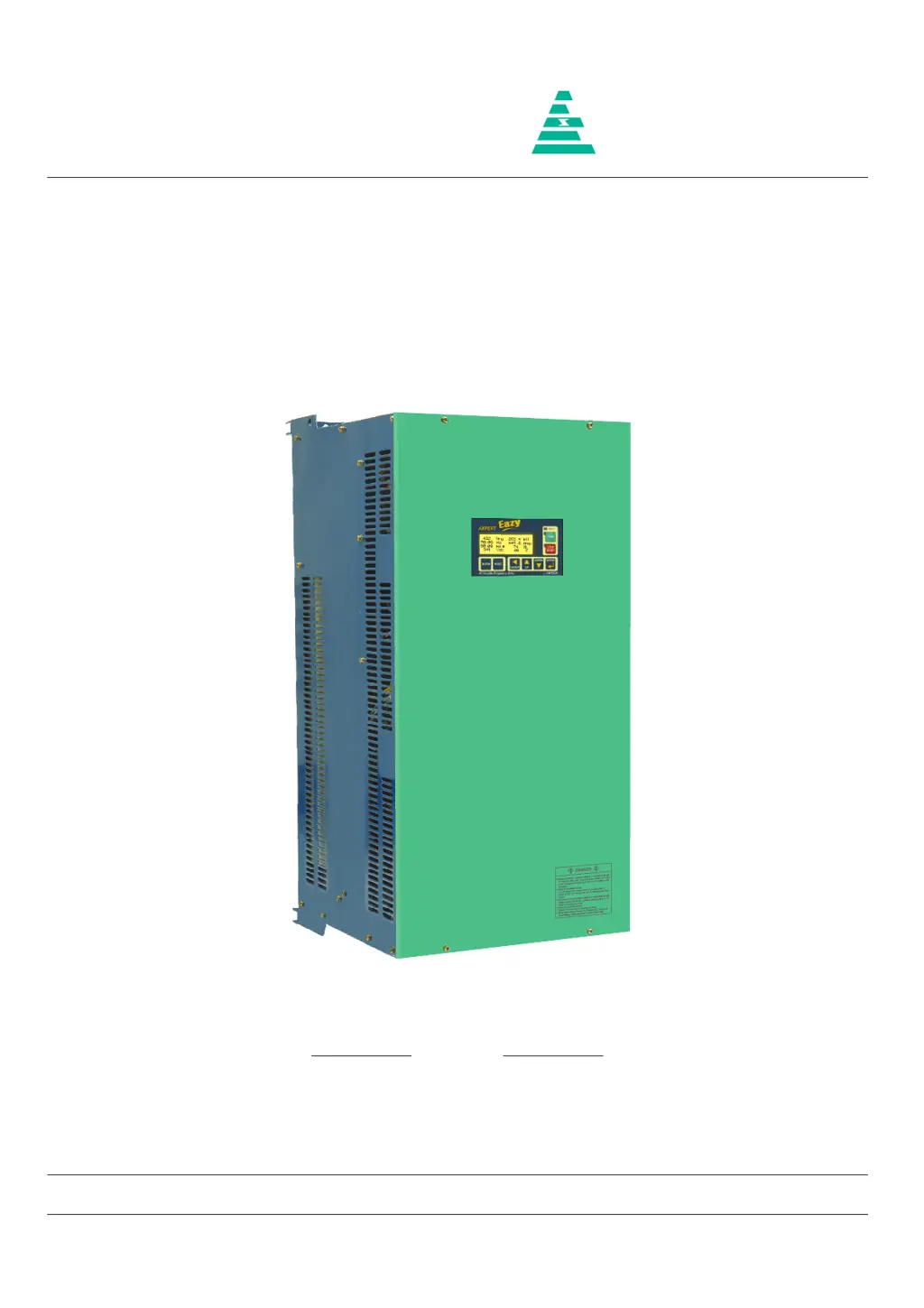
Amtech Axpert-Eazy AMT-075-4 - User Manual

Default Icon
242 pages
Print Icon
To Next Page IconTo Next Page
Loading...
NOTICE
1. Read this manual thoroughly before using the Axpert-Eazy, and store in a safe place for reference.
2. Make sure that this manual is delivered to the final user.
200 V System, 11 kW (15 Hp) ~ 90 kW (125 Hp)
400 V System, 22 kW (30 Hp) ~ 1550 kW (2075 Hp)
500 V System, 30 kW (40 Hp) ~ 1550 kW (2075 Hp)
600 V System, 30 kW (40 Hp) ~ 1800 kW (2415 Hp)
Instruction Manual
Axpert-Eazy Series
AMTECH
IMAE-01, Rev. 1.20
JUL 2017
AMTECH

Table of Contents

Questions and Answers

  • K
    kimberly73Sep 3, 2025
    What causes Under Voltage Fault in Amtech DC Drives?
    • M
      Michael SheltonSep 3, 2025
      An Under Voltage Fault in Amtech DC Drives can be caused by the DC Bus voltage falling below the under voltage level. Check the input power supply and correct it if necessary. Also check soft charge contactor or connection.
  • H
    herrerajessicaSep 2, 2025
    What to do if Amtech Axpert-Eazy AMT-075-4 have Thermistor Over Temperature Fault?
    • J
      Joseph BrandtSep 2, 2025
      If your Amtech DC Drive is showing a Thermistor Over Temperature Fault, it could be due to several reasons. A trouble may have occurred in the cooling blower, so replace it if necessary. The ambient temperature may have risen, so lower the ambient temperature (less than 50 °C for 400 V series or less than 40 °C for 500 V / 600 V series). The temperature switch (thermostat) or thermistor may not be connected or loosely connected at J16 and J13 respectively, so disconnect thermostat switch connection at J16 and ensure that the thermostat shows short circuit. Disconnect the thermistor and ensure that the thermistor shows resistance greater than 2.2 kΩ but less than 60 kΩ. Reconnect thermostat and thermistor properly.
  • B
    Brian SnyderAug 31, 2025
    How to fix U Phase Current Sensor Fail Fault on Amtech DC Drives?
    • J
      Jennifer HarrisAug 31, 2025
      To address a U Phase Current Sensor Fail Fault on Amtech DC Drives, first, check for a loose connection of the hall current sensor cable connected at J12 of PCA-2014A. Switch off the unit, remove the cable, and inspect both sides for proper crimping. If you find any issues, replace the cable and check again. Second, one or more current sensors may have failed. Remove connector J12 and reset the fault. If the fault can be reset, identify the failed current sensor. If, after removing connector J12, the problem persists, replace PCA-2014A.
  • B
    Bryan MartinAug 29, 2025
    What causes an Adjustable Over Current Fault in Amtech Axpert-Eazy AMT-075-4 DC Drives?
    • C
      Cynthia IngramAug 29, 2025
      An Adjustable Over Current Fault in Amtech DC Drives can be triggered by a few factors. The motor current data might be set incorrectly, so set correct motor current data in B103. Alternatively, the adjustable over current settings may be too low, so increase the adjustable over current level (B302). Finally, the output current might be too high, so reduce the motor load.
  • R
    roybrooksAug 27, 2025
    What to do if Amtech DC Drives display a Communication Loss?
    • M
      Mr. Joe OlsonAug 27, 2025
      If an Amtech DC Drive displays a Communication Loss, it could be due to several reasons. There may be a problem in display board PCA-2012, so replace the display board PCA-2012 and check again. Also, there may be a problem in control board PCA-2014A. If +5 V supply or +3.3 V supply is not coming then also this fault will come. Check the power supply unit and if problem is found replace it, or replace the DSP control board PCA-2014A and check again. You can also disable the fault using C405. This will allow the inverter to run in case of communication loss between the PCA-2014A DSP control board and PCA-2012 LCD display board.
  • D
    Deborah ReedAug 26, 2025
    Why does my Amtech DC Drive show a Drive Over Load Fault?
    • J
      Jeffrey CantrellAug 26, 2025
      An Amtech DC Drive may show a Drive Over Load Fault because the AC drive is overloaded. Ensure that motor current data are properly set in B103. Reduce the load or increase the motor and AC DRIVE capacity. If this occurs at low speed, reduce the torque boost settings (A501 / A502) or DC braking settings (A307 / A308).
  • B
    Bobby NormanAug 25, 2025
    What to do if my Amtech Axpert-Eazy AMT-075-4 DC Drives show a Ground Fault?
    • B
      Briana StewartAug 25, 2025
      If your Amtech DC Drive indicates a Ground Fault, it may be due to a short in the output line or motor. Check that no output is shorted to ground; partially damaged output cables can also cause this. Another possibility is a problem with one or more current sensors. Remove the current sensor feedback and check. If the fault persists, replace PCA-2014A, otherwise replace the problematic current sensor.

Summary

Instruction Manual for AMTECH Axpert-Eazy Series

Important Safety Notices

Essential safety precautions before using the Axpert-Eazy AC Variable Frequency Drive.

Preface and Safety Precautions

Precautions For Safety

Essential safety items to prevent damage and ensure safe use of the product.

Preface and General Warnings

Crucial Safety Warnings for AC Drive Usage

High voltage hazards, opening covers, grounding, and operational limitations.

Detailed Safety Precautions and Qualified Personnel

DANGER and CAUTION Symbols

Explanation of danger levels and symbols used for safety warnings.

Chapter 2: Installation and Wiring Guide

General Installation Precautions

Warnings and cautions for installing the AC Drive, braking units, and peripherals.

Power Supply and Motor Wiring Precautions

DANGER: Electrical Shock and Fire Hazards

Critical warnings regarding power OFF, grounding, qualified electricians, and circuit protection.

CAUTION: Wiring and Connection Safety

Guidelines for connecting power supply, output terminals, and tightening screws.

Example of Main Circuit Wiring Diagram

AC DRIVE Input;Output Terminal Connections

Correct connection of power supply to L1, L2, L3 terminals and output to motor.

Control Signal Wiring Precautions

Power Terminal Layout Diagrams

Chapter 3: Digital Operation Panel (Keypad) Functions

Digital Operation Panel Key Functions

Explanation of the functions of the NORM/ESC, MODE, GROUP, UP, and DOWN keys.

Digital Operation Panel Key Functions Explained

ENTER, RUN, and STOP;RESET Key Functions

Description of the ENTER, RUN, and STOP/RESET keys, including status LEDs.

Drive Status Display on the Operation Panel

Parameter Display and Setting Procedure

Example: Adjusting a Parameter Value

Chapter 4: Test Operation and Adjustment

DANGER: Safety During Power ON and Operation

Critical safety warnings about front cover, wet hands, touching terminals, and unexpected restarts.

CAUTION: Operational Safety and Precautions

Cautions regarding hot components, ventilation, setting ranges, holding brakes, and backup devices.

Test Operation Flowchart

Preparation Before Turning Power ON

Selection of Control Modes

Selection of Start Control Method

Selection of Frequency Reference Input

Motor Constant Initialization in Mode-B

Frequency Reference Signal Selection Process Diagram

Automatic Tuning and Adjustment Procedure

Autotune Selection and Execution Steps

Automatic Tuning Modes and Parameter Adjustments

Test Operations After Automatic Tuning

Chapter 5: Control Input;Output Terminals

PCA-2014 A Control Unit Terminal Functions

Detailed description of the functions of terminals on the PCA-2014A control unit.

Terminal Symbol, Name, and Use Descriptions

Terminal Symbol, Name, and Use (Continued)

Programmable Sequence Input (PSI) Wiring

Programmable Analog Input (PAI) Wiring

Wiring diagrams and precautions for FSV, VIN, FSI, and IIN analog inputs.

Programmable Analog Output (PAO) Wiring

Programmable Sequence Output (Open Collector) Wiring

Programmable Sequence Output (Relay) Wiring

Default Terminal Function Assignments

Chapter 6: Parameter Settings and Functions

MODE-M: Monitor Parameters (Group 1)

Monitoring parameters for output frequency, motor speed, current, set frequency, and reference inputs.

Monitor Parameters: Group 2 & 3

MODE-A Parameters: Frequency Setting

Acceleration and Deceleration Time Settings

Start;Stop Selection and DC Braking Parameters

V;F Characteristics Settings

Control Mode Selection (A401)

Sets the motor control mode: V/F, Vector Control (Open/Close Loop, Heavy/Normal Duty).

Torque Boost Settings

MODE-B Parameters: Motor Parameters

Motor Constants

Protection Parameters

Protection Parameters (Continued)

Preset Speed Settings (B401-B407)

Skip Frequency Settings (B501-B504)

Vector Control Constants-1 (B601-B606)

Vector Control Constants-1 (B605-B617) (Continued)

Vector Control Constants-2 (B701-B711)

MODE-C Parameters: Programmable Input;Output

MODE-C Parameters: Analog Output and Input Settings

Status Output Detection Levels (C301-C305)

Status Output Detection Levels (C301-C305) (Continued)

Status Output Detection Levels (C310-C314) (Continued)

Status Output Detection Levels (C315-C319) (Continued)

PLC Panel Parameters (C701-C712)

MODE-D Parameters: Auxiliary Drive Settings

Auxiliary Drive Frequency Settings (D201-D207)

Auxiliary Drive Limiting Parameters (D401-D404)

Auxiliary Drive Limiting Parameters (D404) (Continued)

MODE-E Parameters: Ring Spinning Frame (RSF) Functions

RSF;Pattern Run Parameter Selection Details

MODE-G Parameters: Pattern Run Functions

MODE SELECTION FOR PATTERN RUN TABLE-2

MODE-H Parameters: Special Application Functions

MULTI-PUMP FUNCTION PARAMETERS

Parameters for controlling multiple pumps by managing ON/OFF status and ensuring equal operation time.

MODE-P Parameters: In-Built PLC Functions

Function Explanations: Monitor Parameters Group 1

Function Explanations: Monitor Parameters Group 1 (Continued)

Monitor Parameters: Group 4 - Fault History

Fault History Display Format

Frequency Reference Input Selection (A106)

Frequency Reference Input Selection (A106) (Continued)

Local Torque Setting (A107)

Torque Reference Input Selection (A108)

Torque Reference Input Selection (A108) (Continued)

Current Limit Acceleration and Deceleration Times

Motor Direction Setting (A305)

DC Brake Start Frequency and Current Settings

Custom V;F Curve Voltage Settings (A408-A410)

Display Parameter Selection for Normal Screen (A601-A608)

Frequency Reference Math Operations (A701-A706)

Frequency Reference Math Operations (A701-A706) (Continued)

Default Value Load Options (B311)

Default Value Load Options (B311) (Continued)

Vector Control Constants-1 (B609-B627) (Continued)

Vector Control Constants-1 (B611-B626) (Continued)

Programmable Sequence Input (PSI) Options (Continued)

Programmable Sequence Output (PSO) Configuration

Programmable Sequence Output (PSO) Configuration (Continued)

Programmable Relay Configuration (C111-C112)

Programmable Fault Relay Configuration (C113)

Analog Output Selection (C201-C202)

Analog Output Current Configuration (C203-C204)

Status Output Detection Levels (C306-C309) (Continued)

Status Output Detection Levels (C315-C322) (Continued)

Serial Communication Setup (C401-C405)

Serial Communication Setup (C401-C405) (Continued)

Auto Restart and Speed Search Functions (C501-C511)

Auto Restart and Speed Search Functions (C503-C511) (Continued)

PID Control Selection (C601-C603)

PID Control Selection (C604-C614) (Continued)

PID Control Selection (C615-C619) (Continued)

Multi-Pump Control Operation Example

In-Built PLC Function Explanation and Features

In-built PLC Block Diagram and Related Parameters

In-built PLC Command Format and Examples

Detailed Description of In-built PLC Commands

Detailed Description of In-built PLC Commands (Continued)

In-built PLC Application Examples

PLC Program Code: Input from Display Panel into P101 to PA01

PLC Program Code: Input from Display Panel into P101 to PA01 (Continued)

In-built PLC Applications

PLC Program Code: Example 2 (RUN with Delay)

Chapter 7: Electronics Circuit Boards Overview

Chapter 8: Maintenance, Inspection, and Part Replacement

DANGER: Safety Procedures Before Inspection;Work

Critical safety warnings regarding power OFF, waiting time, and handling metal objects.

Inspection Items and Procedures

Chapter 9: Optional Products and Features

Chapter 10: Encoder Specifications and Wiring

Chapter 11: Serial Communication Setup (RS485;Modbus)

Connecting Host Computer to Multiple Axpert-Eazy Units

Serial Communication Specifications

Introduction to Modbus Protocol

RTU Framing and Message Structure

Modbus Data Access: Register Read and Write

Multi-Drop Serial Link Parameters and Descriptions

Modbus Communication Queries Description

Read Single Parameter Query Format

Read Multiple Parameter Query Format

Write Single Parameter Query Format

Write Multiple Parameter Query Format

Chapter 12: UL and cUL Compliance Instructions

Chapter 13: CE Marking and EMC Compliance

EMC Considerations for Installation

Installation Environments and EMC Compliance

Input Filter Connections and Electrical Shock Hazards

Wiring and Earthing Guidelines

Installation Inside a Metal Cabinet

Insulation Test Precautions

Appendix A: Standard Specifications

Control Functions Overview

Operation Specifications

Appendix B: Fault Codes and Descriptions

Fault Codes 17-38: Description and Causes

Fault Codes 39-67: Description and Causes

Fault Codes 63-67: Description and Causes (Continued)

Appendix C: Trouble Shooting Guidelines

Causes and Countermeasures for Common Faults

Causes and Countermeasures for Common Faults (Continued)

Amtech Axpert-Eazy AMT-075-4 Specifications

General IconGeneral
Rated Power0.75 kW
Power Rating0.75 kW
Protection FeaturesOverload, Overvoltage, Undervoltage, Short Circuit
Storage Temperature-20°C to 60°C
Humidity5% to 95% RH (non-condensing)

Related product manuals