DTF Measurement
The following distance domain measurement is an example of a Distance-to-Fault (DTF)
measurement over a selectable distance range.
Required Equipment
·
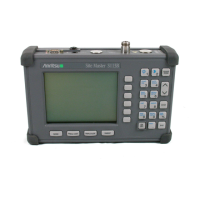
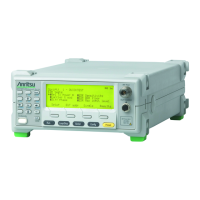
Site Master Model S113B, S114B, S331B, or S332B
·
Precision Open/Short, Anritsu 22N50 or
Precision Open/Short/Load, Anritsu OSLN50LF
·
Precision Load, Anritsu SM/PL
·
Test Port Extension Cable, Anritsu 15NNF50-1.5A
Device-Under-Test Specification
Procedure
Step 1. Press the ON/OFF key on the Site Master.
Selecting the Measurement Mode
Step 2. Press the MODE key.
Step 3. Use the Up/Down arrow key to scroll to
DTF-SWR or DTF-RETURN LOSS.
Step 4. Press the
ENTER key to select DTF-SWR or Return Loss measurement mode.
If the Site Master has not been calibrated (CAL OFF displayed in the upper left
of the display), the DTF AID parameter table will appear.
NOTE: Where CAL ON is indicated on the Site Master, pressing the DTF AID
soft key will activate the DTF parameter table. However, distance and cable
type (propagation velocity and loss) have not been optimized. F1 and F2 are
set by “CAL ON” setup. DTF measurement is valid for D2 £ D
max
(as defined by
F2 and F1).
The number of data points (resolution) will automatically adjust according to the
length of D2.
Step 5. Use the Up/Down arrow key to scroll to
D2, then press ENTER to select the ca
-
ble length.
Step 6. Enter 2 using the keypad or the Up/Down arrow key. Press
ENTER to set D2 to
2.0 meters.
Step 7. Use the Up/Down arrow key to scroll to
F1, then press ENTER to select the start
frequency F1.
Step 8. Enter 3, 0, 0 using the keypad or the Up/Down arrow key. Press
ENTER to set
F1 to 300 MHz.
4-12
Chapter 4 Measurements
Type Typical Loss @1.5m V
g
15NNF50-1.5A
0.3 dB @300 MHz
0.4 dB @600 MHz
0.5 dB @900 MHz
0.6 dB @1200 MHz
0.86





 To Next Page