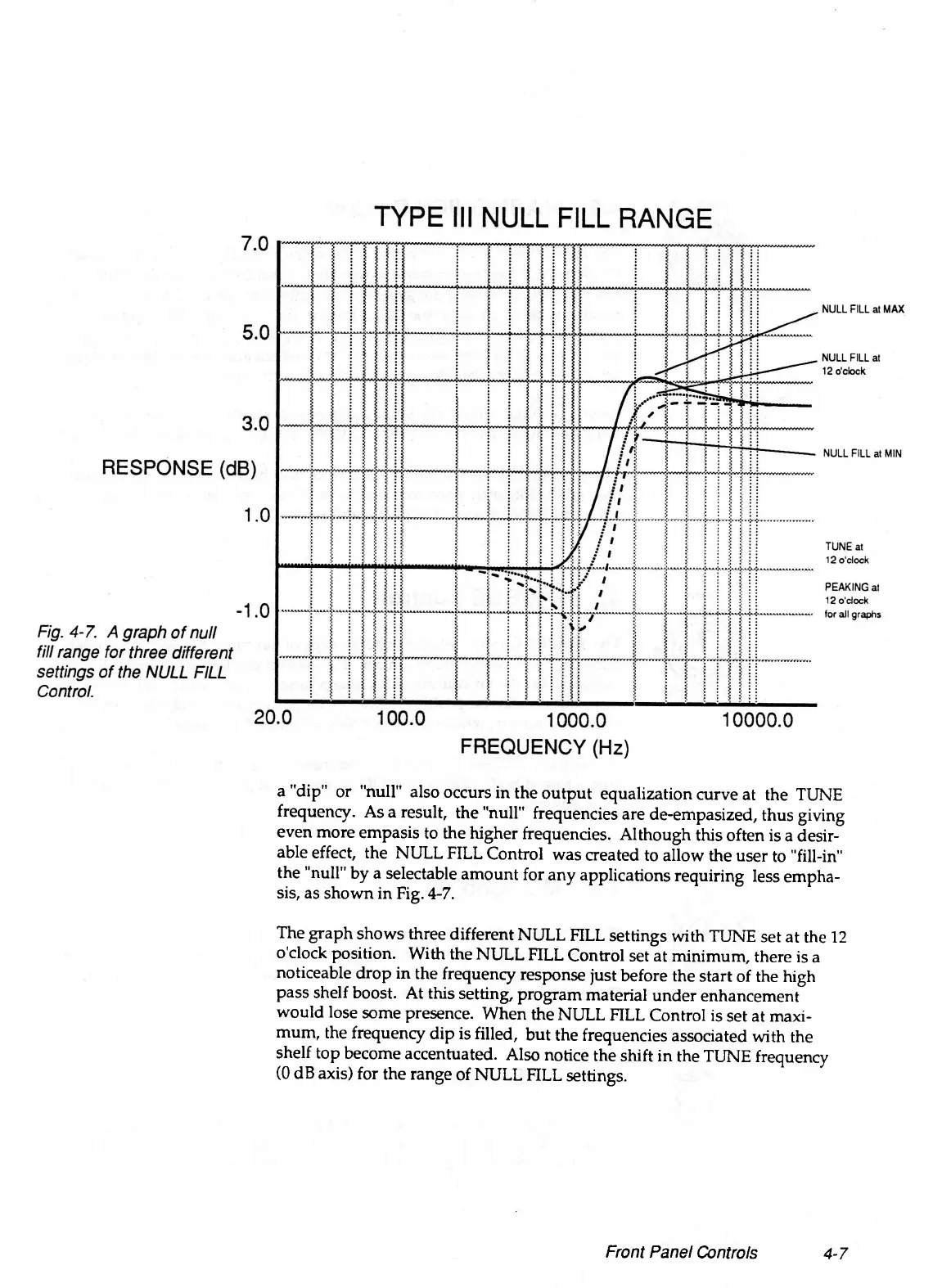
a "dip" or "null" also occurs in the output equalization curve at the TUNE
frequency. As a result, the "null" frequencies are de-empasized, thus giving
even more empasis to the higher frequencies. Although this often is a desir
able effect, the NULL FILL Control was created to allow the user to "fill-in"
the "nuU” by a selectable amount for any applications requiring less empha
sis, as shown in Fig. 4-7.
The graph shows three different NULL FILL settings with TUNE set at the 12
o'clock position. With the NULL FILL Control set at minimum, there is a
noticeable drop in the frequency response just before the start of the high
pass shelf boost. At this setting, program material under enhancement
would lose some presence. When the NULL FILL Control is set at maxi
mum, the frequency dip is filled, but the frequencies associated with the
shelf top become accentuated. Also notice the shift in the TUNE frequency
(0 dB axis) for the range of NULL FILL settings.
Front Panel Controls
4-7


 To Next Page