Mode B is a revolutionary new noise reduction technique which operates to
actually "erase" source audio noise while the Type III enhances the signal.
This feature allows you to restore brightness and intelligibility to noisy
recorded tracks or other noisy sources and improve the signal-to-noise ratio!
Both modes are fast and easy to use, and effective in any application from
live sound to broadcasting and recording.
2.13 Spectral Phase Refractor (SPR)
Correct bass delay The SPR, or Spectral Phase Refractor, function of the Type III is a totally
new concept in psychoacoustic enhancement which can produce some
amazing results. Through the many steps of recording, duplicating, distrib
uting and reproducing sound, the phase of the low frequency audio spec
trum becomes delayed compared to mid and high frequencies. This is a
natural and unavoidable effect which becomes worse with each generation.
When the bass frequencies become delayed in time compared to other
sounds, the bass loses fullness and definition and seems to become less
powerful, even though there may be no actual loss of bass frequency re
sponse. The high end also loses definition, seeming to get duller.
Amplitude equalization at this point will not fully restore the clarity and bass
power. In fact, it may worsen the condition causing clipping or overload
distortion. SPR corrects the bass delay anomaly to restore clarity and
openness and significantly increases the apparent bass energy level without
adding any amplitude equalization or "bass boost. " The SPR function
works harmoniously with the new Aural Exciter circuitry to give the Type III
Aural Exciter amazing new capabilities.
2.1.4 Adjustable Harmonics Level and Timbre Mixing
The DRIVE Control of previous Aural Exciters has been eliminated. In its
place are two new controls that provide adjustable mixing of the exact
amount of desired harmonics level and timbre. These features make the
Type III more flexible and even easier to use.
2.13 Servo Balanced Inputs and Outputs
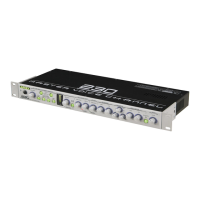
Short-circuit proof Although more costly than conventional designs, servo-balancing offers
many advantages. Servo-balanced input circuits absorb high common-mode
voltages found in long cable runs without sacrificing headroom. Servo-
balanced outputs are not only short-circuit proof, but can be used single-
ended at any time without the usual 6 dB loss of conventional circuits.
To use input or output in a single-ended (unbalanced) mode, you need only
to ground the unused pin. In addition, both inputs and outputs are fully RF
protected. The unity gain I/O structure is normalized for both+ 4 dBu
(professional) and -10 dBv (IHF) operating levels by switch selection from
the rear panel.
2-2
Operational Characteristics


 To Next Page