Ascon Tecnologic - K31D - OPERATING INSTRUCTIONS - PAG. 6
Again in the ]PAn group is present the parameter AdE that
defines the 3 LEDs shift index ( ) functioning.
The lighting up of the green LED (=) indicates that the
process value is within the range [SP + AdE÷SP - AdE], the
lighting up of the LED (-) indicates that the process value
is lower than [SP - AdE] and the lighting up of the LED (+)
indicates that the process value is higher than [SP + AdE].
5.2 Output Configuration
The instrument outputs can be programmed by entering the
group of parameters ]Out, where the relative parameters
o1F, o2F, o3F and o4F (depending on the number of out-
puts available on the instrument) are located.
The outputs can be set for the following functions:
1.rEG Main control output;
2.rEG Secondary control output;
ALno Alarm output normally open (NO);
ALnc Alarm output normally closed (NC);
ALni
Alarm output
NC
with LED reverse indication;
oFF Output deactivated.
The coupling between output-number – alarm-number can
be made in each alarm group referred to each alarm (]AL1,
]AL2 or ]AL3).
If the instrument has an analogue control output, the type of
output can be selected using the Aot parameter in the group]
InP with the following possibilities:
0-20 0
÷
20 mA;
4-20 4
÷
20 mA;
0-10 0
÷
10 V;
2-10 2
÷
10 V.
5.3 Absolute or Differential Temperature
Controller
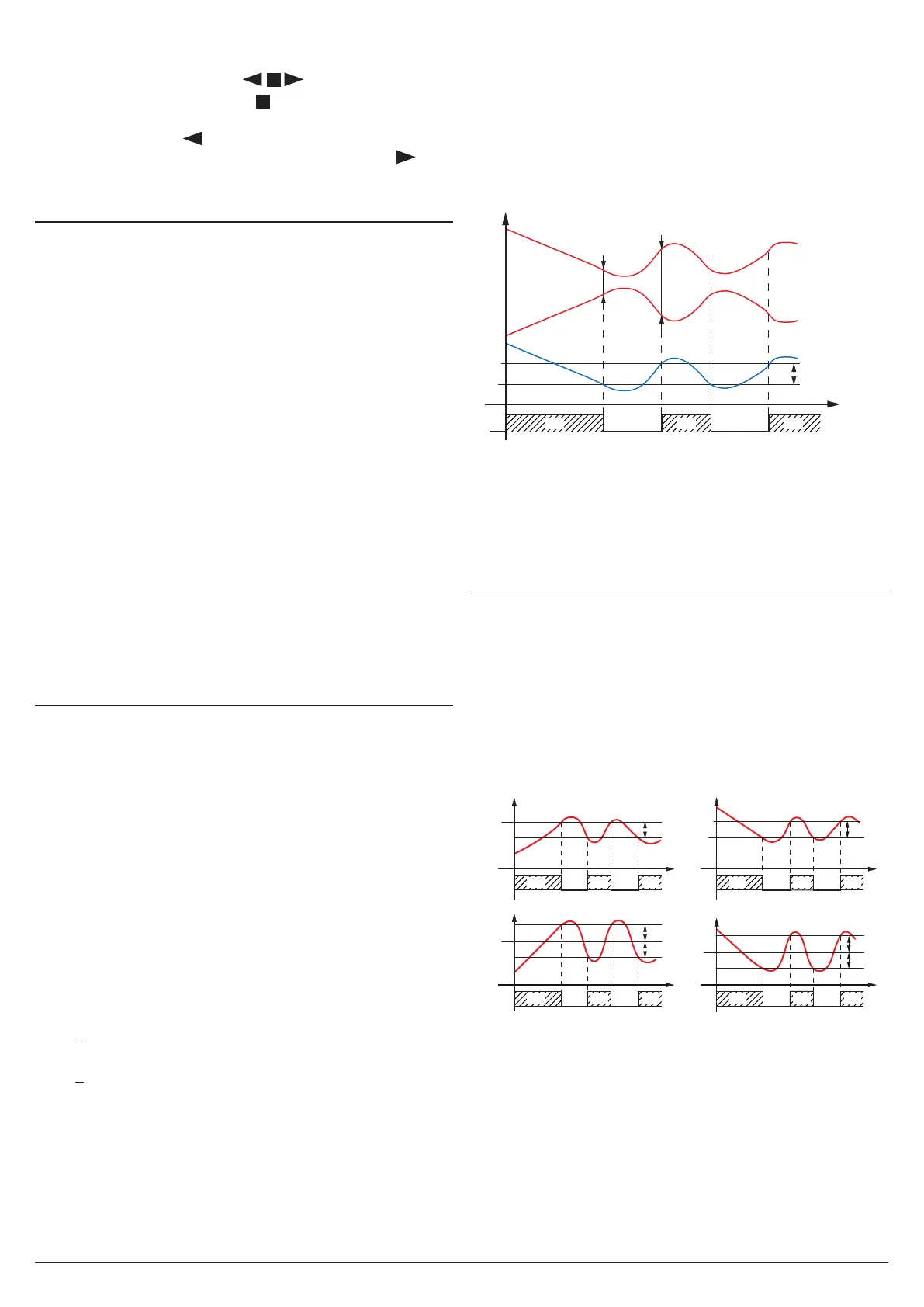
Through the PrrG parameter it is possible to set the process
variable used by the controller to operate.
In fact the controller can operate considering the process
variable as the value measured at Input 1 (Pr1), the value
measured at Input 2 (Pr2), the difference between the two
inputs Pr1-Pr2 (P1-2) or can consider the difference be-
tween the two inputs Pr1-Pr2 but with a maximum limit and a
minimum limit for the Pr2 measurement (P1-L).
The choices PrrG = P1-2 or = P1-L make the controller
operate as a differential controller.
In these cases the controller acts on the control outputs so it
keeps the difference Pr1-Pr2 equal to the Set Point value.
The difference between the two modes lies in the fact that
the P1-L mode activates a limit in the controller in terms of
the calculation of the temperature difference according to the
P2HL and P2LL parameters (both in the ]SP group) so that:
If Pr2 > P2HL the process value considered by the controller is
[Pr1-P2HL]
If Pr2 < P2HL the process value considered by the controller is
[Pr1-P2LL]
When P2HL and P2LL thresholds are exceeded by Pr2 tem-
perature, a control takes place as if the Pr2 temperature is
the value of the limit regardless of the value actually read.
The aim of this function is to limit the differential regulation to
within a maximum range of the Pr2 measurement.
With the differential control the working mode Func = CooL
is used for applications with which the action of the actuator
reduces the Pr1-Pr2 difference (thus countering the Pr1-Pr2
difference that naturally tends to increase).
Viceversa the Func = HEAt mode is used for applications
with which the action of the actuator increases the Pr1-Pr2
difference thus countering the Pr1-Pr2 difference that natu-
rally tends to decrease).
Obviously the Neutral Zone mode or the Double action
mode will set OFF both actions.
HSEt
Func = Cool
offoffoff
ON ON ON
Temp.
time
Pr1
Pr1- Pr2
Pr2
SP1
SP1 + HSEt
SP1
1.rEG
Example of differential ON/OFF control (On.FA) with
Func = CooL.
m
The controller is already programmed in production to
carry out differential regulation and display the tem-
perature difference Pr1 - Pr2.
5.4 ON/OFF Control (1.rEG)
All the parameters referring to the ON/OFF control are con-
tained in the group ]rEG.
This type of control can be obtained by programming pa-
rameter Cont = On.FS or = On.FA and works on the output
programmed as 1.rEG, depending on the process value set
with PrrG, on the active Set Point SP, on the functioning
mode Func and on the hysteresis HSEt.
The instrument carries out an ON/OFF control with symmet-
ric hysteresis if Cont = On.FS or with asymmetrical hyster-
esis if Cont = On.Fa.
HEAt - on.FS
OUT
1.rEG
SP
PV
HSEt
HSEt
HEAt - on.FA
OUT
1.rEG
SP
PV
HSEt
time
off off
CooL
-
on.FS
OUT
1.rEG
SP
PV
HSEt
HSEt
Cool
-
on.FA
OUT
1.rEG
SP
PV
HSEt
time
time time
ON ON ON off offON ON ON
off offON ON ON off offON ON ON
The control works in the following way: in the case of reverse
action, or heating (FunC = HEAt), it deactivates the output,
when the process value reaches [SP + HSEt] in case of sym-
metrical hysteresis, or [SP] in case of asymmetrical hystere-
sis and is then activated again when the process value goes
below value [SP - HSEt].
Viceversa, in case of direct action, or cooling (Func = CooL),
it deactivates the output, when the process value reaches
[SP - HSEt] in case of symmetrical hysteresis, or [SP] in case
of asymmetrical hysteresis and is activated again when the
process value goes above value [SP + HSEt].


 To Next Page