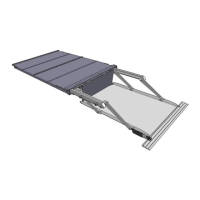
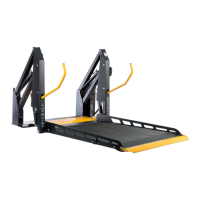
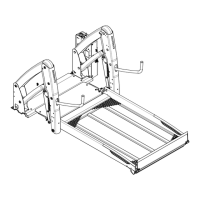
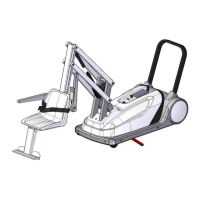
The device described in the manual is the Autolift "F900", a wheelchair lift designed for installation in vehicles. It facilitates the loading and unloading of individuals in wheelchairs into and out of a vehicle.
Function Description:
The Autolift "F900" is a hydraulic wheelchair lift that operates through a hand control. It features a platform that can be extended from a stowed position within a vehicle, lowered to the ground, raised to the vehicle floor level, and then stowed back into the vehicle. The lift is designed to transport a person in a wheelchair, with safety precautions emphasizing proper positioning on the platform, engaging wheelchair parking brakes, and ensuring no obstructions to the roll-stop and bridgeplate. The system includes various microswitches (A, B, C, D) that regulate the central position level, upper position level, and signal when the lift is completely stowed or out.
Important Technical Specifications:
- Model: F900
- Loading Capacity (Tragkraft): 300 Kg
- Weight (Eigengewicht): 135 Kg
- Electrical System (Spannung): 12 Volt
- Max Air Pressure (Oeldruck max): 200 Bar
- Platform Dimension (Piattaformgroessen): 800 x 1250 mm
- Max. Floor Height (Hubhoehe): 850 mm
- Overall Dimensions (approximate from diagram):
- Platform Length: 1720 mm
- Platform Width: 981 mm
- Stowed Height: 380 mm
- Stowed Length: 1250 mm
- Stowed Depth: 470 mm
Usage Features:
The lift is operated via a hand control with buttons for "UP," "DOWN," "IN," and "OUT."
- Getting into the vehicle:
- Press "OUT" to fully extend the platform from the box.
- Press "DOWN" to lower the platform to the ground, ensuring the roll stop is horizontal.
- The wheelchair occupant moves onto the platform.
- Press "UP" to raise the lift to the vehicle floor level.
- The wheelchair occupant moves into the vehicle.
- Press "IN" to automatically lower the lift to the central position and stow it in the box.
- Getting off the car:
- Press "OUT" to fully extend the platform from the box.
- Press "UP" to raise the lift to the vehicle floor level.
- The wheelchair occupant moves from the vehicle cabin onto the platform.
- Press "DOWN" to lower the platform to the ground, ensuring the roll stop is horizontal.
- The wheelchair occupant leaves the platform.
- Press "UP" to raise the platform over the central position level.
- Press "IN" to automatically lower the lift to the central position and stow it in the box.
Safety Precautions:
- The vehicle must be parked on flat ground with the emergency brake engaged and warning lights on.
- The wheelchair occupant must face outwards on the platform, with larger diameter wheels towards the vehicle.
- The wheelchair must be centered on the platform, parking brakes blocked, and wheels not obstructing the roll-stop or bridgeplate.
- Ensure no one is in the moving area of the lift and that limbs or clothing are clear of moving parts.
- Only trained personnel should operate the lift.
- No more than one person on a wheelchair is allowed on the lift simultaneously.
- Ensure no weights or persons are on the platform when it is moving in and out of the box.
- Always return the lift to the stowage position after operations.
Emergency Operations:
- Manual Movement of the Platform (In – Out): The platform can be manually pulled out and stowed by pulling an emergency wire located in the right platform corner.
- Emergency Lifting:
- Plug a lever into the hand pump handle.
- Move the lever up and down to pump the platform to the required height.
- Return the lever to its fixation.
- Contact an Autolift distributor or service point.
- Emergency Lowering:
- Ensure no one is in the platform area.
- Use the lever to open the lowering valve.
- Slowly turn the valve clockwise to carefully lower the platform to the desired height. Avoid opening too much to prevent rapid, dangerous movement.
- Close the valve by turning it anti-clockwise.
Maintenance Features:
- Checks before and after installation: A trained person must perform checks after installation and confirm them. The lift cannot be used if not checked.
- Regular check: A trained person must check the lift at least yearly, with results confirmed in writing.
- Extra Check: Required after any repair or extraordinary maintenance, following the regular check schematic.
- Trained person: Defined as someone with the know-how and experience to evaluate the condition of wheelchair lifts and user safety.
- Necessary Checks (Checklist):
- Handcontrol condition and wire integrity.
- Fixing supports are well mounted, correctly fixed, and in good condition.
- All screws are well tightened.
- Bearings are well mounted and in the right position.
- Platform moves freely without interference.
- Bridge plate works correctly and moves freely.
- Bridge plate is horizontal when the platform is at vehicle floor level.
- Roll-Stop plate works correctly and moves freely when the platform is on the ground.
- Hydraulic cylinders and pipes show no leakage.
- Hydraulic pipes are not damaged.
- Settings (Microswitches A & B): The central position level and upper position (vehicle floor level) can be re-set by adjusting the position of cams on microswitches A and B. Instructions are provided for adjusting when the platform is too high or too low.
- Possible Failures and Solutions: A troubleshooting table is provided for common issues like the platform not extending, not raising, not lowering, or not stowing from the upper position, along with their probable causes and solutions (e.g., checking hand control, microswitches, E-Motor Relais, lowering valve).
- New Fuel Tank (if applicable): If a new vehicle tank is built for clearance, do not overfill. Note that the fuel level indicator may be imprecise, and the tachometer should be used to calculate remaining autonomy.

 Need help?
 General

 To Next Page