23
600 Series
Rated operating capacity
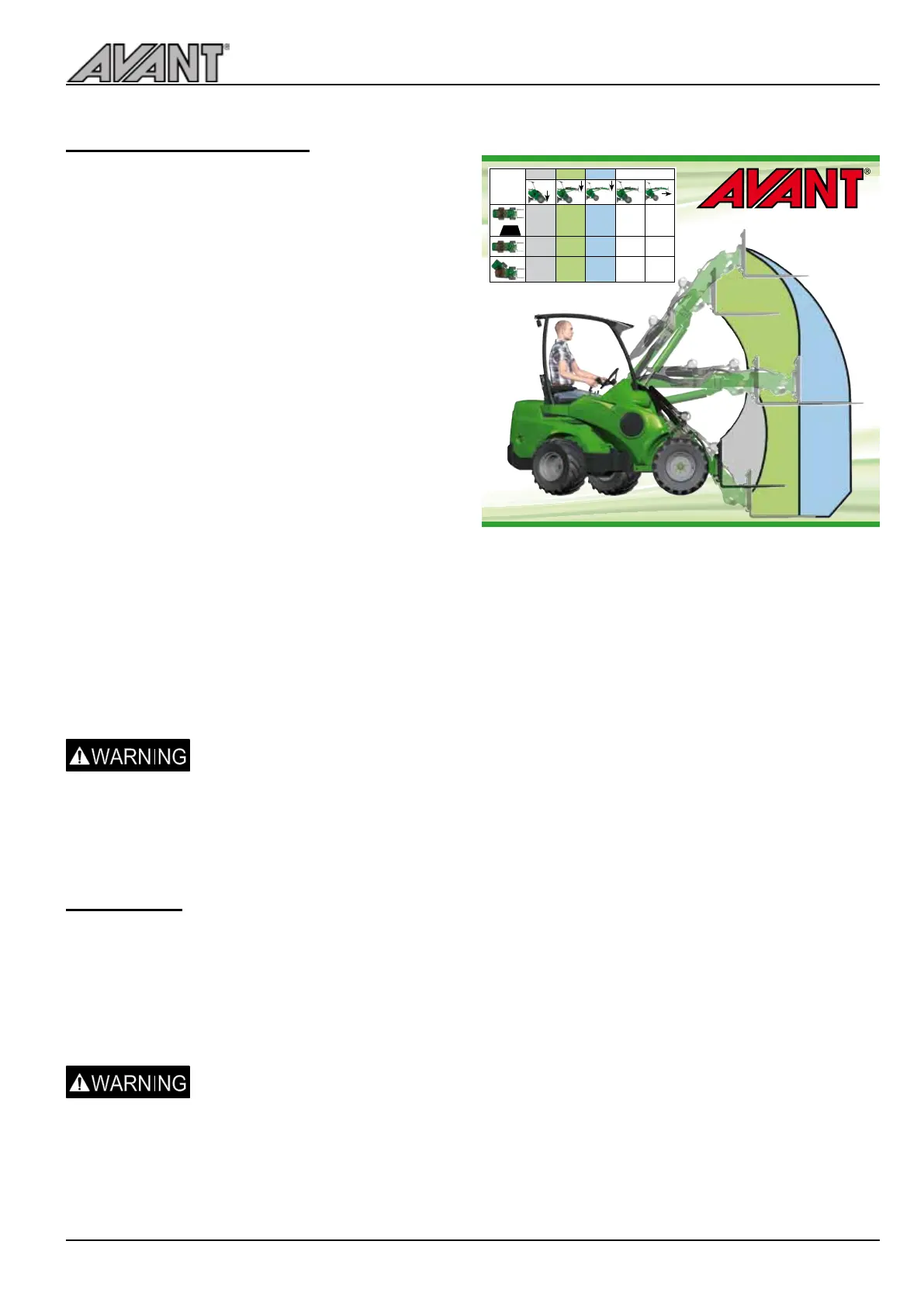
To determine how much the loader can handle safely, a
table of the tipping load and a calculated Rated Operating
Capacity (ROC) is shown in the adjacent label.
A rated Operating capacity label is located near the driver’s
seat and can be read while you sit on the driver’s seat
Rated operating capacity depends on type of use of the
loader:
• In bucket and general application the rated operating
capacity is 50% of tipping load
• In pallet fork application the rated operating capacity is
60% of tipping load
The information shown in the table is the worst case
minimum load, with the conditions listed below. Actual lifting
capacity could be signicantly higher, or it may be lower,
depending on terrain conditions, available lifting force, and
load distribution. Adding or removing counterweights will
affect the indicated ROC.
The ROC table is valid, when:
• The ground is rm and level
• Loader is stationary or driven max 2 km/h, with smooth
and slow control movements
• Driver 165 lb (75 kg) is seated on the driver’s seat
• Load is distributed evenly on pallet forks, with the load
centre of gravity at 16” (400 mm) from the vertical part
of pallet fork arms. The weight of the fork attachment
is taken into account in the indicated load values
Risk of tipping over when
handling heavy loads - See the
warnings and safety instructions
about handling of heavy loads
shown in this manual.
Rated operating capacity
Different loader congurations, rows in the label:
1. Loader frame in straight position, standard
counterweight tted
2. Loader frame in fully articulated position, standard
counterweight tted
Different positions of the loader boom, columns in the
label:
1. Maximum tipping load, stability when lifting load just
off the ground
2. Boom lifted to horizontal position (least stable
position)
3. Rated operating capacity in pallet fork application
1 2 3
640
lb
1
2 3
Rated Operating Capacity
3830 2620 1770 1310 880
3330 2270 1520 1140 770
2890 1960 1300 980 660
o
+
390 lb
A419524
ISO 14397-1
Tipping load
Load sensor
The loader is equipped with a load sensor system. It gives
an audible warning signal and at the same time an indicator
lamp lights up in the dashboard when there is a risk that
the loader tips over its front axle.When the system gives
a warning signal, the load that is being lifted may be too
heavy in relation with the lift capacity of the loader.
If the warning is triggered by
the load sensor:
• Lower the load slowly on the
ground.
• Retract the telescopic boom.
Never extend the telescopic
boom any further when the
warning is triggered.
• Avoid abrupt movements.
Sudden movements of the
boom, or abrupt starting,
stopping, or turning of the
loader, can decrease the
stability of the loader, causing
tipping over.
• Reduce load, or add sufcient
amount of counterweights to
the loader to complete the task.
• Keep in mind that the load
sensor warns only about the
possiblity of tipping forward on
level ground.



 To Next Page