WHEELS AND TYRES
for protection but NOT plastic materials. This
will reduce the deterioration of the tyres and
reduce the cracking and flat spots caused by
continuous loading and external conditions. It
is recommended to protect tyres from direct
sunlight.
If it is not practical to remove the wheels it is
recommended to routinely rotate the wheels to
reduce the potential of cracking, flat spots etc.
Check with your insurance company
that you are still covered when the
wheels are removed.
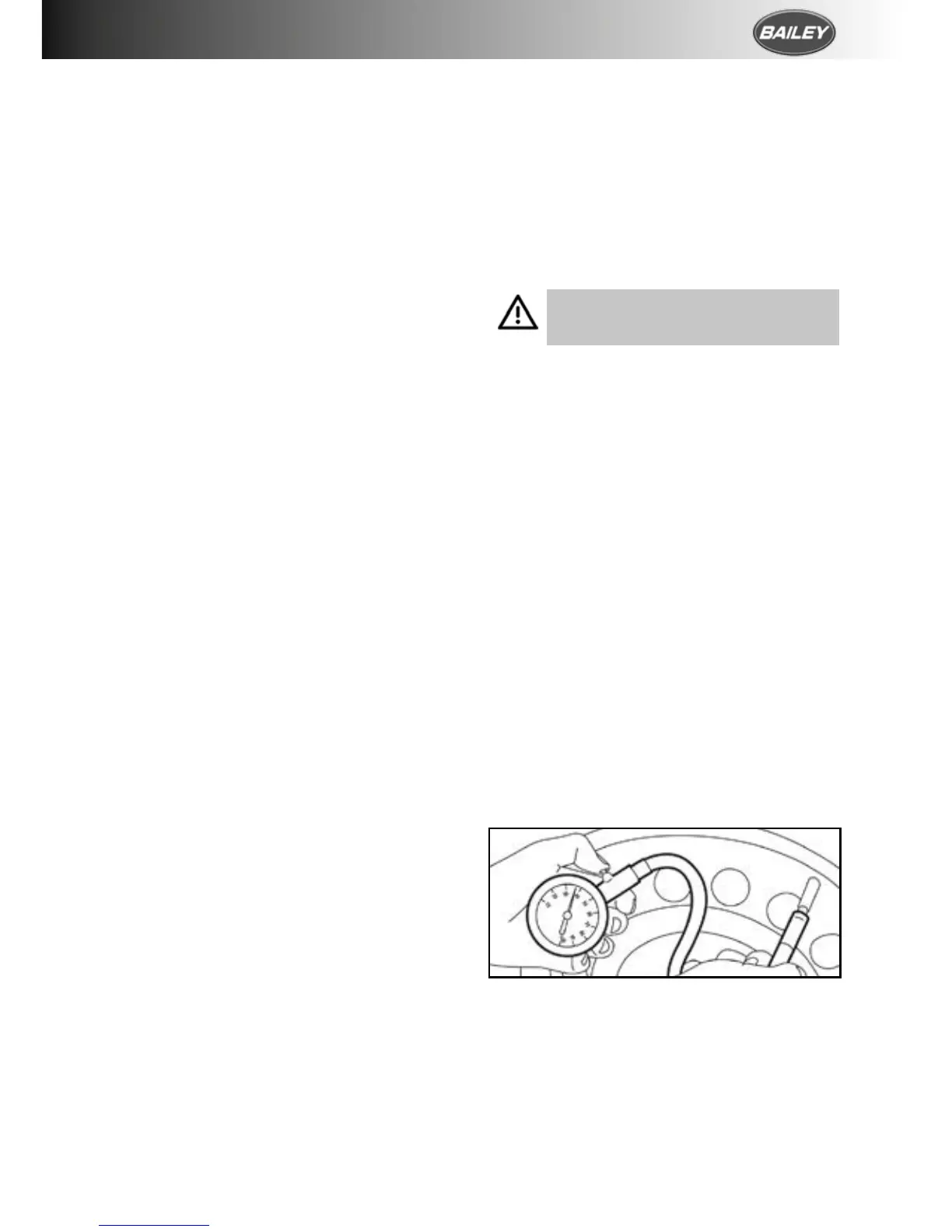
Caravan tyres should be at the pressure
recommended. The towing vehicle’s tyres
should be set to the pressure recommended by
the vehicle manufacturer for laden conditions.
This will ensure the tyres and vehicle operate
in a safe condition and maintain stability of the
vehicle when towing.
Always check your caravan and tow vehicle
tyre pressures when cold and prior to any
journey. Also check tyre conditions for
damage or cuts exposing the casing before and
after any journey (this includes the spare.) If
in doubt it is advisable to have it examined by
a tyre specialist as soon as possible. Incorrect
tyre pressures can seriously affect towed
vehicle performance and the longevity of the
tyre.
Consult your tow vehicle manufacturer for the
correct tyre pressures for towing.
WHEELS AND TYRES
All Bailey vehicles use branded tyres. These are
subject to change at any point without prior
notice.
The tyres on Bailey caravans are suitable for
towing at sustained speeds of up to 81 mph
(130 kph) to allow for use in countries which
permit these speeds.
Radial and cross ply tyres should never be
mixed. It is dangerous and can cause snaking.
Fit only tyres that are of identical specification
on each side, unless towing for a limited time
on the spare wheel.
The legal requirements for tread depth on
motor vehicles also applies to caravans.
In order to equalise wear it is suggested that
wheels be balanced and changed around from
time to time. When caravans are not in use
for extended periods, wheels and tyres should
be removed and stored in dry conditions and
away from the outside elements. Alternatively
caravans should be jacked up to relieve the
load from the tyres.
It is dangerous to neglect tyre damage.
Tyres should be checked for damage or cuts
exposing the casing. If a tyre has suffered
an impact (for example against a kerb) it
is advisable to have it examined by a tyre
specialist as soon as possible.
The caravan industry recommends that
for safety reasons tyres more than 7 years
old from the date of manufacture must be
replaced, but preferably replaced at 4 years
old. The tyres may have deteriorated by this
time, regardless of tread depth.
The cleaning of tyres should only be carried
out using soap and water. Petrol, diesel,
paraffin and other solvents are not suitable.
If the caravan is not used for long periods
of time (periods of longer than 1 month),
it is recommended that the wheels/tyres
are removed and stored upright in a rack
and rotated at least once a month to avoid
the tyres becoming distorted. They can be
covered with a natural material (e.g. hessian)



 To Next Page