9440300990 10-7
DECS-250 Protection
Power Protection
BESTCOMSPlus Navigation Path: Settings Explorer, Protection, Power
HMI Navigation Path: Settings, Protection, Power
Generator power levels are monitored to protect against reverse power flow and loss of excitation.
For optimal 40Q (loss of excitation) operation, set the rated PF to a value less
than 1.0 on the BESTCOMSPlus Rated Data screen. When the rated PF value
is changed, the rated kW is automatically recalculated and the 40Q and 32
(reverse power) element settings must be adjusted appropriately.
Reverse Power
Reverse power protection guards against reverse power flow that may result from a loss of prime mover
torque (and lead to generator motoring). A reverse power condition occurs when the flow of reverse
power exceeds the 32R pickup threshold for the duration of the 32R time delay. Reverse power protection
can be enabled and disabled without altering the pickup and time delay settings. Reverse power pickup
and trip elements in BESTlogicPlus can be used in a logic scheme to initiate corrective action in response
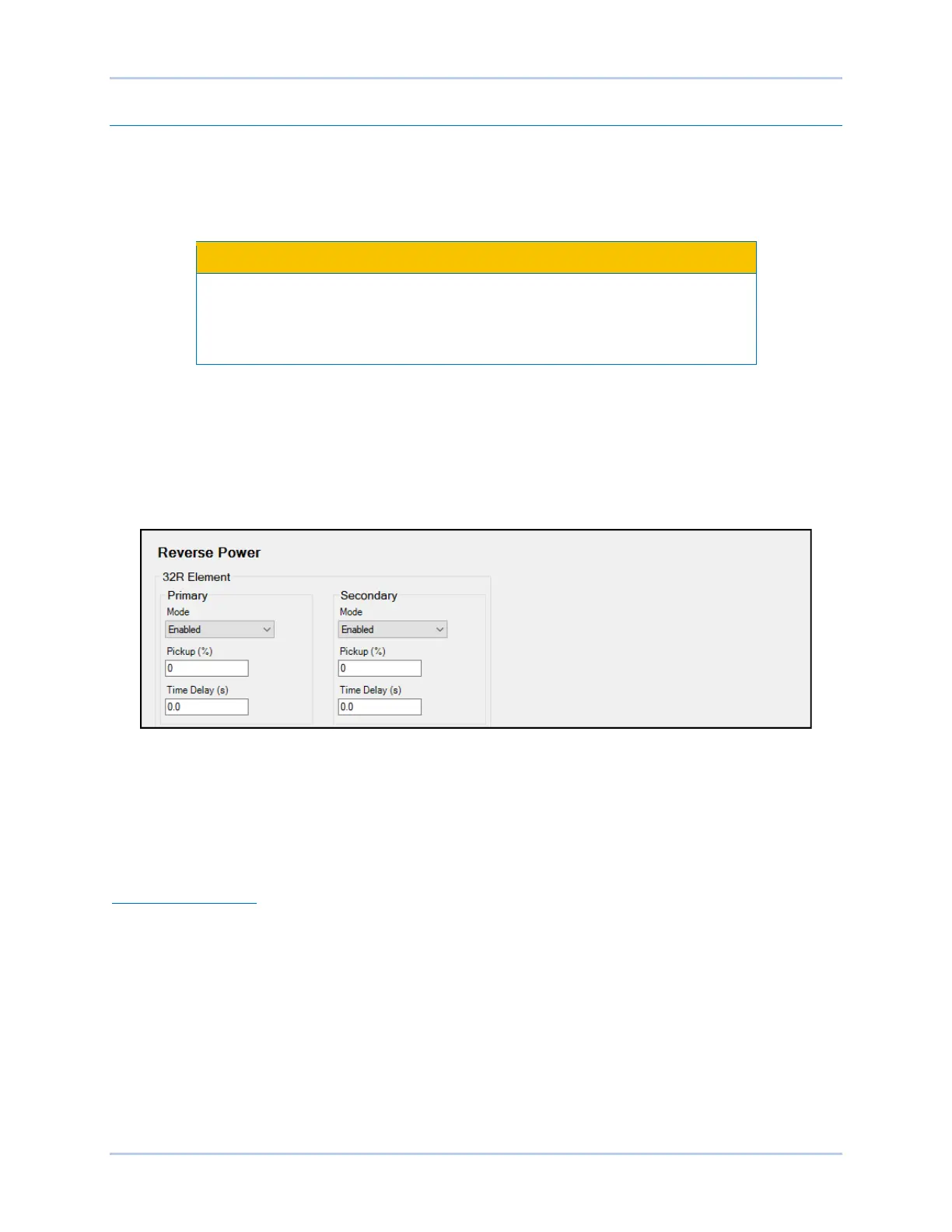
to the condition. BESTCOMSPlus reverse power protection settings are illustrated in Figure 10-9.
Figure 10-9. Reverse Power Protection Settings
Loss of Excitation
The loss of excitation element operates on excessive var flow into the machine, indicating abnormally low
field excitation. This element protects controlled generators as well as motors. A diagram of the 40Q
pickup response is illustrated in Figure 10-10. BESTCOMSPlus settings are described below and shown
in Figure 10-11.
Generator Protection
During loss of excitation, the generator absorbs reactive power from the power system which can
overheat the stator windings. The loss of excitation element acts on the principal that if a generator
begins to absorb vars outside its steady-state capability curve, it has likely lost its normal excitation
supply. The element is always calibrated to the equivalent three-phase power even if the connection is
single-phase.
The loss of excitation element compares the reactive power to a map of the allowed reactive power as
defined by the Pickup setting. The loss of excitation element remains in a pickup condition until power
flow falls below the dropout ratio of 95% of the actual pickup. A time delay is recommended for tripping.
For settings well outside the generator capability curve, adding a 0.5 second time delay helps prevent
transient fault conditions. However, recovery from power system swings after a major fault may take
several seconds. Therefore, if the unit is to pick up near the steady-state capability curve of the generator,
longer time delays are recommended. See Figure 10-10 for details.



 To Next Page