17
4.1.3 ExposureTime
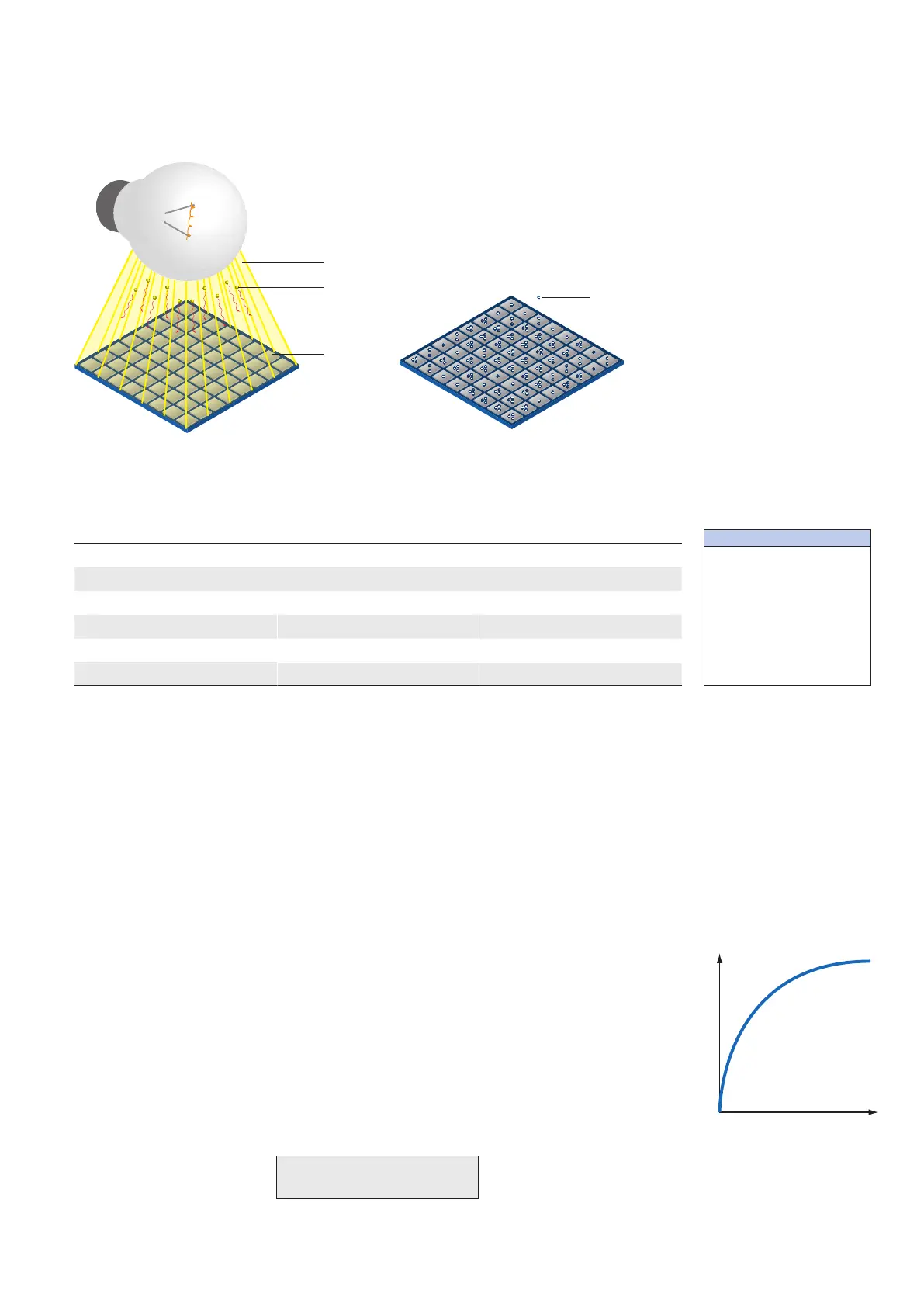
On exposure of the sensor, the inclination of photons produces a charge separation on
the semiconductors of the pixels. This results in a voltage difference, which is used for
signal extraction.
Light
Photon
Pixel
Charge Carrie
The signal strength is inuenced by the incoming amount of photons. It can be increased
by increasing the exposure time (t
exposure
).
On Baumer EXG cameras, the exposure time can be set within the following ranges (step
size 1μsec):
CameraType t
exposure
min t
exposure
max
Monochrome
EXG03 32 μsec 1 sec
EXG50 4 μsec 1 sec
Color
EXG03c 32 μsec 1 sec
4.1.4 HighDynamicRange(HDR)
The term "HDR" envelops several techniques to increase the dynamic range of brightness
(from the brightest spot to the darkest spot of an image) beyond the native dynamic range
of the imaging sensor. On Baumer cameras HDR-Images are created from a bracketing
of several recorded – so called "Low Dynamic Range" (LDR) – images.
4.1.5 Look-Up-Table
The Look-Up-Table (LUT) is employed on Baumer monochrome cameras. It contains 2
12
(4096) values for the available levels of gray. These values can be adjusted by the user.
In this example the LUT is used to overwrite levels of gray which are not of interest or in
the case of overdrive.
4.1.6 GammaCorrection
With this feature, Baumer EXG cameras offer the possibility of compensating nonlinearity
in the perception of light by the human eye.
For this correction, the corrected pixel intensity (Y') is calculated from the original intensity
of the sensor's pixel (Y
original
) and correction factor γ using the following formula (in over-
simplied version):
Y' = Y
original
γ
◄Figure15
Incidence of light causes
charge separation on
the semiconductors of
the sensor.
AutoExposure:
Some models of the EXG
series are equipped with
the ability for automatic
adjustment of the exposure
time by means of target-
settings in respect of the
intensity of the recorded
images.
▲Figure16
Non-linear perception of
the human eye.
H - Perception of bright-
ness
E - Energy of light



 To Next Page