Function
11
RCMA421H_D00069_00_M_XXEN/05.2014
3.2.3 Self test, automatic
The device runs a self test every 24 h. Any internal malfunctions detected are
shown on the display as error codes. The automatic self test is carried out
without internal fault current. The alarm relay is not switched during the 24-h
test.
3.2.4 Self test, manual
The device runs a self test when the test button is pressed (> 1.5 s). Any inter-
nal malfunctions detected are shown on the display as error codes.
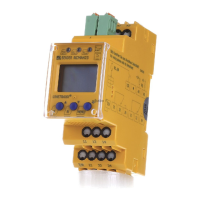
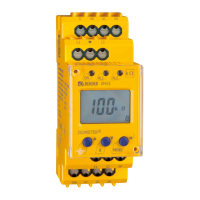
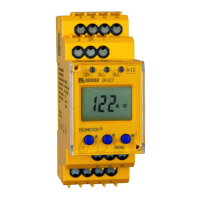
Whilst the test button T is pressed, all display elements available for this de-
vice are shown. When the button is released, the tES test symbol appears and
the manual self test commences.
During the manual self test, an internal test current of approx. 7 mA is evalu-
ated. Consequently, the TPD alarm LED lights up and the alarm relay switches.
Once the alarm relay has switched, the residual current must fall to less than
the rated residual operating current. If it does not, error code E.04 will appear
on the display to indicate that the connected contactor has not shut down the
load circuit.
If the self test has been successfully and the reset button R is pressed, the
alarm LEDs will go out and the relay will switch to its initial state.
If the self test has not been successfully, the TPD alarm LED will light, the ERR
alarm LED will flash, the alarm relay will switch to the alarm state and an error
code will be displayed.
3.2.5 Malfunction
In the event of an internal malfunction, the TPD alarm LED will light and the
ERR alarm LED will flash. An error code will appear on the display until the fault
is removed. Refer to page 30 for details about error codes.
3.2.6 Password protection (on, OFF)
If password protection has been activated (on), settings can only be made
subject to the correct password being entered (0…999).




 To Next Page