xi
Safety Notes
June 2004 - 9507ES/5
Important Facts about Seat Belts
The potential exposure of this seat belt to severe environmental conditions make it crucial to inspect the seat belt system
regularly. It is recommended that the seat belt system is inspected at least once a year or more often if the vehicle is
exposed to severe environmental or vocational conditions, Any seat belt system that shows cuts, fraying, extreme or
unusual wear, significant discoloration due to UV exposure, dusty-dirty conditions, abrasion to the seat belt webbing, or
damage to the buckle, latch plate, retractor, hardware or any other obvious problem should be replaced immediately.
Once replacement of the seat belt has been determined, be certain that it Is only replaced with the original equipment
manufacturer recommended replacement seat belt. See your authorized spares and service centre for replacement. Your
restraint system has been developed and tested specifically for your machine.
If the inspection indicates that any part of the seat belt requires replacement, the entire belt must be replaced. It is vitally
important that all components be mounted back in the same position as the original components which were removed. This
will maintain the design integrity of the mounting points for the seat belt assembly.
Seat Belt Maintenance Guidelines
WARNING
z Failure to properly inspect and maintain a seat belt can cause serious injury or loss of life in the event of an accident.
z It Is critical that any time the machine is involved in an accident, the entire seat belt system must be replaced.
z The seat belt should be considered to have a finite life and must be replaced as needed throughout the life of the
machine. The belt must be inspected for needed maintenance at least once a year or more often if exposed to
severe environmental or vocational conditions.
z If replacement of any part of the seat belt is indicated through maintenance guidelines below, the entire belt must
be replaced, both retractor and buckle side.
Maintenance Guidelines
The following maintenance guidelines detail how to
Inspect seat belt for “cuts, fraying, extreme or unusual
wear of the webbing, etc., and damage to the buckle,
retractor, hardware or other factors” which indicate that
seat belt replacement is necessary,
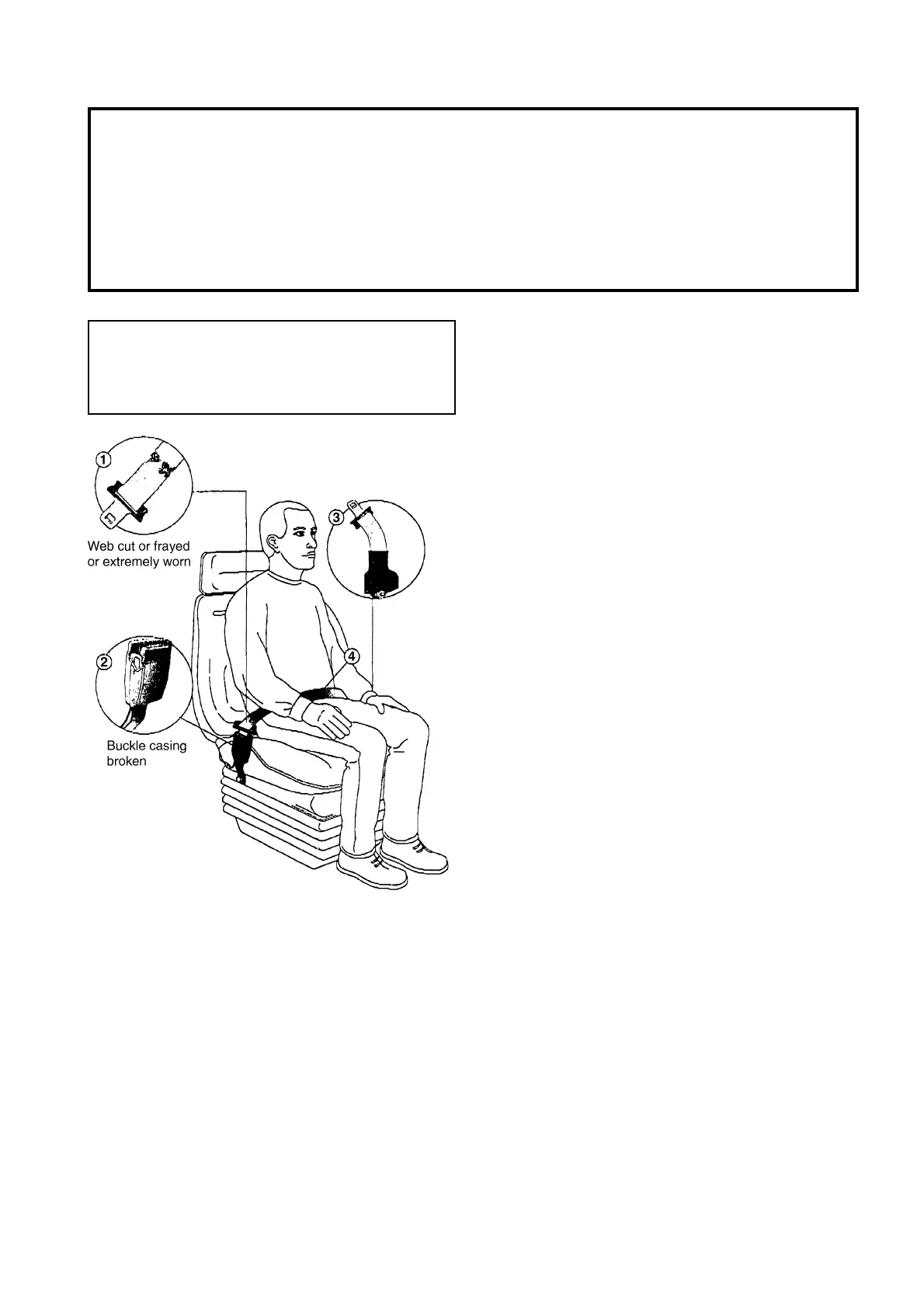
1 Check the webbing. Pull the webbing completely out of
the belt retractor and inspect the full length of the
webbing for cuts, wear, fraying, dirt and stiffness. If a
belt shows any cuts, fraying, extreme or unusual wear,
the system should be replaced.
2 Check the buckle and latch for proper operation and to
determine if latch plate is excessively worn, deformed
or buckle is damaged or casing broken.
3 Check retractor web storage device operation by
extending webbing to determine it locks properly and
that it spools out and retracts webbing properly.
4 Check web in areas exposed to ultraviolet rays from the
sun or extreme dust or dirt. If the original colour of the
web in these areas is extremely faded and/or the web
is packed with dirt, the physical strength of this web
may have deteriorated. If this condition exists replace
the system.
IMPORTANT
Follow Maintenance Guidelines 1-4 to properly
Inspect seat belt and tethers to determine if
replacement Is necessary.



 To Next Page