12/ 2017
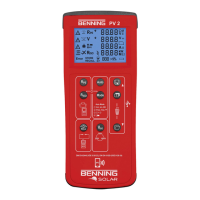
BENNING PV 2
22
- Each time pressing the
V
ISO
-key
7
increases the switch-off time by one minute up to a maxi-
mum time of 10 minutes.
- Release the
Ω
NULL
-key
6
to store the setting.
8.1.3 Setting the date and the time
The BENNING PV 2 is equipped with an integrated real-time clock which automatically adds
a date / time stamp to each storage process or storage location (see chapter 8.7 "Measured
value memory").
To set the date and the time, carry out the following steps:
- Switch the BENNING PV 2 off by simultaneously pressing the keys
R
ISO
4
and
Mode
5
.
- Press and hold the -key
9
and simultaneously press the keys
R
ISO
4
and
Mode
5
.
- The date / time format is displayed as follows:
MM.DD = month (1-12).day (1-31)
YYYY = year
HH.mm = hours (0-23).minutes (0-59)
SS = seconds (0-59)
- Press the
R
PE
-key
2
to select a date / time eld.
- As soon as the eld is ashing, the value for that eld can be set.
- Press the -key
L
or the -key
9
to increase or decrease the value.
Every change resets the eld for the seconds to zero.
- Switch the device off by simultaneously pressing the keys
R
ISO
4
and
Mode
5
to store the set-
ting.
Note:
If the BENNING PV 2 has established a radio connection to the BENNING SUN 2, the date/ time
of the BENNING PV 2 will be synchronized automatically after 10 seconds to the date/ time of
the BENNING SUN 2, if the device detects a deviation of more than 1 minute. BENNING SUN 2
(master) → BENNING PV 2 (slave).
8.1.4 Testing the battery condition
During switch-on and operation, the BENNING PV 2 carries out an automatic battery test. Dis-
charged batteries are indicated by a battery symbol P on the LC display
1
. As soon as the bat-
tery symbol is ashing, the batteries have to be replaced immediately (see chapter 9.4, "Battery
replacement").
8.1.5 Compensation of the measuring leads (null balance)
In order to carry out a compensation (null balance) of the measuring lead resistance, connect the
measuring leads with each other by means of the alligator clips and press the
Ω
NULL
-key
6
until the
Ω
NULL
symbol C is shown on the LC display
1
.
m
Measuring lead resistances can be compensated by up to 10 Ohm.
See gure 4: Null balance of the measuring lead for R
PE
measurement
8.2 Testing the protective conductor resistance (R
PE
)
m
The PV generator must be isolated from the electric power supply! Neither the
positive nor the negative pole of the PV generator must be earthed!
m
If a voltage of > 30 V is applied to the test object, the determined voltage will
be displayed. If the measuring voltage at the probe tips exceeds 30 V, the R
PE
measurement will be blocked! If the R
PE
measurement is started below 30 V, a
low-impedance voltage source might trip the built-in fuse of the BENNING PV 2!
For single measurement:
- Make sure that the switching circuit and/or the test object are free of voltage.
- Connect the red and black safety measuring leads to the corresponding 4 mm test sockets
P
and
O
and connect the test object.
- Press the
R
PE
-key
2
.
- Press the -key
L
to store the measured value to the next storage location available.
See gure 5: Testing the protective conductor resistance (R
PE
)
For continuous measurement:
- Make sure that the switching circuit and/or the test object are free of voltage.
- Connect the red and black safety measuring leads to the corresponding 4 mm test sockets
P
and
O
and connect the test object.
- Press and hold the
R
PE
-key
2
until the symbol G is displayed.
- The measured protective conductor resistance (R
PE
) is displayed
1
continuously.
- Press the
R
PE
-key
2
to terminate the continuous measurement.
- Press the -key
L
to store the measured value to the next storage location available.
See gure 5: Testing the protective conductor resistance (R
PE
)


 To Next Page