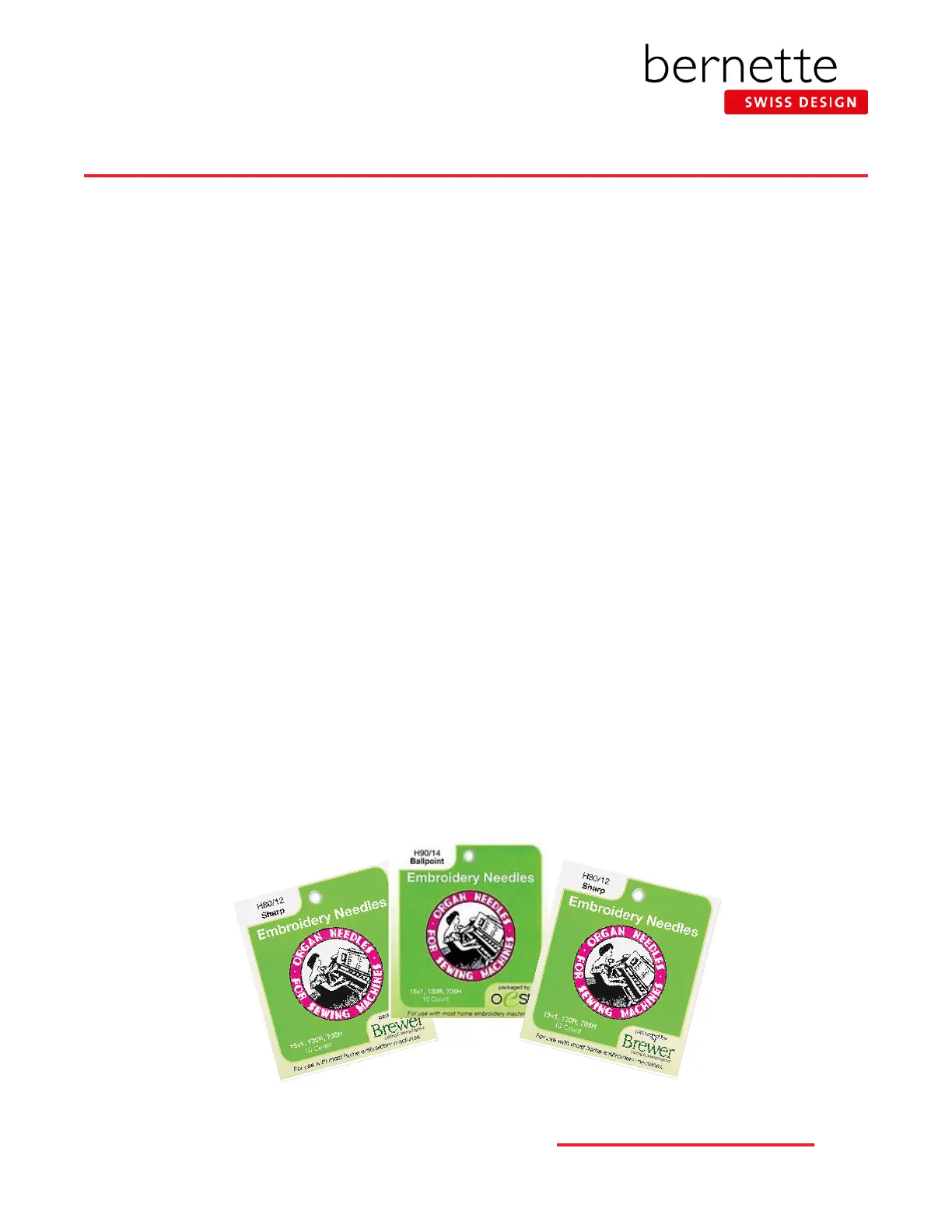
Reference - Embroidery Needles
For most embroidery, an embroidery needle is the best choice. These needles are designed with a larger eye than normal to
prevent thread fraying, and are also designed to withstand the high speeds of the embroidery process.
Needle Use & Care
• Change needles every 2-3 hours or about every 50,000 stitches.
• Change the needle if you are experiencing looping or skipped stitches.
• Never use a bent needle or dull needle.
Needle Size
• 75/11 and 80/12 are the two most commonly used sizes.
• For heavy fabrics, use a larger needle (higher number).
• For lightweight fabrics, use a smaller needle (lower number).
• For dense designs, use a small needle so that it will slide into the stitches easier.
Universal Embroidery Needles
• These are the most widely used for embroidery. They have a slightly rounded ballpoint tip.
Ballpoint Embroidery Needles
• Ballpoint needles are designated by the letters SUK.
• They are shown to have positive results when embroidering with metallic thread. (Due to the wiry nature and memory of
this type of thread, a traditional embroidery needle with a sharp point can cut the thread, causing breakage. Ballpoint nee-
dles are blunt enough to avoid this.)
Titanium-coated Embroidery needles:
• Last 3 times longer than regular embroidery needles.
• Work well with all embroidery designs and fabric types.
• Are especially useful when using an adhesive-coated stabilizer, because the coating resists adhesive build-up as the needle
moves in and out of the fabric.
• Are often gold-colored.
• Should be changed after 90,000 or more stitches.
Specialty Needles
• Occasionally other needles may be recommended for specially digitized techniques, such as a Wing Needle for heirloom
embroidery.
27
bernette
EMBROIDERY MACHINE WORK
BOOK




 To Next Page