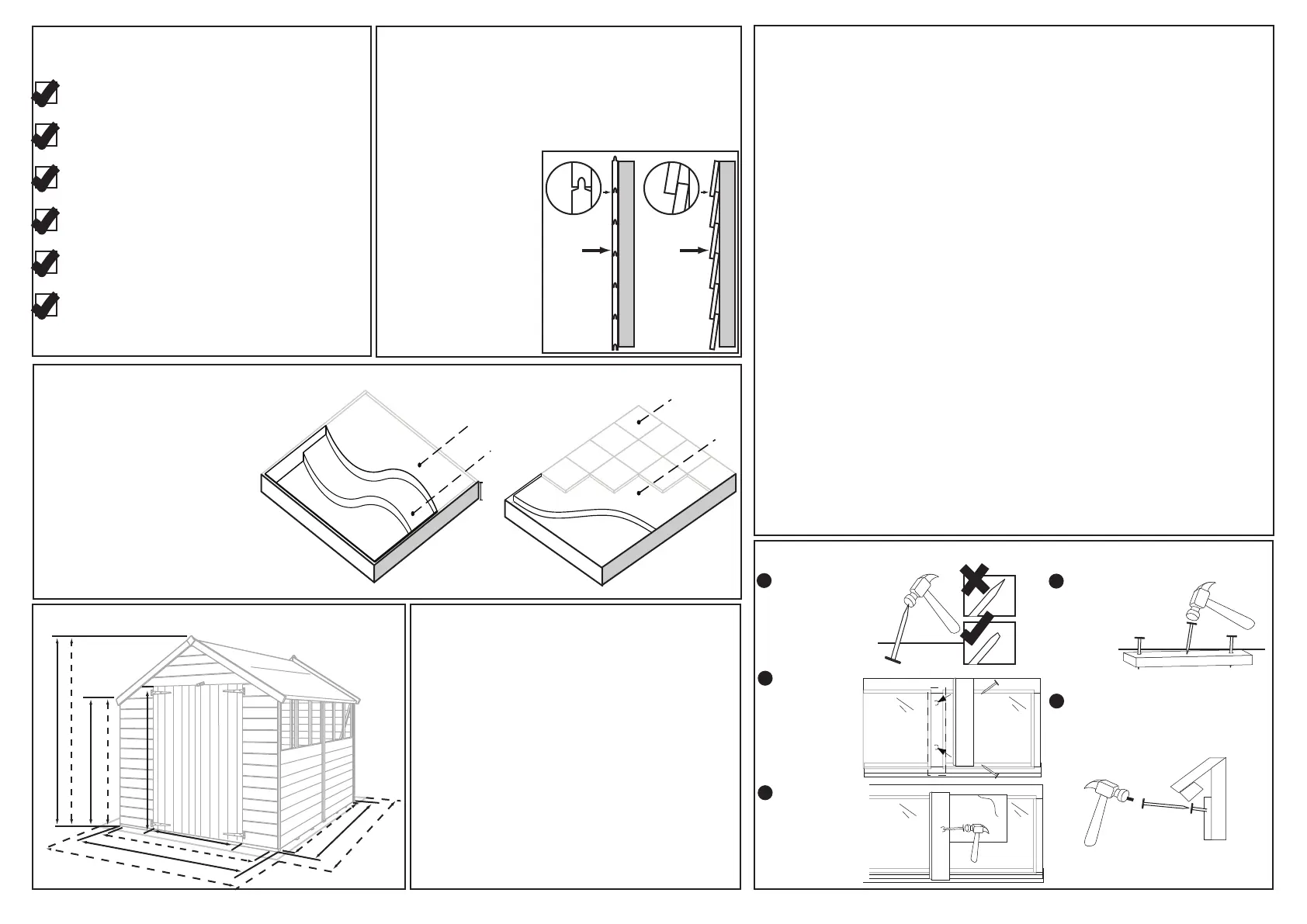
Flag Stones
Sharp Sand
50mm deep
CONCRETE BASE
75 mm of Concrete
laid on top of
75mm of
hardcore.
FLAG STONES
Slabs laid on 50mm
of sharp sand.
mm051
Concrete
75mm deep
Hardcore
75mm deep
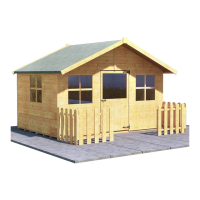
When thinking about where the
building and base are going to be
constructed ensure that there will
be access to all sides for maintenance
work and annual treatment. This
building should be situated at least
2m away from any structures or
obstructions (such as fences, buildings,
trees etc). We recommend that areas
around playhouses have a soft
surface such as play bark or grass.
All garden buildings must be built on
a level, at base to be erected correctly.
BUILDING A BASE
Tongue
&
Groove
Overlap
Outside
of
building
Outside
of
building
CLADDING STYLE
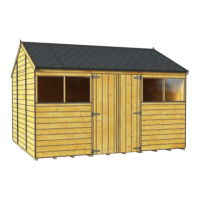
Overlap: This style of cladding is
very traditional and uses rough
sawn timber.
This gives the panels their
unnished look and helps the
building to blend in to it’s
natural surrondings. When the
wood has dried through hotter
weather knots may become
loose, which is natural. Overlap
is an economic solution for
lower impact use.
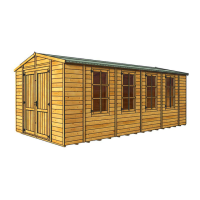
Tongue & Groove: This style of
cladding allows the timber to
interlock giving greater strength
to the building. It also creates
a smoother nish and continous
lines throughout the panel. Due
to the natural movement of
wood the lines between tongue
and groove panels may not
marry up.
PANEL ORIENTATION
It is essential to ensure that the panels of your
building are in the correct orientation. Assembly
in the wrong orientation may lead to water
ingress and deterioration.
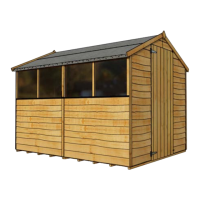
BOARDS OVER HANG THE EDGE OF THE FLOOR
In most cases the lower edge of the panels
overhangs the oor of the building and the panel
is xed to oor with screws through the frame on
the inside of the panel.
PRODUCT MAINTENANCE CHECK LIST:
Wooden Sheds / Playhouses / Summerhouses
Level Base:
A rm level base and protection from moisture penetration is key to
maintaining the building.
Seal The Windows:
Use a silicone sealant on the inside and outside of the windows as soon
as possible after assembly is a strong way of sealing the windows.
Annually Treat The Building:
Treat your building after construction with a good quality water
resistant treatment. Repeat this process annually inside and out.
The Building Must Not Be In Contact With Anything:
Overhanging hedges or trees must be cut back regularly as a branch
may pierce the roong felt or glazing and would allow water ingress.
Regularly Check / Replace Damaged Felt:
Check the felt regularly. Any damaged felt must be replaced.
Lubrication:
Use a suitable oil to lubricated all moving parts, such as hinges, for
continued propper use.
TROUBLE SHOOTING GUIDE
Pre-Assembly:
Q: When is the best time to apply treatment? A: To truly cover all parts of the building, that will be exposed to the elements, you should
treat your product with a high quality wood treatment before assembling the building.
Q: What type of base should I use? A: You must lay a solid at / level base. Failure to do so will result in your building tting together
incorrectly. We highly recommend a properly laid and at and level concrete or ag stone base (see Building a Base section of this instruction
document).
Q: I have glazing / xing kit missing. What should I do? A: Firstly check that all of your building’s parts are there by laying them
all out on the ground. Check between the panels / larger parts as the glazing comes banded together and is placed between the panels, along
with the xing kit, for safer transportation. If they are still not found call customer services: 0871 2300 380
Q: What tools do I require? A: Drill with 4.5, 3 and 2mm drill bit / Hammer / Spirit Level / Measuring Tape / Screwdriver (Phillips) / Stanley
Knife / Wood Saw / Step Ladder.
Q: Are my window & plain panels interchangeable? A: On apex buildings the window & plain panels are interchangeable where they
are the same size or make up the same size panel as the opposing wall with more than one part.
Q: Can I have my personnel door on the other side of my building? A: Yes.
During Assembly:
Q: How are the windows xed to the building? A: This process depends on the individual building. Please read the instructions to nd
out which method your particular building uses.
Q: Which way do the joists run? A: This process depends on the individual building. Please read the instructions to nd out which way the
joists run.
Q: My building seems a little imsy? A: Your building won’t reach full rigidity until fully assembled so do not panic.
Q: Construction seems tricky? A: Take your time and read the instructions thoroughly. These buildings should be constructed by two people.
If in doubt seek professional help.
Q: The felt seems a little tight? A: To reduce waste, to help protect the environment and reduce costs for our customers we only supply the
required amount of felt or roong material.
Q: My building isn’t going together properly, it is twisted. A: It sounds like you are building on an uneven surface. You must build
on a at / level base for your building to t together correctly.
Post-Assembly:
Q: Why is there a gap around the doors? A: During the year the wood of your building will shrink and expand, which will create a gap
around you building’s doors. This is natural.
Q: My building is not water tight around the windows. A: These products have been designed as an aordable solution to
most popular light domestic uses and we do not state that they are water tight. Use silicon sealant around the windows to improve the water
resistant qualities of the building.
Q: My building has developed a leak A: Use silicon sealant to stop the leak and make sure that your building is not in a damp area and if
necessary move it and replace the damaged boards.
Use the dimensions that are on the
techincal details documentation for your
specic building to workout the required
dimensions when laying your solid base.
Do not forget about the roof overhang when
chosing your building location. Keep in mind
where the roof will nish and how you will
maintain the building.
FLOORLESS BUILDINGS
For buildings that are bought without
oors please go to this webpage to
download the NO FLOOR GUIDE which
will guide you in building a base for your
oorless building:
www.billyoh.com/global/guides/NO-FLOOR-GUIDE.pdf
BASE DIMENSIONS
BUILDING DIMENSION TERMINOLOGY
INTERNAL RIDGE HEIGHT
EXTERNAL RIDGE HEIGHT
INTERNAL EAVES HEIGHT
EXTERNAL EAVES HEIGHT
EXTERNAL WIDTH
INTERNAL WIDTH
DOOR WIDTH
DOOR HEIGHT
INTERNAL DEPTH
EXTERNAL DEPTH
ROOF OVERHANG
ROOF OVERHANG
When xing
WINDOW CLOAKING
STRIPS over two
glazing panes
make sure not to
pierce the glazing
beneath.
To reduce wood splitting
BLUNT ALL NAIL and PANEL
PIN POINTS by hitting them
with a hammer before
xing window parts.
In hard to reach areas when
glazing and tting CLOAKING STRIPS
try using a hammer and 6” inch
nail to x the nails and pins.
When xing WINDOW
BEADING get your nails or
pins xed in the beading
away from the glazing
before nal
positioning.
TIPS ON GLAZING YOUR BUILDING:
1
2
3
4
5
Use a piece of
CARDBOARD to protect
the glazing when
xing WINDOW
CLOAKING STRIPS,WINDOW
BEADING or WINDOW
CROSSES.



 To Next Page
 Loading...