30 | Chapter 4: Useful help
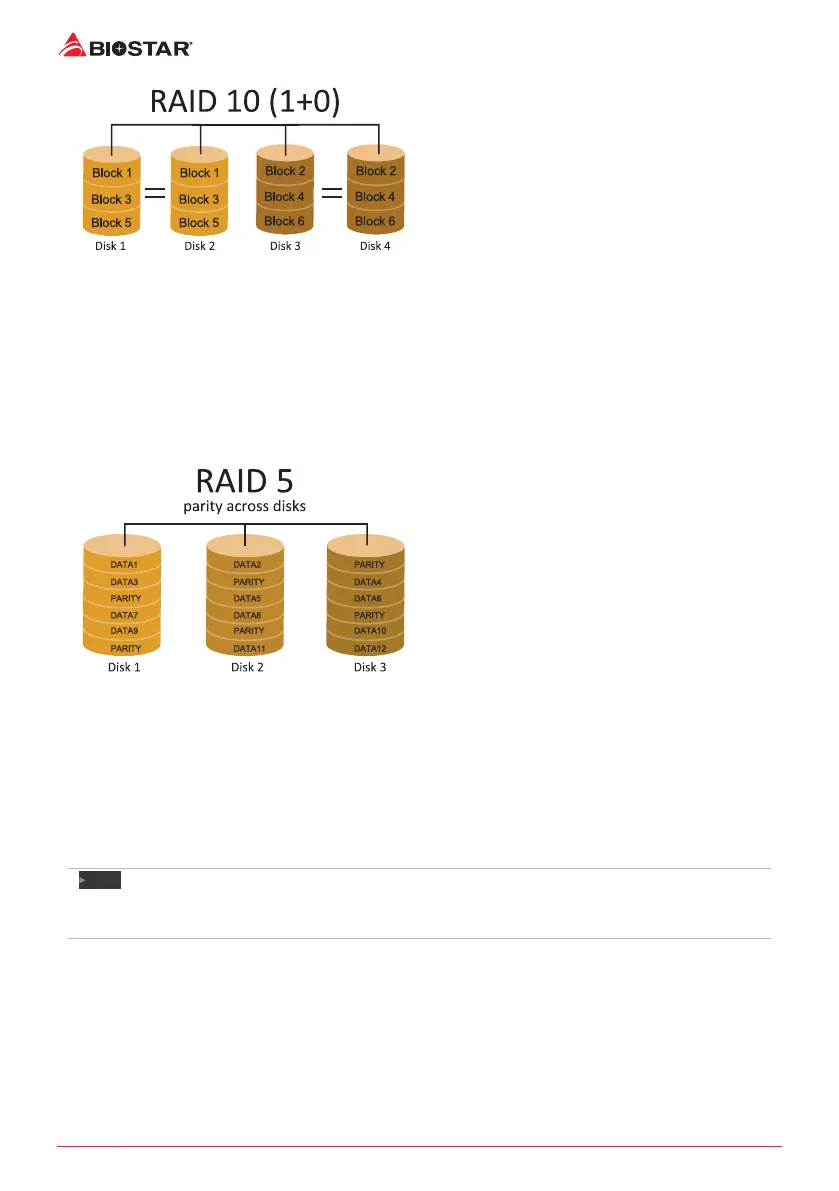
RAID 10 combines the advantages (and
disadvantages) of RAID 0 and RAID 1 in one
single system. It provides security by mirroring
all data on a secondary set of disks (disk 3 and
4 in the drawing below) while using striping
across each set of disks to speed up data
transfers.
Features and Benets
• Drives: Minimum 4, and maximum is 6 or 8, depending on the plaorm.
• Benets: Opmizes for both fault tolerance and performance, allowing for automac
redundancy. May be simultaneously used with other RAID levels in an array, and allows
for spare disks.
• Drawbacks: Requires twice the available disk space for data redundancy, the same as
RAID level 1.
• Fault Tolerance: Yes.
A RAID 5 array can withstand a single disk
failure without losing data or access to data.
Although RAID 5 can be achieved in soware,
a hardware controller is recommended.
Oen extra cache memory is used on these
controllers to improve the write performance.
Features and Benets
• Drives: Minimum 3.
• Uses: RAID 5 is recommended for transacon processing and general purpose service.
• Benets: An ideal combinaon of good performance, good fault tolerance, and high
capacity and storage eciency.
• Drawbacks: Individual block data transfer rate same as a single disk. Write performance
can be CPU intensive.
• Fault Tolerance: Yes.
Note
»
FormoredetailssengsaboutIntel®RapidStorageTechnology(Intel®RST),pleasevisit
hp://www.intel.com/p/en_US/support/highlights/chpsts/imsm





 To Next Page