1
Chapter 1 Introduction
Purpose and Function
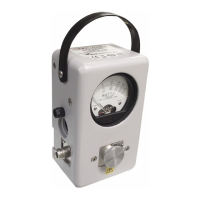
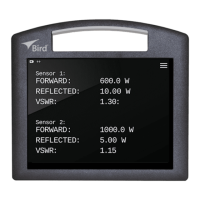
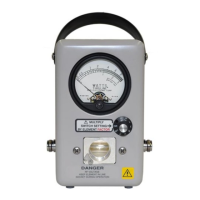
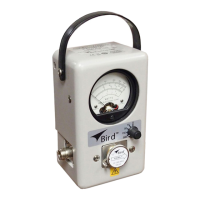
This manual covers the operation of the Bird 43 Thruline Wattmeter
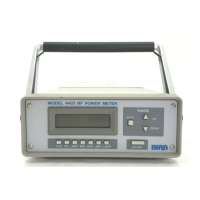
and its descendants. Two models have RF sampler ports, while the
Bird 43P can measure peak power. The Bird 4520 series comes ready
for panel mounting. Differences are discussed in Chapter 6, on
page 35. Except where indicated, instructions and specifications for
the 43 apply to other models also.
The 43 is an insertion-type RF wattmeter, designed to measure RF
power and load match in 50 ohm coaxial transmission lines. It is
intended for use with CW, AM, FM, and TV modulation, but not pulse
modulation. When used in 50 ohm applications, the 43 has a
maximum VSWR of 1.05 for frequencies up to 1000 MHz. The meter
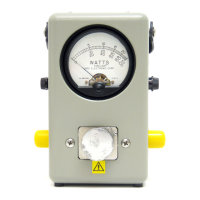
provides direct readings in watts with an expanded scale for easy
reading. The scale is graduated for 25, 50, and 100 full scale. Elements
are available in a variety of power and frequency ranges (see the Bird
Electronic Corporation Catalog for details).
Performance Characteristics and Capabilities
The Bird 43 is portable, with an attached carrying strap. It has an
aluminum housing and an easily removed back cover, with bumpers
on the base and back that allow the meter to stand or lie flat. For
additional protection, the microammeter is specially shock mounted.
A slotted screw on the lower front face of the meter is used to zero the
pointer. Below the meter face, the RF line section protrudes slightly
from the wattmeter housing with the element socket in the center.




 To Next Page