Operating Instructions
25
Load Matching
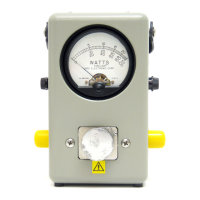
When a Bird 43 is used to tune a load to a transmitter and a good
match is obtained, removing the unit will not change the match
quality. A good 50 ohm load can terminate a 50 ohm transmission line
of any length without altering conditions at the transmitter. The 43 is
just an extra length of 50 ohm line in series with the measurement.
When the load is not well matched (an antenna with a VSWR of 1.5 or
2.0) the line length between the load and the transmitter will
transform the load impedance as seen at the transmitter. Removing
the wattmeter shortens the total line length by four inches plus two
connectors. This is still not significant at low frequencies where five
inches is a small fraction of a wavelength, but at higher frequencies the
frequency or power output of the transmitter may be affected.
Transmission line theory shows that if the line length changes by
exactly
1
⁄
2
wavelength, the impedance is unchanged. To have identical
match with the wattmeter in or out of the circuit, insert or remove
1
⁄
2
wavelength of line (including the unit). To do this, use a length of cable
which, when added to the unit, equals a
1
⁄
2
wavelength at the frequency
of interest. If multiple frequencies are needed, a separate cable length
is required for each. See Figure 11 for sample cable lengths.
NOTE: Cable length is measured from end to end of the
connector’s outer conductor, except for UHF or mini-UHF plugs
where the length is measured from tip to tip of the center pins.
NOTE: Dimensions shown are for solid polyethylene cable like
RG-58C/U or RG-8/U, which have a velocity of propagation 66% of
that of air. If RG-58 or RG-8 type cables containing foam poly-
ethylene (velocity of propagation of 79%) are used, the dimensions
in the graph must be multiplied by the ratio of the relative
velocities; 79% ÷ 66% = 1.2 in this case.




 To Next Page