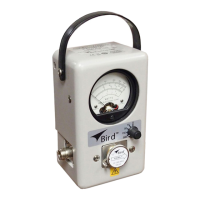
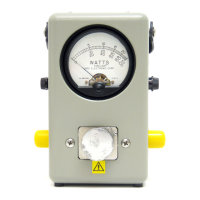
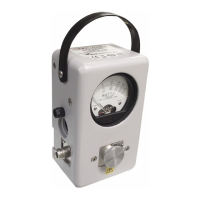
Bird Model 43 Wattmeter
16
Impedance Mismatch
There may be cases where it is necessary to use the Bird 43 with a
non-50 ohm transmission line. If the reflected power is less than 10%
and the frequency is below 200 MHz, the resulting mismatch will not
be too serious. At higher test frequencies and/or higher reflected
power levels, the load impedance will change when the wattmeter is
removed from the circuit.
When the line and load impedances are known, the system’s VSWR
equals the ratio of the two. Always divide the larger impedance by the
smaller, since VSWR must always be greater than 1.
As an example, consider using a Bird 43 to tune a 70 ohm line. If the
load impedance is also 70 ohms, the wattmeter will measure a VSWR
of 70/50 = 1.4. However, if you remove the wattmeter, the VSWR will
actually be 1.0. Similarly, if the load impedance is 35.7 ohms, the
VSWR will be 50/35.7 = 1.4 with the wattmeter and 70/35.7 = 2.0
without it. Caution must therefore be used, since both good and bad
matches can have the same measured VSWR. In this case, the correct
impedance can be determined by slightly changing the load
impedance. When the load impedance is near 70 ohms, the Bird 43
will read increasing VSWR as the load impedance is increased.
NOTE: When working with non-50 ohm lines, it is especially
important to calculate the load power by subtracting the reflected
power from the forward power.




 To Next Page