5
Chapter 2 Theory of Operation
Travelling Wave Viewpoint
The easiest way to visualize Thruline operation is from a travelling
wave viewpoint. In transmission lines the voltages, currents, standing
waves, etc., on any uniform line section result from the interaction of
two travelling waves:
y The forward wave (and its power) travels from the source to the
load. It has RF voltage E
f
and current I
f
in phase, with E
f
/ I
f
= Z
o
.
y The reflected wave (and its power) originates by reflection at the
load and travels from the load back to the source. It has an RF
voltage E
r
and current I
r
in phase, with E
r
/ I
r
= Z
o
.
Each wave is mathematically simple and has a constant power:
W
f
= Watts Forward = E
f
2
/ Z
o
= I
f
2
Z
o
= E
f
I
f
W
r
= Watts Reflected = E
r
2
/ Z
o
= I
r
2
Z
o
= E
r
I
r
Z
o
is the characteristic impedance of a uniform line section. For useful
lines it is usually a pure resistance of 50 ohms. The RF circuit of the
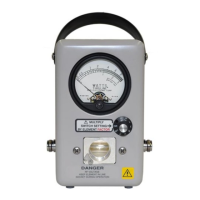
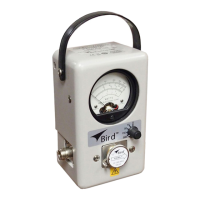
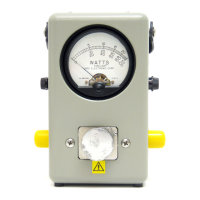
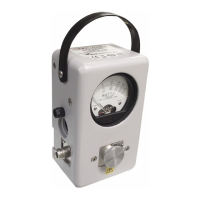
Bird 43 is a length of uniform air line with Z
o
= 50 ohms.




 To Next Page