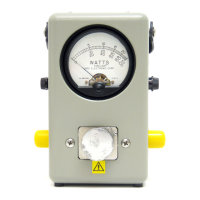
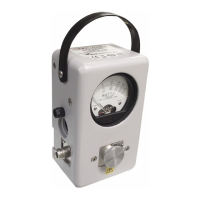
Bird Model 43 Wattmeter
8
Standing Wave vs. Travelling Wave Viewpoint
As mentioned previously, the Thruline Wattmeter reacts to forward
and reverse travelling waves to measure power in a transmission line.
The standing wave viewpoint, also widely used, is highly developed
both in theory and in practice. This viewpoint can be traced to the
early use of slotted transmission lines.
The slotted line measures the standing wave ratio by mechanically
positioning a voltage detector at peaks and nulls along a length of line
section. Its drawbacks are that it is usually too long, too expensive for
good accuracy, not portable, and too slow. These problems grow rapidly
as the measurement frequency drops below 1000 MHz. The Thruline
Wattmeter by comparison is fast, convenient, and accurate. It provides
the same information as a slotted line with the exception of the phase
angle of the reflection coefficient (distance, load to minimum).
ρ vs. φ
The simple relationships:
can be used to convert between the standing wave ratio (
ρ) and the
reflected/forward power ratio
(φ), which can be directly read from the
Thruline Wattmeter. The relationship between
ρ and φ is graphed in
Figure 4 and Figure 5.
and
Where
ρ = VSWR
and
φ = W
r
/ W
f
ρ
1+ φ
1 φ–
----------------=




 To Next Page