34
Operation
2.13 Trash Disposal
The discharge of plastic trash or trash mixed with
plastic is illegal anywhere in the marine environ-
ment. U.S. Coast Guard regulations also restrict
the dumping of other forms of garbage. Regional,
state and local restrictions on garbage discharges
also may apply.
Responsible boaters store refuse in bags and
dispose of it properly on shore. You should make
sure your passengers are aware of the local waste
laws and the trash management procedure on
your boat.
2.14 Maximum Capacities Plate
Coast Guard rules require boats less than 20 feet
(6 meters) to display a gross weight and person-
capacity plate provided by the manufacturer.
Boat manufacturers in the National Marine Manu-
facturers Association (NMMA) program will display
a gross weight and person-capacity plate on boats
up to 26 feet (7.9 meters).
The person/load capacity is determined by the US
Coast Guard. The capacity plate is usually located
near the helm in clear view of the operator. The
limits indicated on the capacity plate are enforce-
able by law. Occupant seating charts in Appendix
H show the proper seating position for you and
your passengers on boats less than 26 feet (7.9
Meters).
You should never exceed the “U.S. Coast
Guard Maximum Capacities” indicated on the
capacity plate.
2.15 Trailering Your Boat
If you trailer your boat, make sure that your tow
vehicle is capable of towing the weight of the
trailer, boat and equipment and the weight of the
passengers and equipment inside the vehicle.
This may require that the tow vehicle be spe-
cially equipped with a larger engine, transmission,
brakes and trailer tow package. Additionally, the
laws in your state may require special permits to
tow a boat this large on some or all highways.
The boat trailer is an important part of your boat-
ing package. The trailer should be matched to
your boat’s weight and hull. Using a trailer with
a capacity too low will be unsafe on the road and
cause abnormal wear. A trailer with a capacity too
high, can damage the boat. Contact your trailer
dealer to evaluate your towing vehicle and hitch
and to make sure you have the correct trailer for
your boat.
Important:
YourBlacknisaheavyboatandcaremust
be taken when selecting the trailer. We rec-
ommend that you use a bunk style trailer
that incorporates a combination of heavy
duty rollers or bunks, to support the keel
and long bunks running under and parallel
to the stringers to support the hull. Avoid
using a full roller trailer that does not have
bunks. Roller trailers have a tendency to put
extreme pressure points on the hull, espe-
cially on the lifting strakes and have dam-
aged boats. The situation is worse during
launching and haul out. Damage resulting
from improper trailer support or the use of
a full roller trailer will not be covered by the
BlacknWarranty.
Notice:
Contact your trailer dealer to evaluate your
towing vehicle and hitch and to make sure
you have the correct trailer for your boat.
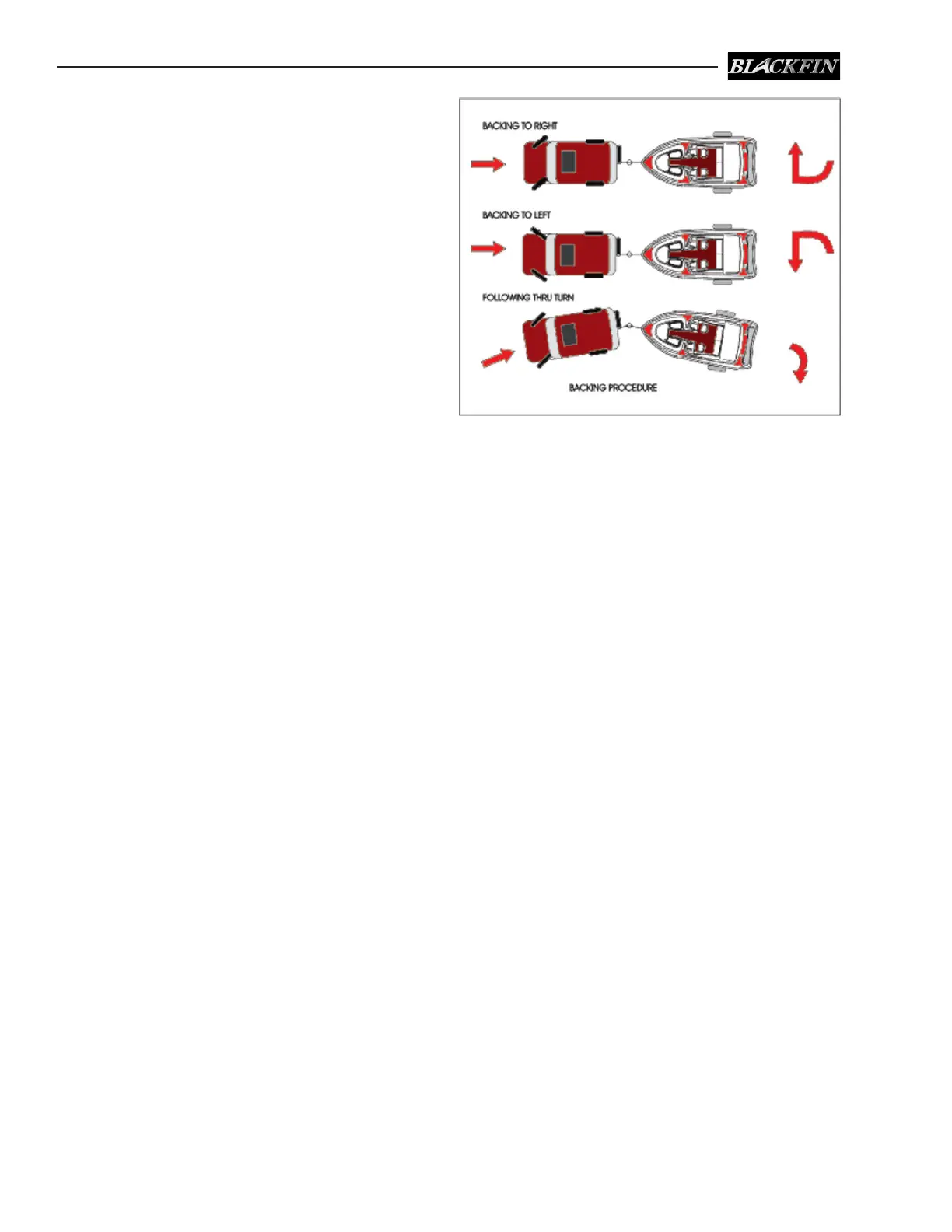
Backing Procedure for Boat Trailers


 To Next Page