70
Electrical System
Anodes deteriorate before other metals, thereby
protecting the underwater metals from galvanic
corrosion or stray electrical current. Since the
anodes are sacricial, it is important to monitor
them and replace them when they have deterio-
rated to 50 - 75% of their original size.
The bonding system is connected to the engine
and battery DC ground. If your boat is equipped
with the optional battery charger, the earth ground
wire for the AC electrical system is also connected
to the bonding system. It provides a path to the
safety earth ground in the event of a fault in the
shore earth ground connection.
6.11 Electrical System Maintenance
DC Electrical System Maintenance
At least once a year, spray all exposed electrical
components behind the helm, in the stern bilge
area and in the plugs with a protector. Remov-
able light xture bulbs should be removed and
the metal contact areas coated with a non-water
soluble lubricant like Teon or Silicone grease.
The sockets should be sprayed with a protector.
Care must be taken not to get any oil or grease
on the glass portion of the bulbs as this will cause
the bulb to overheat and burn out.
Notice:
Most LED light xtures are sealed and not
serviceable.
WHEN REPLACING LIGHT BULBS IN MARINE LIGHT
FIXTURES, ALWAYS USE A BULB WITH THE SAME RATING AS
THE ORIGINAL. USING A DIFFERENT BULB COULD CAUSE
THE FIXTURE TO OVERHEAT AND MELT OR SHORT CIRCUIT.
Check all below deck wiring to be sure it is properly
supported, that the insulation is in good condition
and that there are no loose or corroded terminals.
Corroded terminals should be thoroughly cleaned
with sandpaper or replaced, tightened securely
and sprayed with a metal and electrical protector.
Inspect all engine wiring.
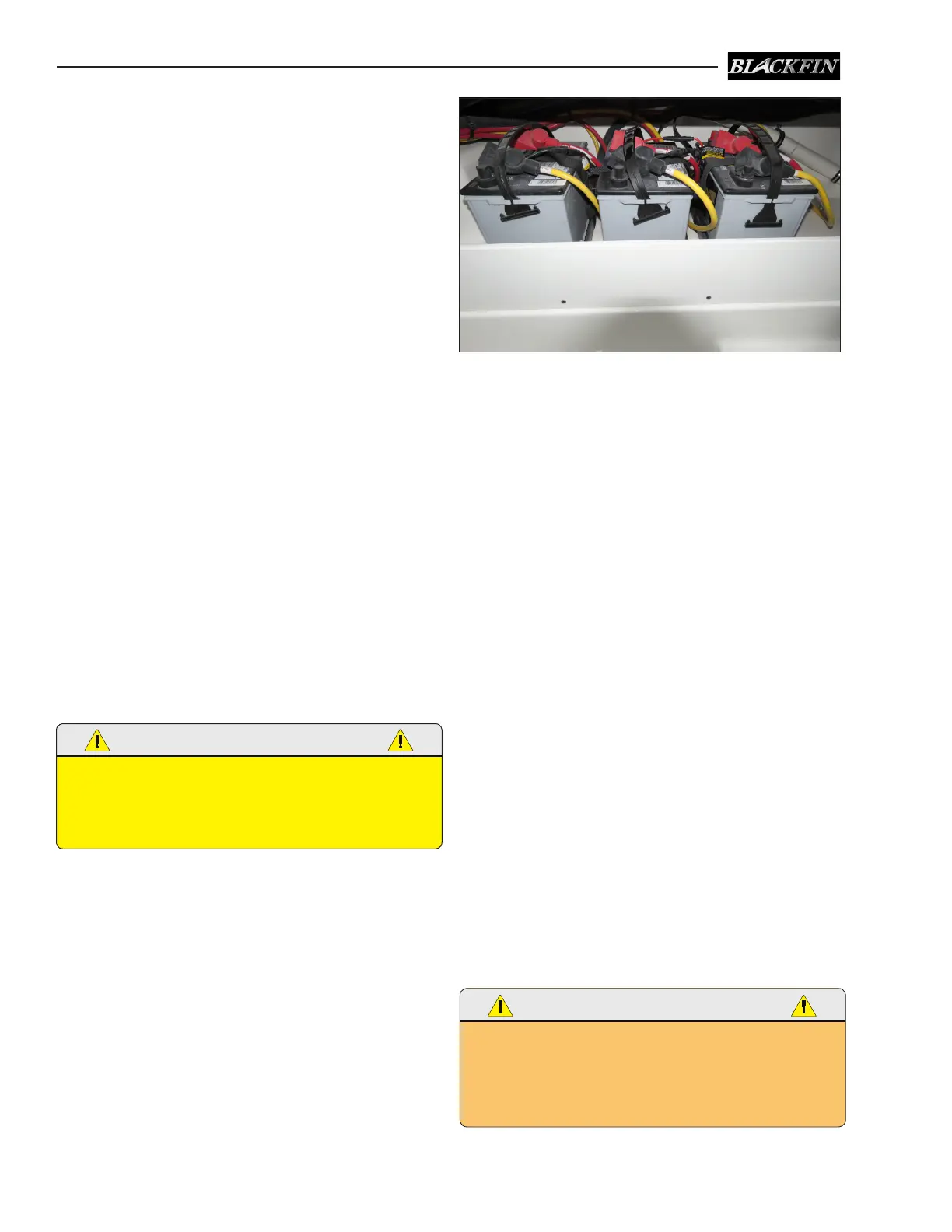
Your boat is equipped with batteries that were sup-
plied by your dealer. Some batteries are sealed,
AGM or maintenance free wet cell batteries that
do not require inspection or service. However, if
your boat is equipped with standard wet cell type
batteries that are not maintenance free, they will
require the following inspection and service.
Check the electrolyte level in the batteries regu-
larly and add distilled water as necessary. If the
batteries are frequently charged by an automatic
battery charger, the electrolyte level will have to
be checked more often. The correct uid level in
the cells is approximately 1/4 to 1/2 inch above
the plates. If uid is needed, ll to the proper
level with distilled water. Do not over ll and only
use distilled water.
Keep all battery tops clean and dry. Dirt and water
can conduct electricity from one post to the other
causing the battery to discharge.
The battery posts on all batteries should be kept
free of corrosion. Remove the cables and clean
the posts and cable clamps with a battery post
cleaner or sandpaper as required. Coating the
battery posts and cable clamps with Teon or
Silicone grease will protect them and reduce cor-
rosion. Battery cables, both hot and ground, must
be replaced when they show signs of corrosion or
fraying. Deteriorated cables cause a considerable
voltage loss when high currents are drawn, as for
starting the engine.
Never use aN opeN flame iN the battery storage
area. avoid strikiNg sparks Near the battery. a bat-
tery caN explode if a flame or spark igNites the
hydrogeN gas the battery emits while beiNg
charged.
Typical Wet Cell Batteries



 To Next Page