2. Intended use
3
2. Intended use
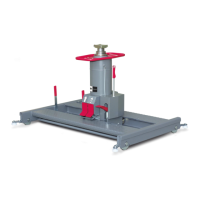
The lift is intended to be used to lift and lower com-
mercial vehicles for repair, maintenance and clean-
ing during normal workshop operation.
The lift is only to be used as intended, in technically
sound condition according to technical specifications
in chapter 3.2.
The maximum load capacity of one lifting cylinder is
15 000 kg and must not be exceeded. The permis-
sible load distribution in or against drive direction is
2:1.
Standing or working under suspended load is per-
mitted.
2.1 Misuse
Improper behavior can cause danger to life and
health of persons working in the vicinity of the lift.
The manufacturer is not responsible for damages
caused by use against regulations and misuse.
Prohibited:
Standing and riding on load and load-bearing
equipment.
Standing or working under the load during lifting
and lowering.
Lifting of vehicles loaded with hazardous goods.
Lift installation in explosive areas.
3. The lift
3.1 Mode of operation
The lift is used to lift heavy vehicles for mainte-
nance, cleaning or repair to optimum working
height.
Operation is carried out with a mobile
control panel.
Lifting and lowering the vehicle is carried out in
jog mode.
Electronic controls ensure level lifting of the ve-
hicle.
The lifting cylinders are movable in vehicle longi-
tudinal direction to adjust for different distances
between axles.
3.2 Technical data
Duplex versions with 1...6 lifting cylinders
Duplex S2-T1-15-1900
Duplex S2-T2-15-1900
Duplex S2-T3-15-1900
Duplex S2-T4-15-1900
Duplex S2-T5-15-1900
Duplex S2-T6-15-1900
Capacity per lifting cylinder [kg]
Set pressure safety valve [bar]
Installation depth [mm]
● Frame
● Trough
Drive power per lifting cylinder [W]
Oil filling per cylinder [ l ]
Cross member
● Height [mm]
● Extension [mm]
Electrical data
● Nominal voltage [V]
● Mains frequency [Hz]
Optional Flexcover
Maximum load per wheel [kg]



 To Next Page