– 4 – – 5 –
up by the U.S.A, Canada, Russia, and France; today there are
over 40 member countries. It is an essential aid to search and
rescue (SAR) operations for land, air and sea. The purpose of
the system is to reduce the delay in communicating distress
calls to SAR services as much as possible, as well as the time
needed to locate the victims and bring help.
Besides the PLB (Personal Locator Beacon) category to which
the Emergency belongs, there are two other types of radio
beacons:
•
EPIRB (Emergency Position Indicating Radio Beacon) for
use at sea
• ELT (Emergency Locator Transmitter) for use in aviation.
The beacon’s signal is picked up by at least one low-orbit
LEOSAR (Low-Earth Orbiting Search And Rescue) satellite or
by a GEOSAR (Geostationary Search and Rescue) satellite
in
geosynchronous orbit, which relays the signal to a receiving
station on the ground (LUT/Local User Terminal) for
transmission to the Mission Control Center (MCC) that is in
contact with the search and rescue services. LEOSAR satellites
can determine the beacon’s position using the Doppler Effect.
1. INTRODUCTION
The Breitling Emergency is a small and light wristworn
personal survival instrument equipped with both a
multifunction analog-digital watch and an independent
miniature distress beacon.
The micro-transmitter of the Emergency is a dual frequency
distress beacon belonging to the Personal Locator Beacon
(PLB) category that transmits a digital signal on the 406 MHz
frequency, along with an analog signal on the 121.5 MHz
frequency. The first signal serves to issue the alert via the
Cospas-Sarsat worldwide satellite system, while the second
facilitates homing in on victims.
Extreme miniaturization of the system as well as the
stringent demands of the prevailing norms called for
specific developments resulting in significant technological
breakthroughs in the fields of transmitter circuits,
antennae and batteries. This notably involved developing a
dedicated rechargeable battery able to meet these rigorous
requirements, including in particular the transmission at
temperatures ranging from -20°C to +55°C (-4°F to +131°F).
The Emergency is supplied with a charger-tester serving to
recharge the beacon’s battery and to perform a self-test in
order to check the smooth operation of the transmitter.
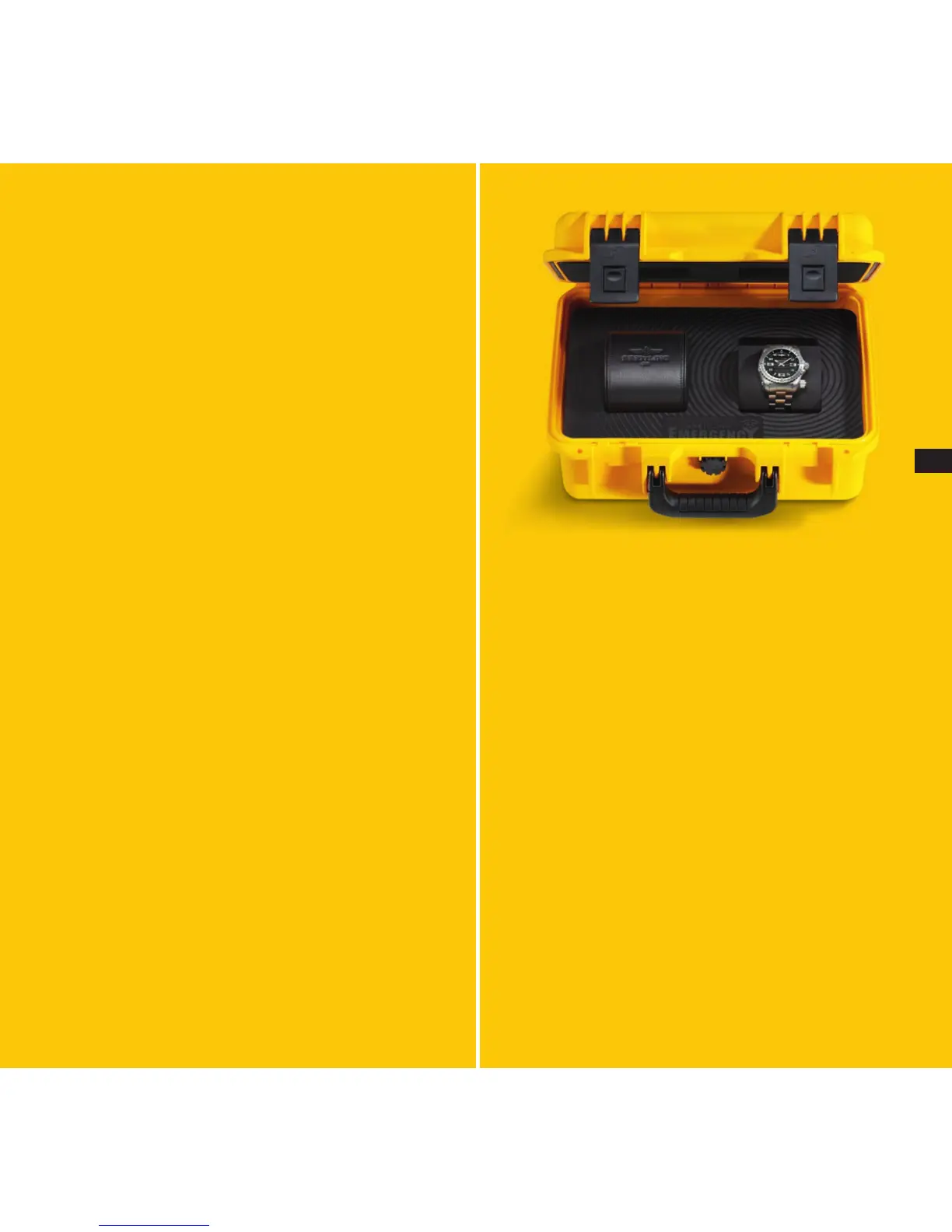
2. CASE CONTENTS
The Emergency comes in a case containing the following items:
• Emergency transmitter watch
• Charger/tester
• Transformer with international plugs
• User manual
• Related documents
3. GENERAL DESCRIPTION OF THE
COSPAS-SARSAT SYSTEM
3.1 Cospas-Sarsat (C/S)
Cospas-Sarsat (C/S) is based on a worldwide satellite system
for identifying distress calls and locating emergency radio
beacons (406 MHz frequency). The system was originally set
E








 To Next Page