Brivo ACS Installation Manual ACS5000-E
ENG-WI-001 © 2005 Brivo Systems, LLC. All rights reserved. Page 21
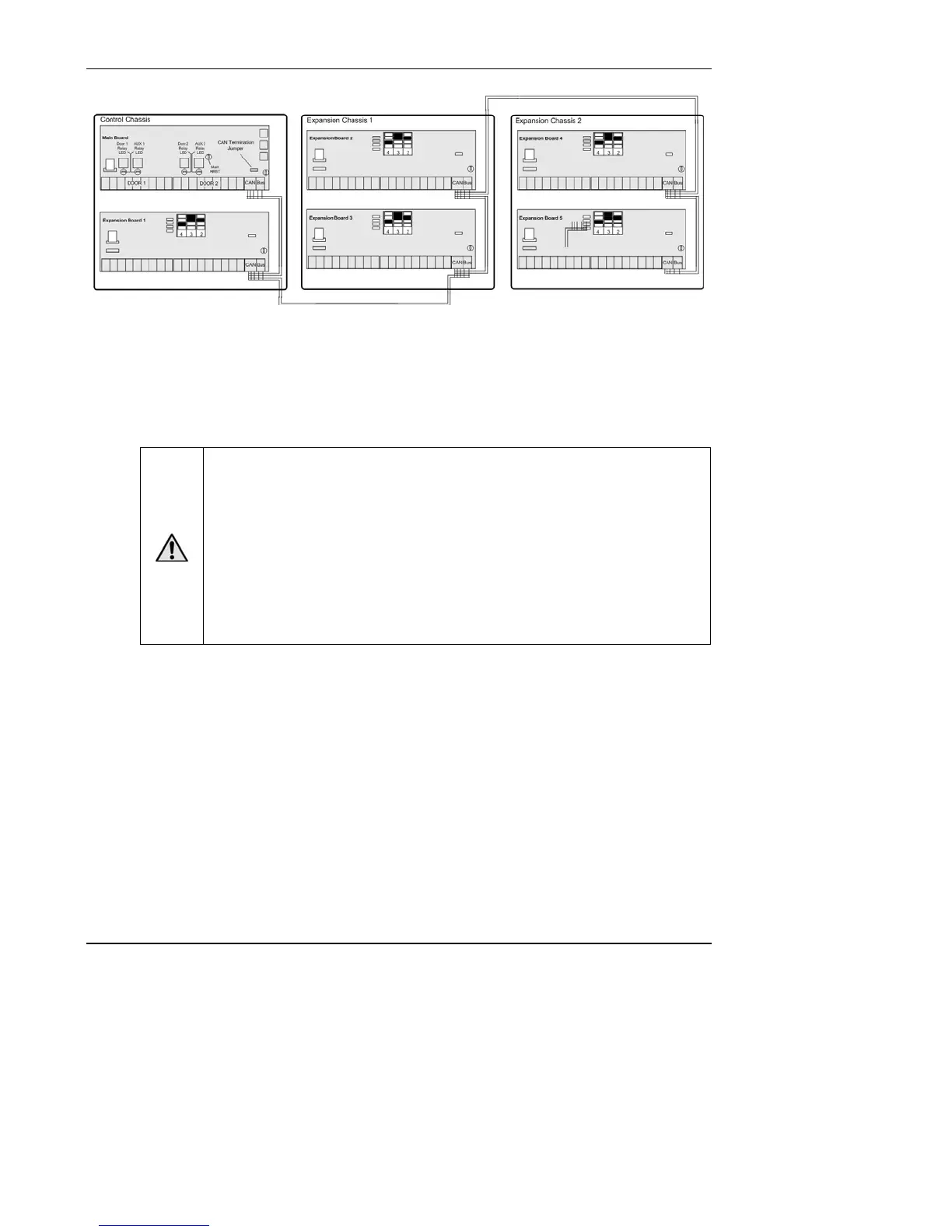
Figure 11. CAN BUS Configuration
4. Use standard CAT5 (unshielded twisted pair) cabling to connect all the boards in the
control panel via the CAN BUS terminals.
5. Always connect like terminals to one another (i.e., A to A, B to B, and so on.).
6. Follow the color coding shown on the wiring diagram on the inside of the chassis door.
WARNING: CAN BUS Wiring
THE A/B CIRCUITS MUST SHARE A TWISTED PAIR, AND THE C/D CIRCUITS
MUST SHARE A TWISTED PAIR.
Otherwise, the distance and data integrity of the
communications channel will be compromised
.
WHEN USING JUST A MAIN BOARD, THE JUMPER MUST REMAIN ATTACHED
TO THE CAN TERM HEADER ON THE MAIN BOARD. If expansion boards are
used, this jumper remains attached on the very last board(s) in the daisy chain; i.e. It
must be removed from all boards except the endpoint of the daisy chain. (NOTE: The
MAIN BOARD does not have to be an endpoint in the control panel; the control panel
may be in the middle of the chain with expansion boards branching out in either
direction.)
7. On the first board, connect the wires of the Cat 5 cable to the CAN BUS terminal block as
follows:
a) Connect the green wire to the A terminal.
b) Connect the green and white wire to the B terminal.
c) Connect the blue wire to the G (ground) terminal.
d) Connect the orange wire to the C terminal.
e) Connect the orange and white wire to the D terminal.
8. After all the wires of the Cat 5 cable are connected to the first board, connect the wires to
the second board in the same manner.
9. Connect the CAN NODE ADDRESS jumpers. The silkscreen next to the CAN NODE
ADDRESS pins shows how to position the jumpers for first four addresses.
10. Positions for additional address values are shown in the diagram below.


 To Next Page