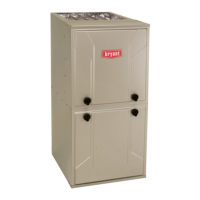
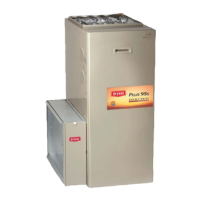
926SB: Installation, Start-up, Operating, Service and Maintenance Instructions
Manufacturer reserves the right to change, at any time, specifications and designs without notice and without obligations.
62
General
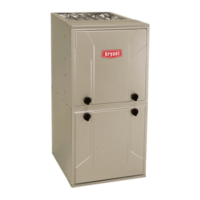
These instructions are written as if the furnace is installed in an upflow
application. An upflow furnace application is where the blower is
located below the combustion and controls section of the furnace, and
conditioned air is discharged upward. Since this furnace can be installed
in any of the 4 positions shown in Fig. 2, you must revise your
orientation to component location accordingly.
ELECTRICAL CONTROLS AND WIRING
Each pressure switch is labeled with the reference location (noted as
“COLLECTOR BOX-LPS” or “HOUSING-HPS” on the switch). The
nominal break point of each switch is shown on the label below the
reference location in inches of water column, “W.C.” The maximum and
minimum break point of the switch is +/- 0.05 inches of water column
from the nominal break point of the switch. The maximum make point of
the switch is 0.10 inches of water above the maximum break point of the
switch.
Example: Nominal break point on pressure switch is 0.68-in. w.c. The
minimum break point of the switch is 0.63-in. w.c. The maximum break
point of the switch is 0.73-in. w.c. The maximum make point of the
switch is 0.83-in. w.c.
The electrical ground and polarity for 115-V wiring must be properly
maintained. Refer to Fig. 33 for field wiring information and to Fig. 61
for furnace wiring information.
NOTE: If the polarity is not correct, the STATUS LED on the control
will flash rapidly and Status code (10.1 ) is displayed. This will prevent
the furnace from heating. The control system also requires an earth
ground for proper operation of the control and flame-sensing electrode.
The 24-V circuit contains an automotive-type, 3-amp. fuse located on
the control. See Fig. 38. Any shorts of the 24-V wiring during
installation, service, or maintenance will cause this fuse to blow. If fuse
replacement is required, use ONLY a 3-amp. fuse. The control LED will
display status code (24.1) when fuse needs to be replaced.
Proper instrumentation is required to service electrical controls. The
control in this furnace is equipped with a status code LED
(Light-Emitting Diode) and Major/Minor 3 digit codes to aid in
installation, servicing, and troubleshooting. Status codes can be viewed
at the sight glass in blower access door. The furnace control LED is
either ON continuously, rapid flashing, or a code composed of 2 digits.
The major status code is displayed on the LED indicator through the
door with the first digit being the number of short flashes and the second
digit being the number of long flashes. The major status code is
displayed in the first 2 digits of the display. The minor status code is
displayed in the third digit.
For an explanation of status codes, refer to service label located on
blower access door, or Fig. 60 and the troubleshooting guide by scanning
the QR code or see Fig. 71 for a brief Troubleshooting Guide.
Retrieving Stored Fault Codes
The stored status code will not be erased from the control memory, if
115-V or 24-V power is interrupted. See the Service Label, Fig. 60 for
more information.
1. To retrieve the last 7 fault codes, proceed with the following:
NOTE: NO thermostat signal may be present at control, and all
blower-OFF delays must be completed.
a. Leave 115-V power to furnace turned on.
b. Remove outer access door.
c. Depress blower door switch to energize the control board.
d. Press menu/select button until (FLt) is displayed.
e. Press Next/Option button to cycle through the fault history.
Faults remain in memory for 72 hours of powered operation after
the last fault occurs. Faults may be manually cleared by selecting
(CLr) with the menu/select button.
CARE AND MAINTENANCE
For continuing high performance and to minimize possible furnace
failure, periodic maintenance must be performed on this furnace.
CAUTION
!
ELECTRICAL OPERATION HAZARD
Failure to follow this caution may result in improper furnace operation
or failure of furnace.
Label all wires prior to disconnection when servicing controls. Wiring
errors can cause improper and dangerous operation.
WARNING
!
ELECTRICAL SHOCK, FIRE OR EXPLOSION HAZARD
Failure to follow this warning could result in personal injury or death,
or property damage.
Before installing, modifying, or servicing system, main electrical
disconnect switch must be in the OFF position and install a lockout tag.
There may be more than one disconnect switch. Lock out and tag
switch with a suitable warning label. Verify proper operation after
servicing. Always reinstall access doors after completing service and
maintenance.
WARNING
!
ELECTRICAL SHOCK HAZARD
Failure to follow this warning could result in personal injury or death.
There may be more than one electrical supply to the furnace. Check
accessories and cooling unit for additional electrical supplies that must
be shut off during furnace servicing. Lock out and tag switch with a
suitable warning label.
CAUTION
!
SHOCK HAZARD
Failure to follow this caution could result in personal injury.
Do not tape or permanently allow the door switch to be bypassed.
Temporarily press the door switch with one hand while accessing the
service buttons with your other hand. Do not touch uninsulated
electrical components.
WARNING
!
FIRE OR EXPLOSION HAZARD
Failure to follow this warning could result in personal injury, death
and/or property damage.
Never store flammable or combustible materials on, near, or in contact
with the furnace, such as:
1. Spray or aerosol cans, rags, brooms, dust mops, vacuum
cleaners, or other cleaning tools.
2. Soap powders, bleaches, waxes or other cleaning compounds,
plastic or plastic containers, gasoline, kerosene, cigarette lighter
fluid, dry cleaning fluids, or other volatile fluids.
3. Paint thinners and other painting compounds, paper bags, or
other paper products. Exposure to these materials could lead to
corrosion of the heat exchangers.


 To Next Page
 Loading...