LOWLANDER HD MK2 & WIDEBODY MANURE SPREADER – INSTRUCTION & SPARES MANUAL
Page 84
6.3.8.3 DISABLING THE SPRING BRAKE CHAMBER
Using a "caging bolt" or other mechanism, a technician can manually compress or "cage" the spring in a spring brake
chamber. This may be necessary to move a trailer in an emergency. When a spring brake chamber fails, a technician
may use the manual caging method to temporarily disable it. A spring brake chamber that has been disabled by this
method looks different and the parking and emergency brake will not apply. Disabled or caged spring brakes
chambers can be recognized by the protrusion of the caging bolt or other similar mechanism. Drivers encountering a
disabled spring brake chamber should have the trailer inspected and repaired immediately.
6.3.8.4 SPRING BRAKE (PARKING AND EMERGENCY) CONTROL VALVES
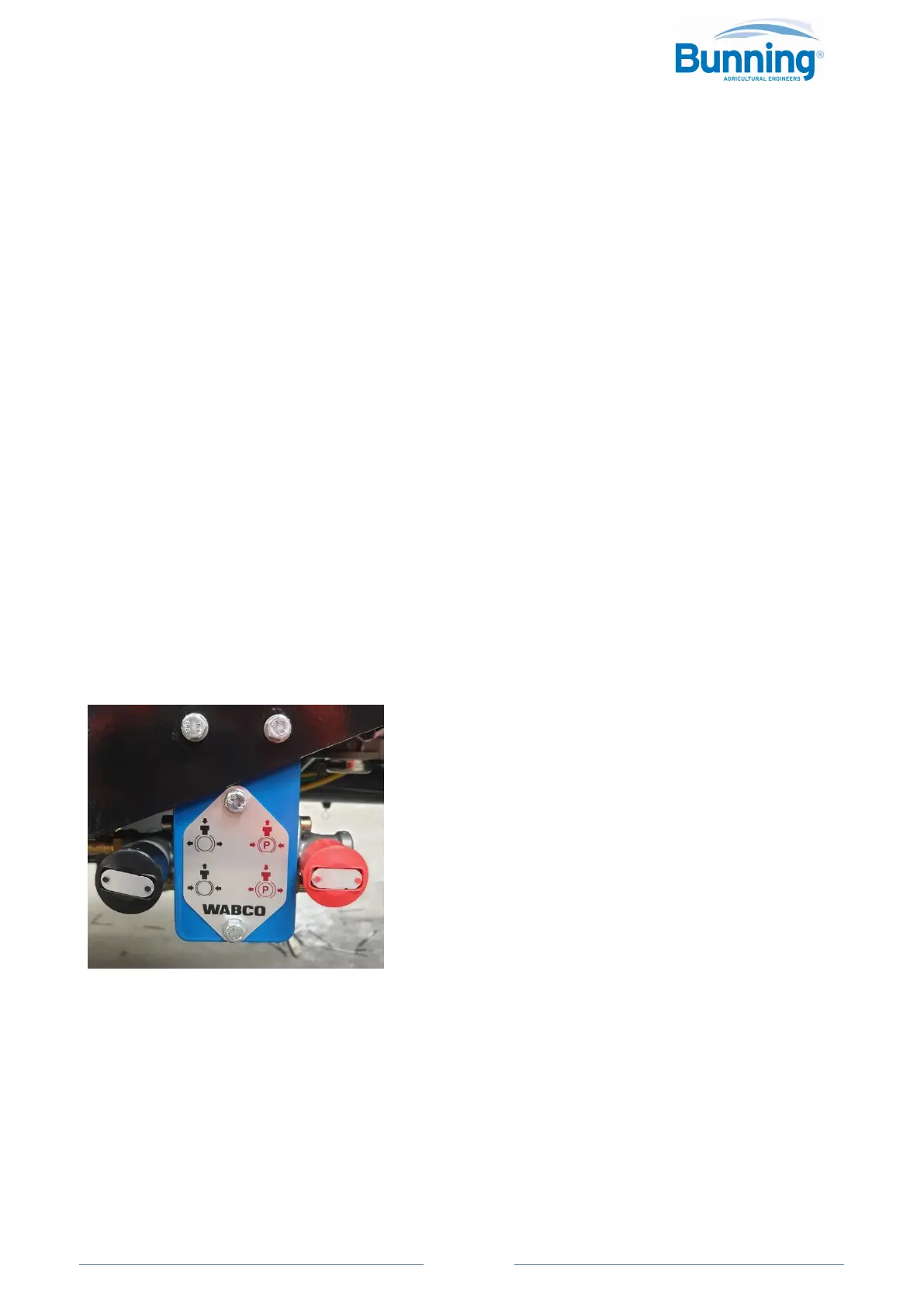
A spring brakes control valve is normally a push/pull type valve fitted with a round red button/knob located on the
right-hand side of the trailer (See diagram 4-3). The spring parking brakes control valve is pushed to supply air and
release the spring brakes, then pulled to exhaust air and apply the spring parking brakes. Drivers must be familiar with
the type of control valves used in their tractor and on their trailer.
The round black button/knob of the shunt valve must be pushed in to release the trailer’s brakes, when a tractor with
air braking is not available.
Spring brakes control valves are designed to respond to air brake system pressure dropping below a certain level
(normally 414 kPa or 60 psi) by exhausting the remaining air that is holding the spring brakes in the released position.
This causes sudden automatic application of the spring brakes and an uncontrolled vehicle stop. The control valve
button/knob will pop out when this occurs.
Important: If air brake system pressure drops below its normal operating range (normally 414 kPa or 60 psi), the
spring brakes will automatically begin to apply.
In an emergency when the service brakes fail, the spring brakes can be applied by using the spring brakes control
valve.
The effectiveness of a vehicle’s spring brakes depends on the condition of the brakes and proper brake adjustment. If
brakes are out of adjustment, the spring brakes may not stop or hold a vehicle stationary.
Remember: Poor brake adjustment reduces the ability of service brakes to stop a vehicle and reduces the ability of
spring brakes to stop or hold a vehicle.
Diagram 4-3: Spring parking brakes control valve
Key points to remember
The brake pedal in the tractor is used to apply the service brakes.
Spring brakes chambers include both service brake and spring brake sections.
The large coil spring inside a spring brake chamber is under high tension and can be hazardous.
When the spring in a spring brake chamber is compressed or "caged", it looks different and the spring brakes
will not apply.
A spring brakes control valve is a push/pull type valve fitted with a round red button/knob located on the side
of the trailer.
When the air brake system pressure falls below its normal operating range (normally 414 kPa or 60 psi), the
spring brakes will begin to apply automatically.
If brakes are out of adjustment, the spring brakes may not stop or hold a vehicle or trailer.



 To Next Page