1067
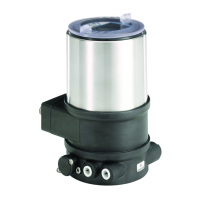
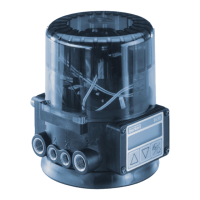
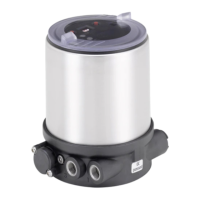
POSITIONER TYPE 1067
E-25-
4 OPERATION
4.5.3 Function of keys in the configuration level
Operation of the „Arrow up“ key
- Scroll upwards in menu (selection).
- Incrementing numerical values in a selected and confirmed menu item.
Operation of the „Arrow down“ key
- Scrolling downwards in the menu (selection).
- Decrementing numerical values in a selected and confirmed menu item.
Operation of the MANUAL/AUTOMATIC key within the main menu
- Confirmation of a selected menu item.
- Confirmation of a set value.
Operation of the MANUAL/AUTOMATIC key within the additional menu
- Confirmation of a selected menu item of the additional menu for inclusion in the main menu. The
selected menu item is marked with a star (*) in the additional menu. The menu item now appears
in the main menu where it can be selected and manipulated.
- Confirmation of a selected menu item of the additional menu, marked with a star, for deletion from
the main menu.
4.5.4 Notes on the basic and additional functions
X-SENS (factory setting: DIRECT): Specification of the type of information transfer between the
continuous action valve (valve setting) and the travel measuring system.
Options:
DIRECT: There is a linear relationship between the valve position and the input signal of the
path-measuring system.
Examples:
Fitting the positioner to a piston valve (e.g. the Type 2031) and using the external feedback/positional
transducer (linear potentiometer) to measure the piston position (see section 3.1.2 and Fig. 11).
Here, the linear movement of the piston is transformed into a linear movement of the potentiometer.
A characteristic correction is therefore not required.
Fitting the positioner to a flap valve with part-turn valve actuating drive (e.g. the type 3210) and using
the internal feedback/positional transducer (rotary potentiometer) to measure the flap position (see
section 3.1.3 and Fig. 15). The rotary movement of the flap is converted into a proportional rotary
movement of the potentiometer. A characteristic correction is not required.
LEVER: There is a sinusoidal relationship between the valve position and the input signal of
the path-measuring system.
Example:
Fitting the positioner to a membrane valve (e.g. the type 265) and using the internal feedback/
positional transducer (
rotary potentiometer
) to measure the valve position (see section 3.1.1 and
Fig. 7). Coupling is via a lever conforming to NAMUR. The linear movement of the membrane is
transformed into a rotary movement of the potentiometer. A sinusoidal curve results. In this option,
therefore, the transmission characteristic is linearized internally.
INPUT (factory setting: 4 - 20 mA): Specification of the selected unit signal.
Options:
4 - 20 mA: Use of the 4 ... 20 mA unit signal input
0 - 20 mA: Use of the 0 ... 20 mA unit signal input
0 - 10 V: Use of the 0 ... 10 V unit signal input


 To Next Page