3
EN
1 Introduction and safety
1.1 Abbreviations and subject index
Softening:
The water purification process removes the
hardness from raw water. Hardness constitu-
ents are the portion of calcium and magnesium
ions in the water.
Raw water:
Raw water (usually untreated drinking water)
must be pre-treated (usually softening) before
it can be used in the RO device.
RO:
Abbreviation for reverse osmosis.
Permeate:
This is “pure water” that has been largely de-
salinated by reverse osmosis. The characteristic
value is the electric conductivity in S/cm.
Concentrate:
This is waste water containing the salts and
minerals that have been removed from the raw
water.
Diaphragms:
The “filter” of the device which is capable of
desalinating the raw water by high pressure
and flow.
TDS:
Abbreviation for “Total Dissolved Solids” the
total amount of dissolved salts, measured in
mg/l.
SDI:
Abbreviation for “Silt Density Index”. The “Silt
Density Index” is a measure of the blockage
tendency of water. The characteristic value is
the electrical conductivity.
The smaller the value of the electrical conduc-
tivity measured (in S/cm) by the RO device,
the lower the salt concentration in the perme-
ate product.
IOM:
Abbreviation for “Installation and Operating
Manual”
Permeate yield (WCF):
The ratio between the quantity of pure water
produced (permeate) and the waste water pro-
duced.
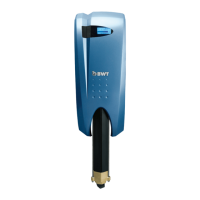
Bypass setting with cold drinking water:
Using the bypass setting on the blue setting
mixer head (at the top of the device below the service cover), an
amount of cold drinking water can be add-
ed to the pure water produced. By turning the
blending head while holding the blue switch,
you can set the required locking position 0, 1, 2
or 3. The higher the number of the locking po-
sition, the higher the mixing ratio of the feed
water
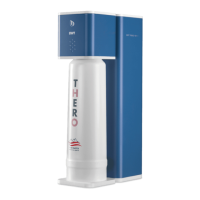
(Chapter3.2). The BWT THERO 90PRO ena-
bles continuous adjustment of the bypass inde-
pendent of locking position 0, 1, 2, 3).



 To Next Page