CEBORA S.p.A. 4
2 - SYSTEM DESCRIPTION
2.1
- Introduction.
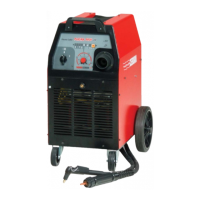
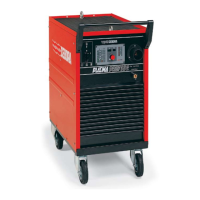
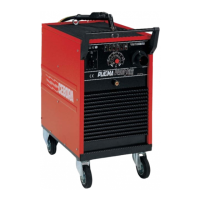
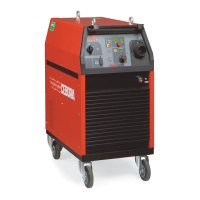
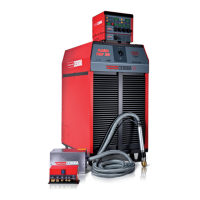
The PLASMA PROF 80 is a system for cutting electrically conductive materials, using a
plasma arc process.
It is made up of an electronic power source (art. 947), and a set of accessories for use in both
manual applications and automated systems (see list in Sales Catalogue).
The power source is controlled by microprocessor circuits, which manage the operative
functions of the cutting system and operator interface.
2.2
- Technical specifications.
To verify the technical specifications, see the machine plate, Instruction Manual, and Sales
Catalogue.
2.3
- Description of power source art. 947.
Art. 947 is a direct current power source with controlled current, essentially consisting of a
three-phase transformer and scr-controlled rectifier bridge.
Referring to the electrical diagram in par. 5.1, the drawing in par. 4.1 and table 4.2, we can
identify the main blocks that make up the power source.
The switch (8) powers the power transformer (50), the primary circuit of which consists of
three windings with a center socket. When switched appropriately by the voltage changer, these
allow the power source to operate at 230, 400 or 440 Vac at 50/60 Hz.
Voltage may be delivered (always at 230 Vac) from 2 terminals on the voltage change, which
correspond to the terminals of one of the primary windings of the transformer (50), to power the
fan (45) and the service transformer (18). The latter powers the electronic boards and internal
services of the power source, and supports the fuse board (18) with the fuses arranged to protect
these circuits.
The secondary circuit of the power transformer (50) is connected to the power board (20)
containing the scr rectifier bridge for power source output current rectifying and adjustment.
This bridge is made up of a single module containing 6 thyristors (scr) connected in a “total
controlled bridge” configuration. This configuration supplies the output terminals of the power
board (20), TP4(+) and TP5(-), with direct current regulated based on the cutting current.
The power board (20), inserted upstream from the output TP4, contains the solenoid with reed
bulb (26) to detect the cutting current on the earth conductor of the power source.
The resistor (39) (280 ohm), connected between J2 and J3 of power board (20), thus
essentially parallel to the rectifier bridge output TP4 and TP5, is used to ensure that the bridge
scr are properly engaged in every load condition of the power source.
The choke (44) is used to level the cutting current and the HF transformer (23) to engage the
pilot arc.
The connector cable of the choke (44) contains the Hall-effect current transducer (34), which
provides the setting board (19) with the output current signal of the power source, required for
current adjustment.
The control board (9) that is mounted on the front panel of the power source also acts as a
control panel, and for these functions has a set of leds to indicate the operating status, a
potentiometer to adjust the cutting current, and a button to activate the “pilot self-restart”
function.
Depending on the signals to its inputs, the control board (9) sets the power source operating
mode by controlling the solenoid valves EL1 and EL2 (37), the nozzle relay RL1 on relay board
(27), and processing the current interface and reference signals to be sent to the setting board
(19). It also makes sure that conditions for power source operation are always present, by
3.302.167 25/06/04




 To Next Page