Page 42
TWIN MG 092223
INSTALLING THE CONDENSING UNIT
1. Select installation location
Before installing the outdoor unit, you must choose an ap-
propriate location. The following are standards that will help
you choose an appropriate location for the unit.
Proper installation locations meet the following stan-
dards:
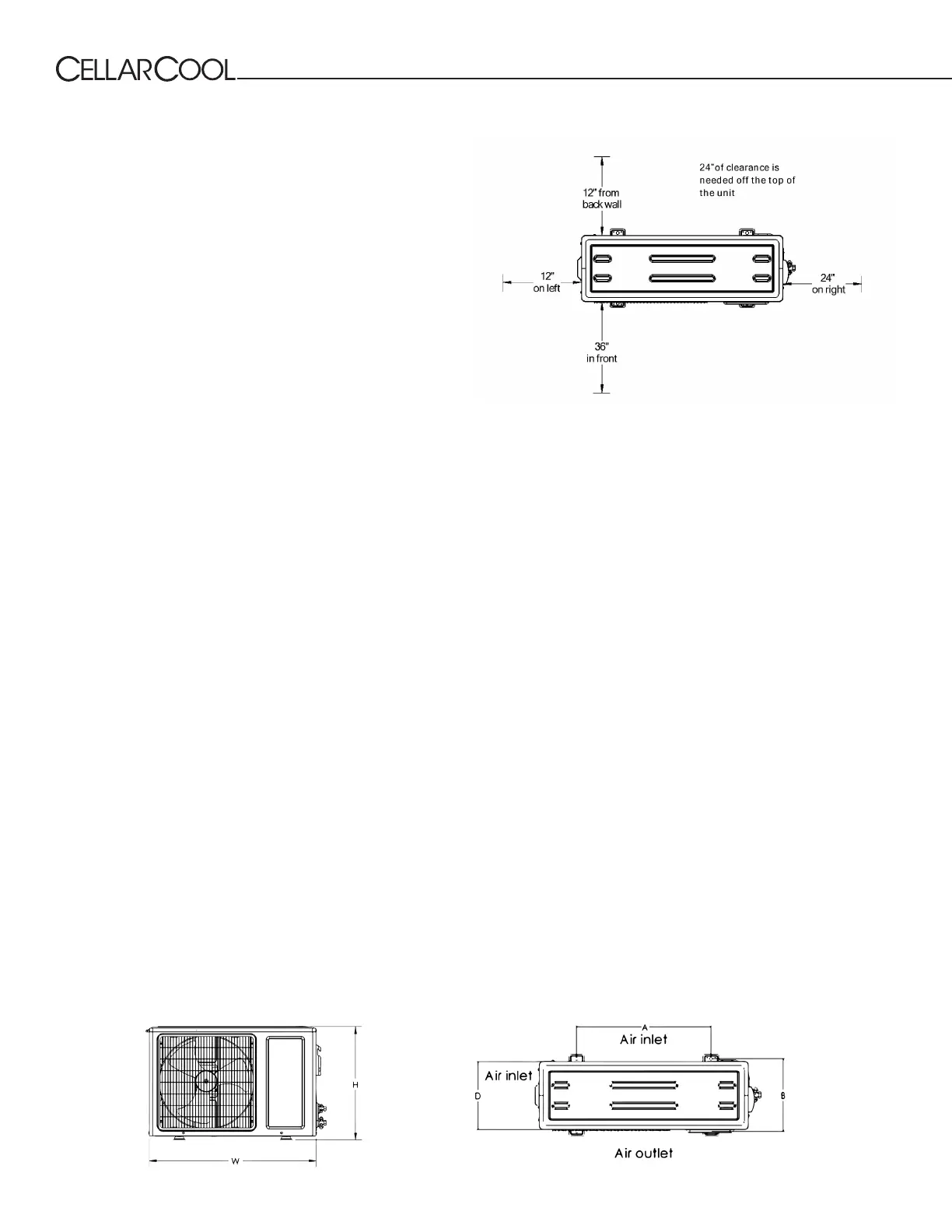
• Meets all suggested spatial requirements according
to diagram.
• Good air circulation and ventilation.
• Firm and solid—the location can support the unit, is
level, and will not vibrate.
• Condensing unit is suggested to be mounted on
concrete pad. Wall mounting is optional but can
• Near an obstacle that will block air inlets and outlets.
• Near a public street, crowded areas, or where noise from the unit will disturb others.
• Near animals or plants that will be harmed by hot air discharge.
• Near any source of combustible gas.
• In a location that is exposed to large amounts of dust.
• In a location exposed to a excessive amounts of salty air.
• In a closet or small room.
Special Considerations For Cold Weather And Other Outdoor Conditions
If the unit is exposed to heavy wind: Install unit so that air outlet fan is at a 90° angle to the direction of the wind. If needed,
build a barrier in front of the unit to protect it from extremely heavy winds.
If the unit is frequently exposed to heavy rain or snow: Build a shelter above the unit to protect it from the rain or snow. Be
careful not to obstruct air ow around the unit. The unit should be elevated to prevent build up of debris and snow in front of
fan.
2. Anchor outdoor unit
The outdoor unit can be anchored to the ground or to a wall-mounted bracket.
Unit Mounting Dimensions:
The following is a list of dierent outdoor unit sizes and the distance between their mounting feet. Prepare the installation
base of the unit according to the dimensions.
3. Connect signal and power cables
cause excess vibration.
DO NOT install unit in the following locations:



 To Next Page