EasyManua.ls Logo

Cessna R182 - Page 71

Cessna R182
178 pages
Print Icon
To Next Page IconTo Next Page
To Previous Page IconTo Previous Page
Loading...
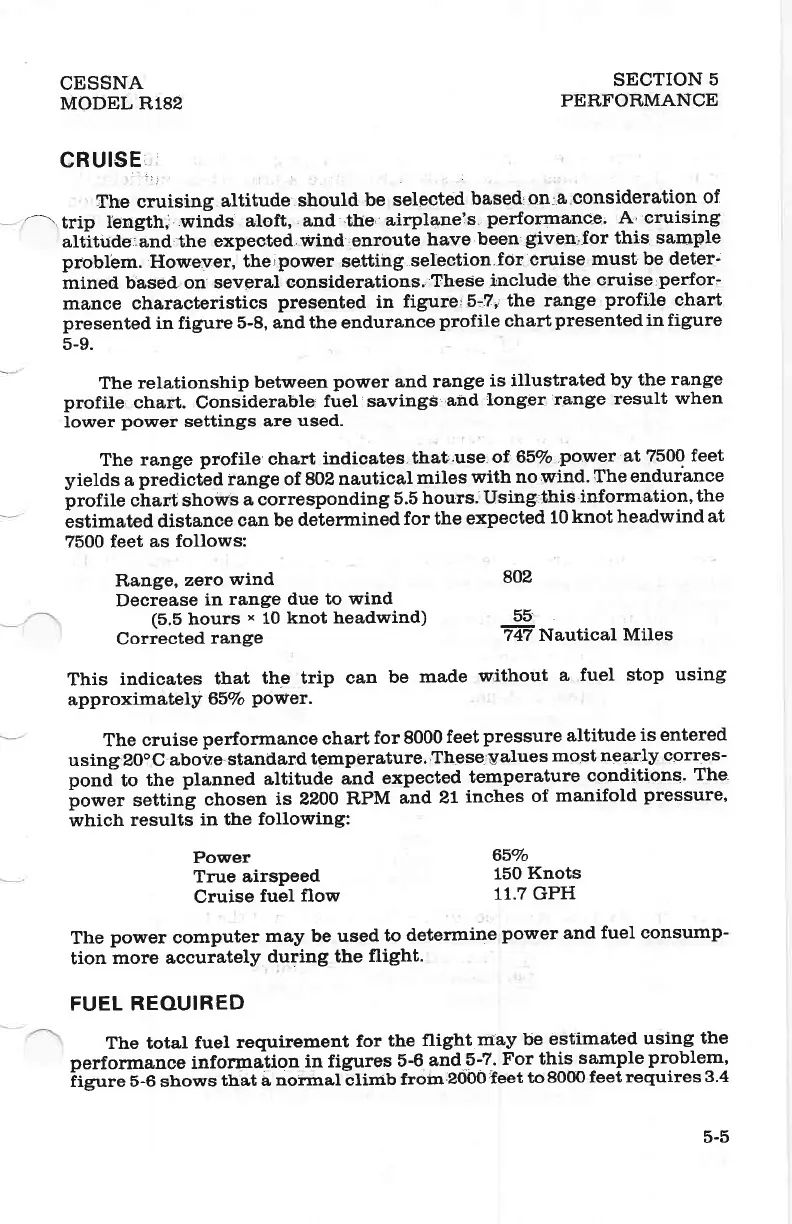
CRUISE,
,
The cruising
altitude
should
be selected
based:on:&"consideration
of
^,
trip
length,
winds
aloft,
and
.the.
airplanels.
perfor.tnanc-e, A' cruising
altitude;nd the
expected.wind'enroute
have
been
given:for
this sample
problbm.
However,
the;pow.er se.tting.selectiou..for
cruise
must
be deter:
mined based on.
several
oonsiderations,
TheSe
include
the
cruise,perfor-
mance characteristics
presented
in
figure'
5.7;r
ths range
profile
chart
presented
in figure
5-8, and the endurance
profile
chart
presented
in figure
5-9.
The
relationship
between
power and range
is illustrated
by the
range
profile
charit. Considerable,
fuel savingS.aiid
longer'range
result when
lower
power
settings
are
used.
The
range
profile
ehart
indicates.that,use
of 6lS%o.power
at 7500 feet
yields
r
p"ud'ict"a iange of 80P
nautical
miles
with no
wind. The endur'ance
profile
chart shows
a corresponding
5.5
hours.
Usingthis
inforrnation'
the
estimated
distance
can be
determined
for the
expected
10
knot
headwind at
7500 feet as
follows:
CESSNA
MODEL R182
Range,
zero
wind
Decrease
in
range due
to wind
(5.5
hours
*
10 knot
headwind)
Corrected
range
This
indicates
that
the trip can
be
made
approximat
ely
65Vo
Power.
Power
True airspeed
Cruise
fuel flow
SECTION
5
PERFORMANCE
802
AD
ENautical
Miles
without
a fuel stop
using
65Vo
150
Knots
11.7 GPH
The
cruise
performance chart
for 8000
feet
pressure altitude
is
entered
using 20oc
above
standard
temperature.
These.galues
most near.ly
corr.es-
pona-to
the
planned altitude
and
expected
temperature
cq-nditions.
The
power
setting
chosen
is 2200
RPM
and
21
inches
of
manifold
pressure,
which
results
in the
following:
The
power
computer
may be used
to
determine
power
and
fuel consump-
tion
more accurately
during the
flight.
FUEL REOUIRED
The total
fuel
requirement
for
the
flight
may be
estimated
using
the
performance
infonnation
in figures
5-6
and
5-7.
For this
sample
problem'
iigure b-6 shows
that a
nofmat-ctirriU
froin,z$bo
feet
toSOtx)
feetrequires
3.4
D.D

Table of Contents

Related product manuals