EasyManua.ls Logo

Cessna T188C - Page 400

Cessna T188C
624 pages
Print Icon
To Next Page IconTo Next Page
To Previous Page IconTo Previous Page
Loading...
MODEL
188
&
T188
SERIES
SERVICE
MANUAL
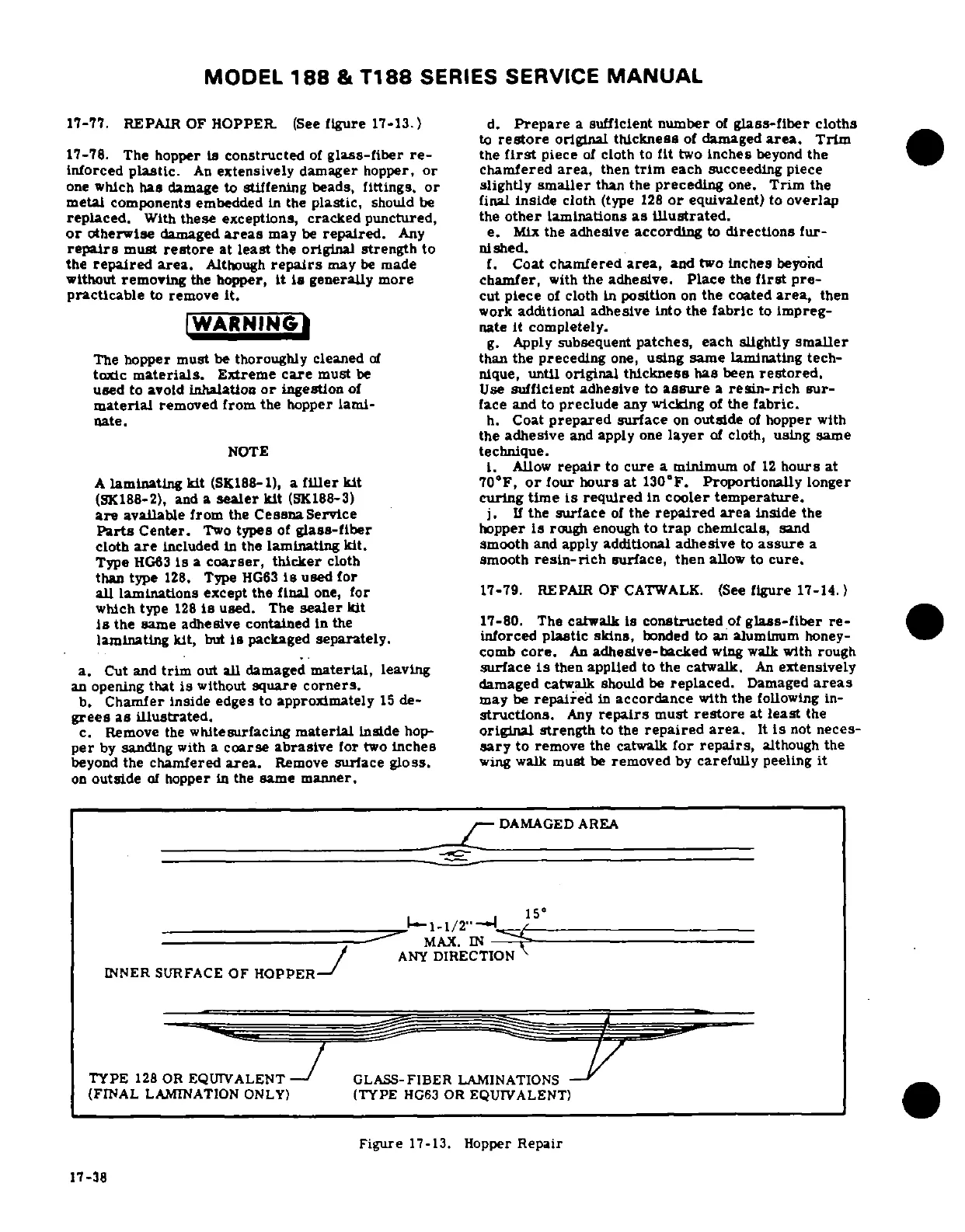
17-77. REPAIR
OF
HOPPER
(See
figure
17-13.)
d.
Prepare
a
sufficient number
of
glass-fiber
cloths
to
restore
original
thickness
of
damaged
area.
Trim
17-78.
The
hopper
is
constructed
of
glass-fiber
re-
the
first
piece
of
cloth
to
fit
two
inches
beyond
the
Inforced
plastic.
An
extensively
damager
hopper,
or
chamfered
area,
then
trim
each
succeeding
piece
one
which
has
damage
to
stiffening
beads,
fittings,
or
slightly
smaller
than
the
preceding
one.
Trim
the
metal
components
embedded
in
the
plastic,
should
be
final
inside
cloth
(type
128
or
equivalent)
to
overlap
replaced.
With
these
exceptions,
cracked
punctured,
the
other
laminations
as
illustrated.
or
otherwise
damaged
areas
may
be
repaired.
Any
e.
Mix
the
adhesive
according
to
directions
fur-
repairs
must
restore
at
least
the
original
strength
to
nished.
the
repaired
area.
Although
repairs
may
be
made
f.
Coat
chamfered
area,
and
two
inches
beyond
without
removing
the
hopper,
it
is
generally more
chamfer,
with
the
adhesive.
Place
the
first
pre-
practicable
to
remove
it.
cut
piece
of
cloth
in
position
on
the
coated
area,
then
work
additional
adhesive
into
the
fabric
to
impreg-
WARNING
nate
it
completely.
g.
Apply
subsequent
patches,
each
slightly
smaller
The
hopper
must
be
thoroughly
cleaned
of
than
the
preceding
one,
using same
laminating
tech-
toxic
materials.
Extreme
care
must
be
nique,
until
original
thickness
has
been
restored.
used
to
avoid
inhalation
or
ingestion
of
Use
sufficient
adhesive
to
assure
a
resin-rich
sur-
material
removed
from
the
hopper
lami-
face
and
to
preclude
any
wicking
of
the
fabric.
nate.
h.
Coat
prepared
surface
on
outside
of
hopper
with
the
adhesive
and
apply
one
layer
of
cloth,
using
same
NOTE
technique.
1.
Allow
repair
to
cure
a
minimum
of
12
hours
at
A
laminating
kit
(SK188-1),
a
filler
kit
70°F,
or
four
hours
at
130F.
Proportionally
longer
(SK188-2),
and
a
sealer
kit
(SK188-3)
curing
time
is
required
in
cooler
temperature.
are
available
from
the
Cessna
Service
j. If
the
surface
of
the
repaired
area
inside
the
Parts
Center.
Two
types
of
glass-fiber
hopper
is
rough
enough
to
trap
chemicals,
sand
cloth
are
included
in
the
laminating
kit.
smooth
and apply
additional
adhesive
to
assure
a
Type
HG63
is
a
coarser,
thicker
cloth
smooth
resin-rich
surface,
then
allow
to
cure.
than
type
128.
Type
HG63
is
used
for
all
laminations
except
the
final
one,
for
17-79.
REPAIR
OF
CATWALK.
(See
figure
17-14.)
which
type
128
is
used.
The
sealer
kit
is
the
same adhesive
contained
in
the
17-80.
The
catwalk
is
constructed
of
glass-fiber
re-
laminating
kit,
but
is
packaged
separately.
inforced
plastic
skins,
bonded
to
an
aluminum
honey-
comb
core.
An
adhesive-backed
wing
walk
with
rough
a.
Cut
and
trim
out
all
damaged
material,
leaving
surface
is
then
applied
to
the
catwalk.
An
extensively
an
opening
that
is
without
square
corners.
damaged
catwalk
should
be
replaced.
Damaged
areas
b.
Chamfer
inside
edges
to
approximately
15
de-
may
be
repaired
in
accordance
with
the
following
in-
grees
as
illustrated.
structions.
Any
repairs
must
restore
at
least
the
c.
Remove
the
whitesurfacing
material
inside
hop-
original
strength
to
the
repaired
area.
It
is
not
neces-
per
by
sanding
with
a
coarse
abrasive
for
two
inches
sary
to
remove
the
catwalk
for
repairs,
although
the
beyond
the
chamfered
area.
Remove
surface
gloss,
wing
walk
must
be
removed
by
carefully
peeling
it
on
outside
of
hopper
in
the
same
manner.
,-
DAMAGED
AREA

Table of Contents

Related product manuals