14
To prevent SERIOUS INJURY or DEATH from a moving gate:
•
ALL gate operator systems REQUIRE two independent entrapment
protection systems for each entrapment zone.
•
Entrapment protection devices MUST be installed to protect anyone
who may come near a moving gate.
•
Entrapment protection devices MUST be located to protect in BOTH
the open and close gate cycles.
•
Locate entrapment protection devices to protect between moving
gate and RIGID objects, such as posts, walls, pillars, columns, or
operator itself.
Step 6 Install Entrapment Protection
Install entrapment protection devices according to the UL 325
Entrapment Protection Requirements section, see page 1. Use the Site
Planning Safety Checklist in the appendix, to identify entrapment zones
that will result from the installation.
1. Install entrapment protection devices for ALL entrapment zones.
This operator has an inherent entrapment protection device built-in.
The installer MUST provide one additional entrapment protection
device for each entrapment zone.
2.
The operator will NOT run unless a minimum of one external device
is connected in either the open or closed direction. If no entrapment
zone exists in the other direction, an external entrapment protection
device is NOT required in that direction.
3. Test ALL entrapment protection devices AFTER installing the
operator, refer to the manual provided with your entrapment
protection device.
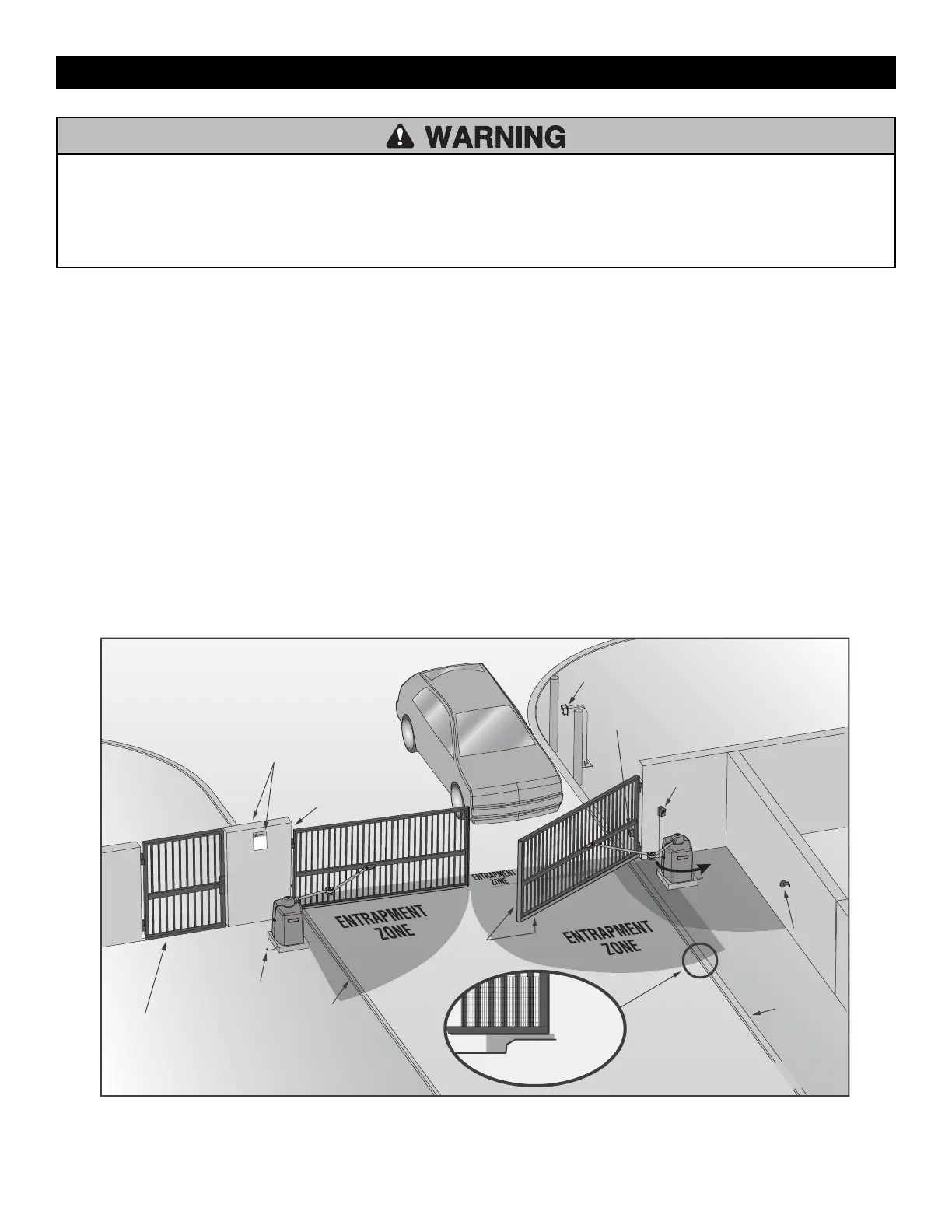
Illustration is for example only; your site may have additional entrapment
zones which MUST be protected.
Definitions
ENTRAPMENT: The condition when a person is caught or held in a position
that increases the risk of injury.
SWING GATE ENTRAPMENT ZONE: Locations between a moving gate or
moving, exposed operator components and a counter opposing edge or
surface where entrapment is possible up to 1.8 m (6 ft) above grade. Such
locations occur if during any point in travel:
a. The gap between the bottom of a moving gate and the ground is
greater than 101.6 mm (4 in) and less than 406 mm (16 in); or
b. The distance between the center line of the pivot and the end of the
wall, pillar, or column to which it is mounted when in the open or
closed position exceeds 101.6 mm (4 in). Any other gap between a
moving gate and fixed counter opposing edges or surfaces or other
fixed objects is less than 406 mm (16 in) (examples are walls, curbs,
berms or other immovable objects).
Illustrations provided by DASMA Gate Systems Safety Guide
Cross Section
Pedestrian gate located near
the swing gate. Make sure a
separate pedestirian entrance
is available and the path is
clearly designated.
Secure Side
Public Side
Edge
sensor
Entrapment
zone
Curb
Curb
Reflector for
photoelectric
sensor
Photoelectric
sensor
Photoelectric sensor
(public side)
Photoelectric sensor
(public side)
Earth ground
Mount access control devices at
least 6' (1.8 m) beyond the gate
Take a photograph of the complete
installation site for your records
Place the warning signs on both
sides of the gate in clear view
E
N
T
RAPM
E
NT
Z
ON
E
Illustration is for example only; your site may have
additional entrapment zones which MUST be protected.
INSTALLATION





 To Next Page