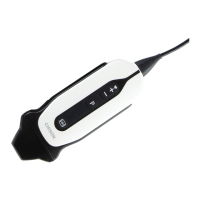
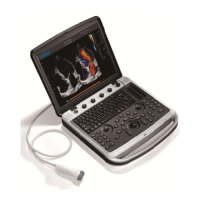
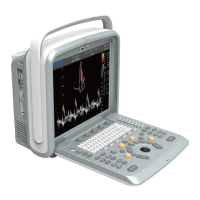
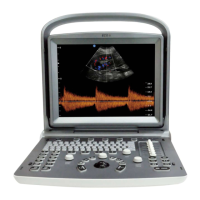
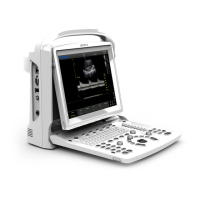
Digital Color Doppler Palm Ultrasound System
13
I’=I*RF Where I’ is the intensity in soft tissue, I is the time-averaged intensity measured in water.
Tissue Model:
Tissue temperature elevation depends on power, tissue type, beam width, and scanning mode. Six
models Tissue temperature elevation depends on power, tissue type, beam width, and scanning
mode. Six models are developed to mimic possible clinical situations.
Thermal Models Composition Mode Specification Application
TIS
Soft tissue
Unscanned
Large aperture (>1cm
2
)
Liver PW
TIS Soft tissue Unscanned
Pencil System
TIS Soft tissue Scanned Evaluated at surface Breast color
TIB Soft tissue and bone Scanned Soft tissue at surface Muscle color
Soft tissue:
Describes low fat content tissue that does not contain calcifications or large gas-filled spaces.
Scanned: (auto-scan)
Refers to the steering of successive burst through the field of view, e.g. B and color mode.
Unscanned:
Emission of ultrasonic pulses occurs along a single line of sight and is unchanged until the transducer is
moved to a new position. For instance, the PW mode.
TI:
TI is defined as the ratio of the In Situ acoustic power (W.3) to the acoustic power required to raise tissue
temperature by 1°C (Wdeg), TI = W.3/Wdeg.
Three TIs corresponding to soft tissue (TIS) for abdominal; bone (TIB) for fetal and neonatal cephalic; have
been developed for applications in different exams.
An estimate of the acoustic power in milliwatts necessary to produce a 1°C temperature elevation in soft
tissue is:
W
deg
= 210/fc, for model 1 to 4, where fc is the center frequency in MHz.
W
deg
= 40 K D for model 5 and 6, where K (beam shape factor) is 1.0, D is the aperture
diameter in cm at the depth of interest.
MI:
Cavitation is more likely to occur at high pressures and low frequencies in pulse ultrasound wave in the


 To Next Page