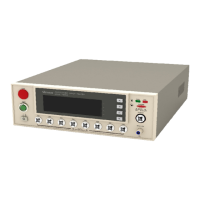
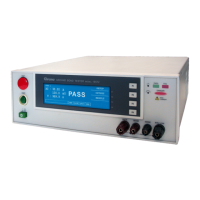
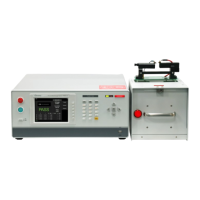
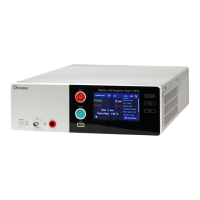
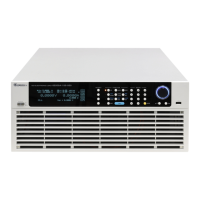
Wound Component EST Scanner 19035/19035-M/19035-S
Quick Start Guide
<<< CAUTION! When output terminal is cutoff >>>
7. Ensure the test is done
Sometimes the user might need to touch the high voltage areas such
as DUT, high voltage test cable or output terminal etc. due to
configuration or test required change. In such case, please make
sure that:
■ The power switch is turned off.
■ Being an insulation resistance test object the DUT after test may
full of high voltage; therefore it is necessary to read the
description of item 8 and 9 for execution.
<<< CAUTION! Charging when doing insulation resistance test >>>
8. Charging
When doing insulation resistance test, the DUT, capacitor, test cable,
probe and output terminal, even the Scanner itself may full of high
voltage. The charged voltage may need some time to discharge
completely after turning off the power switch. It is necessary to follow
the instruction described above for actions. Do not touch any places
that may cause electric shock especially when the power is just turned
off.
9. Ensure the charged voltage is fully discharged
The time required for fully discharging the voltage depends on the test
voltage applied and the features of DUT. Assuming the high voltage
added on the DUT equals the high voltage added to a 0.01uF
capacitor and paralleled to a 100MΩ resistance circuit. When the
test voltage is 1000V, then it requires approximately 3.5 seconds for
the voltage that added to test and on DUT to fall to 30V under after
turned off the power. For 500V test voltage, it requires about 2.8
seconds. Assuming the time constant of a DUT is already known,
the way described above can be used to calculate the time required
for voltage falling to 30V under after powered off by timing the time
constant multiple to the time decreased to 30V under as Figure 2-5
shows.
Formula: Vo
e
= VIL
RCt /−
Ex: 1000V × = 30V
e
RCt /−
= 0.03
e
RCt /−
-t / RC = ln 0.03 ∴ t = 3.5 Sec
7


 To Next Page