EasyManua.ls Logo

Cleaver-Brooks CBH 40 - Automatic Ignition; Combustion Air; Oil Fuel Flow

Default Icon
75 pages
Print Icon
To Next Page IconTo Next Page
To Previous Page IconTo Previous Page
Loading...
line
when
the
gas
valves
are
de-energized.
The
vent
valve
closes
when
the
gas
valves
are
energized.
MAIN
GAS
COCK
(Figure
1-4)
For
manually
opening
and
closing
the
main
fuel
gas
supply
downstream
of
the
main
gas
line
pressure
regulator.
A
second
shut-off
cock,
down-
stream
of
the
main
gas
valve(s),
may
be
installed
to
provide
a
means
of
shutting
off
the
gas
line
whenever
a
test
is
made
for
leakage
across
the
mam
gas
valve.
LOW
GAS
PRESSURE
SWITCH
(Figure
1-4)
A
pressure
actuated
switch
that
is
closed
whenever
main
gas
line
pressure
is
above
a
preselected
pressure.
Should
the
pressure
drop
below
this
set-
ting,
the
switch
contacts
will
open
a
circuit
causing
the
main
gas
valve(s)
to
close,
or
prevent
the
bur-
ner
from
starting.
This
switch
is
usually
equipped
with
a
device
that
must
be
manually
reset
after
being
tripped.
HIGH
GAS
PRESSURE
SWITCH
(Figure
1-4)
A
pressure
actuated
switch
that
is
closed
whenever
main
gas
line
pressure
is
below
a
preselected
pres-
sure.
Should
the
pressure
rise
above
the
setting,
the
switch
contacts
will
open
a
circuit
causing
the
main
gas
valve(s)
to
close,
or
prevent
the
burner
from
starting.
The
switch
is
usually
equipped
with
a
device
that
must
be
manually
reset
after
being
tripped.
LEAKAGE
CONNECTION
The
body
of
the
gas
valve
has
a
plugged
opening
that
is
used
whenever
it
is
necessary
or
desirous
to
conduct
a
test
for
possible
leakage
across
the
closed
valve.
D.
AUTOMATIC IGNITION
A
gas
burner
(and
an
oil
burner
on
a
combination
unit),
is
ignited
by
an
interrupted
type
gas
pilot.
Some
insurance
regulations
require
that
a
light
oil
burner
(Model
100)
be
ignited
with
a
gas
pilot
al-
though
standardly
this
model
has
spark
ignition.
The
gas
pilot
flame
is
ignited
automatically
by
an
electric
spark.
Fuel
for
the
pilot
is
supplied
from
the
utility
mains
or
from
a
tank
(bottle)
supply.
Flow
rate
(flame
size)
is
regulated
by
a
pressure
regulator
(Figure
1-4
).
The
burner
is
designed
to
have
combustion
air
flow
into
and
mix
with
the
pilot
gas
stream
to
provide
a
suitable
flame.
At
the
beginning
of
the
ignition
cycle,
the
pilot
gas
solenoid
valve
and
ignition
transformer
are
simultaneously
energized.
The
ignition
trans-
former
supplies
high
voltage
current
for
the
igniting
spark
which
arcs
between
the
single
elec-
trode
within
the
pilot
tube
and
the
wall
of
the
tube
itself.
The
gas
pilot
solenoid
and
transformer
are
de-energized
after
main
flame
is
ignited.
Chapter
1-General
Description
and
Principles
of
Operation
On
a
Model
100
boiler
with
spark
ignition,
the
low
fire oil
nozzle
is
ignited
by
a
spark
arcing
between
two
electrodes
supplied
with
high
voltage
current
from
the
ignition
transformer.
At
the
beginning
of
the
ignition
cycle,
the
low
fire
oil
solenoid
valve
and
ignition
transformer
are
simultaneously
ener-
gized.
The
ignition
transformer
is
de-energized
af-
ter
low
fire is
established
and
proven.
E.
COMBUSTION
AIR
Air
for
the
combustion
of
fuel,
(also
called
"sec-
ondary"
air)
is
furnished
by
the
forced
draft
fan
(Figure
1-3)
mounted
in
the
front
head.
In
oper-
ation,
air
pressure
is
built
up
in
the
entire
head
and
forced
through
a
diffuser
plate
for a
thorough
mixture
with
the
fuel
for
proper
combustion.
The
supply
of
combustion
air
is
governed
by
auto-
matically
throttling
the
output
of
the
fan
by
regulating
the
air
damper
to
furnish
the
proper
amount
of
air
for
correct
ratio
of
air
to
fuel
for ef-
ficient
combustion
at
both
low
and
high
firing
rates.
F.
Oil
FUEl
FlOW
An
oil
fired
boiler
is
equipped
with
a
belt
driven
fuel
pump
(Figures
1-1 & 1-5)
that
withdraws
fuel
oil
from
a
storage
tank.
The
pump
has
a
greater
capacity
than
the
maximum
burning
rate
and
all
oil
not
delivered
to
the
burner
nozzles
is
returned
to
the
storage
tank.
The
pump
has
an
integral
pressure
regulator
that
can
be
adjusted
to
provide
the
necessary
atomizing
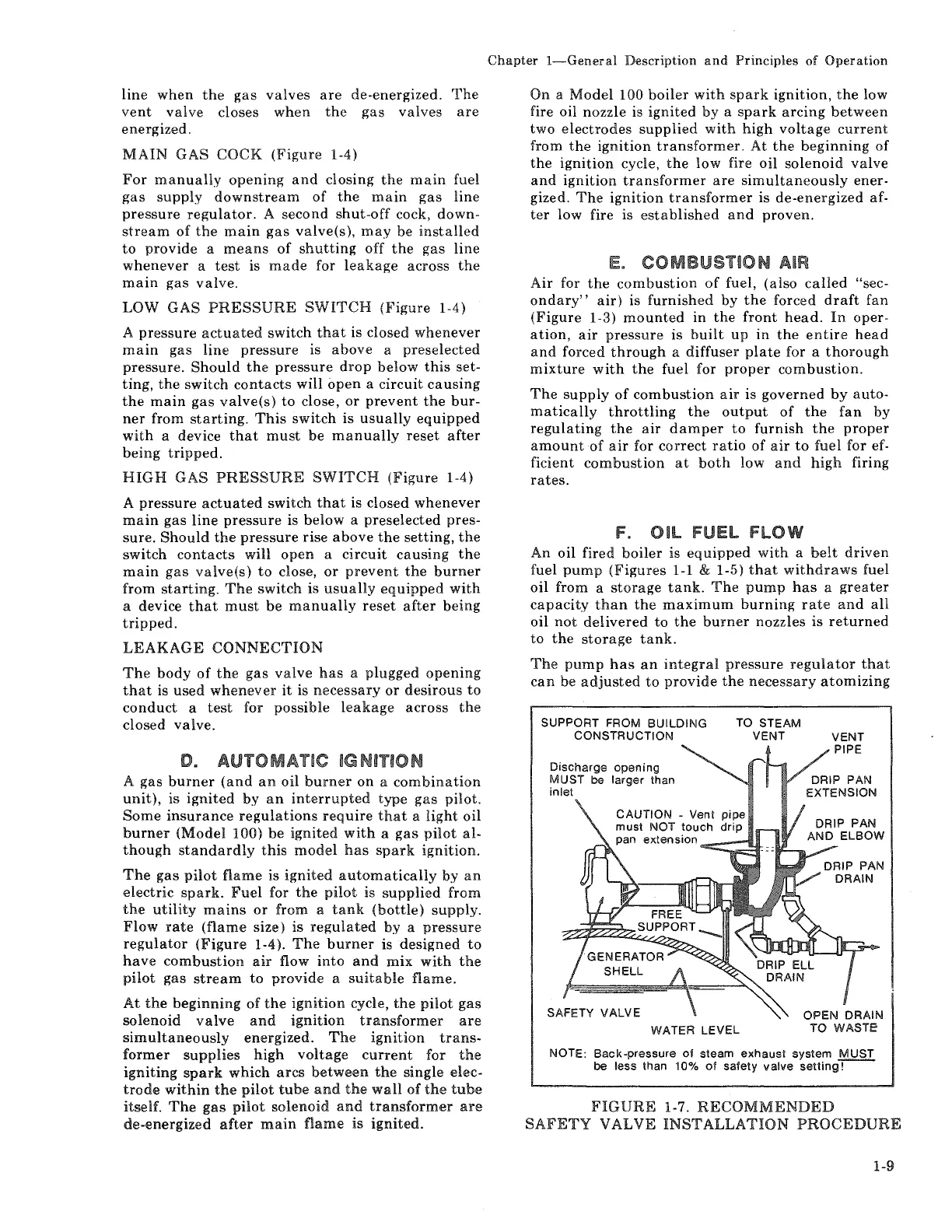
SUPPORT FROM BUILDING
CONSTRUCTION
Discharge
opening
MUST
be
larger than
inlet
TO STEAM
VENT
WATER LEVEL
NOTE:
Back-pressure
of
steam
exhaust
system
MUST
be less than 10%
of
safety
valve
setting-!--
FIGURE
1-7.
RECOMMENDED
SAFETY
VALVE
INSTALLATION
PROCEDURE
1-9

Table of Contents

Related product manuals