EasyManua.ls Logo

Cleaver-Brooks CBH 40 - Oil Pump

Default Icon
75 pages
Print Icon
To Next Page IconTo Next Page
To Previous Page IconTo Previous Page
Loading...
Nozzles
may
be
of
different
capacities
and
it
is ex-
tremely
important
that
they
are
replaced
in
proper
firing
order.
Nozzles
can
be
identified
by
the
capa-
city
and
spray
angle
stamped
on
them.
See
chart
5-
2 for
proper
location
of
nozzles.
The
capacity
stamped
on
side
of
nozzle
represents
delivery
rate
with
oil
pressure
at
100 psi. Since
the
burner
is
designed
to
use
considerably
higher
atomizing
oil
pressures,
the
capacity
of
the
nozzle
is
greatly
increased.
Do
not
assume
that
under-
sized
nozzles
are
installed
on
the
basis
of
nozzle
marking
compared
to
the
burner
input.
The
oil
pressure
required
for full
burner
input
is
approximately
175 psi. Oil
pressure
is
adjusted
by
the
regulator
in
the
fuel
oil
pump
and
final
pressure
setting
may
be
slightly
higher
or
lower.
If
smoke
occurs
at
open
damper,
the
pressure
should
be
adjusted
downward
to
clear
the
fire.
See
the
later
section
covering
oil
burner
combustion
ad-
justment.
IGNITION
SYSTEM
Maintain
the
proper
gap
and
dimensions
of
the
ignition
electrode(s)
for
best
ignition
results.
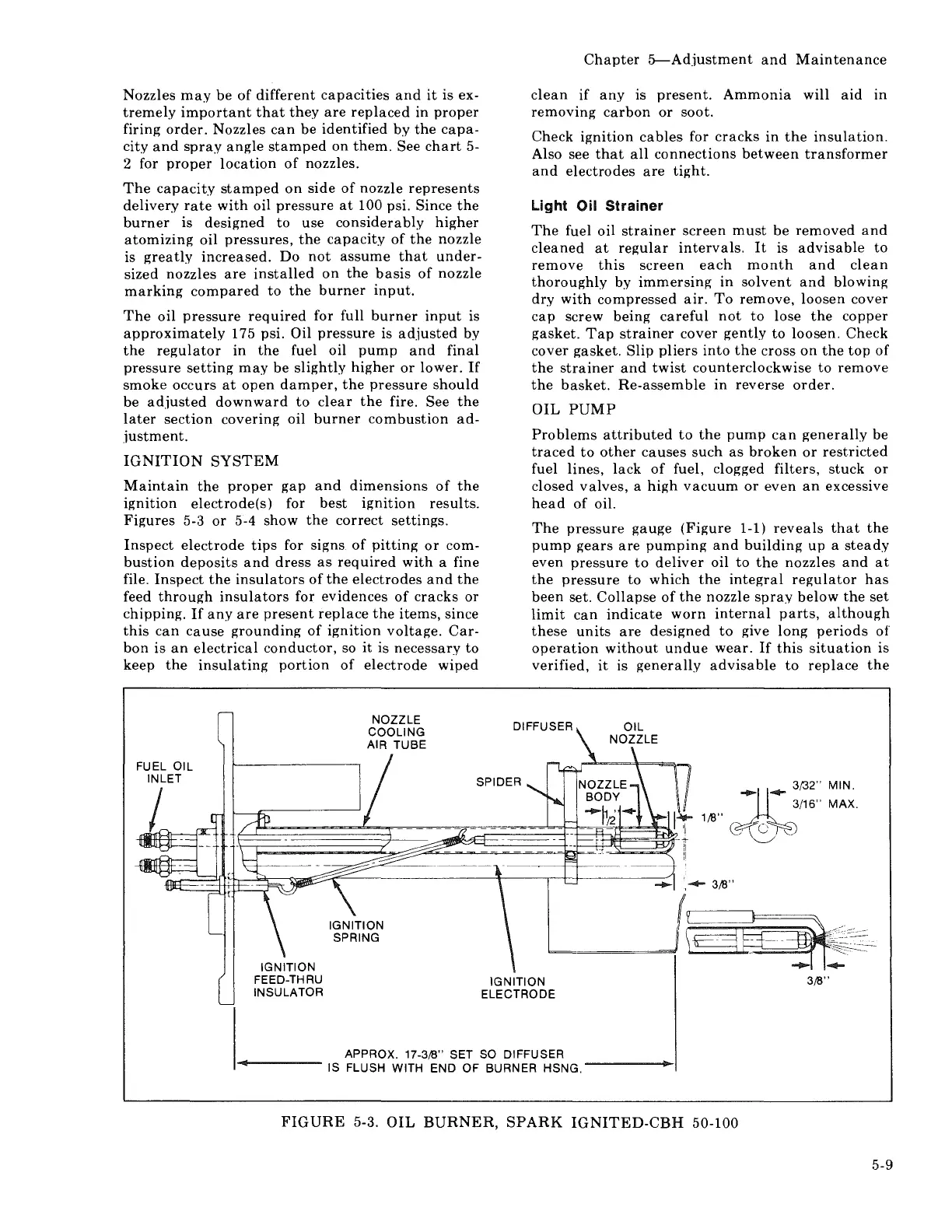
Figures
5-3
or
5-4
show
the
correct
settings.
Inspect
electrode
tips
for
signs
of
pitting
or
com-
bustion
deposits
and
dress
as
required
with
a fine
file.
Inspect
the
insulators
of
the
electrodes
and
the
feed
through
insulators
for
evidences
of
cracks
or
chipping.
If
any
are
present
replace
the
items,
since
this
can
cause
grounding
of
ignition
voltage.
Car-
bon
is
an
electrical
conductor,
so
it
is
necessary
to
keep
the
insulating
portion
of
electrode
wiped
Chapter
5--Adjustment
and
Maintenance
clean
if
any
is
present.
Ammonia
will
aid
in
removing
carbon
or
soot.
Check
ignition
cables
for
cracks
in
the
insulation.
Also see
that
all
connections
between
transformer
and
electrodes
are
tight.
light
Oil
Strainer
The
fuel
oil
strainer
screen
must
be
removed
and
cleaned
at
regular
intervals.
It
is
advisable
to
remove
this
screen
each
month
and
clean
thoroughly
by
immersing
in
solvent
and
blowing
dry
with
compressed
air.
To
remove,
loosen
cover
cap
screw
being
careful
not
to
lose
the
copper
gasket.
Tap
strainer
cover
gently
to
loosen.
Check
cover
gasket.
Slip
pliers
into
the
cross
on
the
top
of
the
strainer
and
twist
counterclockwise
to
remove
the
basket.
Re-assemble
in
reverse
order.
OIL
PUMP
Problems
attributed
to
the
pump
can
generally
be
traced
to
other
causes
such
as
broken
or
restricted
fuel
lines,
lack
of
fuel, clogged
filters,
stuck
or
closed
valves,
a
high
vacuum
or
even
an
excessive
head
of
oil.
The
pressure
gauge
(Figure
1-1)
reveals
that
the
pump
gears
are
pumping
and
building
up
a
steady
even
pressure
to
deliver
oil
to
the
nozzles
and
at
the
pressure
to
which
the
integral
regulator
has
been
set.
Collapse
of
the
nozzle
spray
below
the
set
limit
can
indicate
worn
internal
parts,
although
these
units
are
designed
to
give
long
periods
of
operation
without
undue
wear.
If
this
situation
is
verified,
it
is
generally
advisable
to
replace
the
........
3/B"
~~(\aEv----
~q=
__
~~
3/B"
FIGURE
5-3.
OIL
BURNER,
SPARK
IGNITED-CBH
50-100
5-9

Table of Contents

Related product manuals