EasyManua.ls Logo

Cleaver-Brooks CBH 40 - Oil Burner; Burner Nozzles

Default Icon
75 pages
Print Icon
To Next Page IconTo Next Page
To Previous Page IconTo Previous Page
Loading...
Chapter
5-Adjustment
and
Maintenance
after
in
accordance
with
a
planned
maintenance
program.
The
operating
limit
control
may
be
checked
by
allowing
steam
pressure
or
water
temperature
to
increase
until
the
burner
shuts
down.
Depending
upon
the
load,
it
may
be
necessary
to
manually
in-
crease
the
firing
rate
to
raise
steam
pressure
to
the
burner
shut
off
point.
If
load
is
heavy,
the
header
valve
can
be
closed
or
throttled
until
the
pressure
increases.
Observe
the
steam
gauge
to
check
the
cutoff
pressure
as
the
operating
limit
control
shuts
the
burner
down.
Open
the
header
valve
to
release
steam
pressure
or
vent
steam
and
check
the
cut-in
setting
as
the
burner
restarts.
Check
the
high-low
fire
control
for
desired
operating
pressure
range.
Water
temperature,
on
a
hot
water
boiler
that
may
be
operating
at
less
than
full
load,
may
be
raised
by
manually
increasing
the
firing
rate
until
the
burner
shuts
down
thru
the
action
of
the
operating
limit
control.
Observe
the
thermometer
to
verify
the
desired
settings
at
the
point
of
cut-out
and
again
when
burner
restarts.
Check
the
modulating
control
for
the
desired
temperature
range.
Observe
the
ignition
and
programming
control
operations
to
make
sure
that
they
are
correct.
Check
the
proper
operation
and
setting
of
the
low
water
cut-off
(and
pump
operating
control,
if
used).
Proper
operation
of
the
flame
failure
device
should
be
checked
at
time
of
starting
and
at
least
once
a
week
thereafter.
Refer
to
previous
section
for in-
formation
on
flame
safety
checks.
Check
for
tight
shut-off
of
all
fuel
valves.
Despite
precautions
and
strainers,
foreign
material
may
lodge
under
a
valve
seat
preventing
tight
closure.
Promptly
correct
any
conditions
causing
leakage.
F.
Oil
BURNER
GENERAL
There
are
relatively
few
adjustments
that
can
be
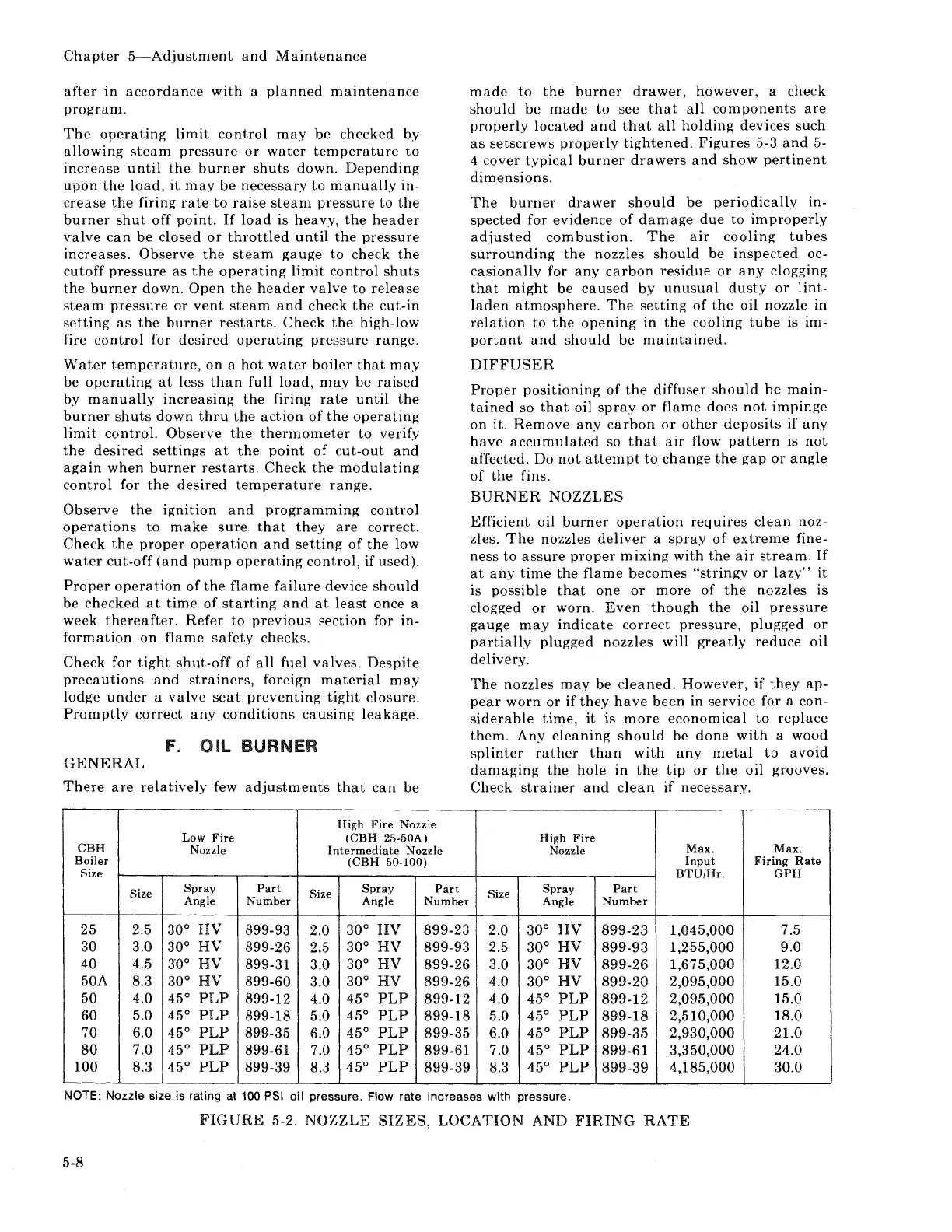
High
Fire
Nozzle
Low
Fire
(CBH
25-50A)
CBH
Nozzle
Intermediate
Nozzle
Boiler
(CBH
50-100)
Size
Size
Spray
Part
Size
Spray
Part
Angle
Number
Angle
Number
25 2.5 30°
HV
899-93
2.0
30°
HV
899-23
30 3.0 30°
HV
899-26
2.5
30°
HV
899-93
40 4.5
30°
HV
899-31
3.0
30°
HV
899-26
50 A
8.3
30°
HV
899-60
3.0
30°
HV
899-26
50
4.0
45°
PLP
899-12 4.0
45°
PLP
899-12
60
5.0
45°
PLP
899-18 5.0
45°
PLP
899-18
70
6.0 45°
PLP
899-35
6.0
45°
PLP
899-35
80
7.0 45°
PLP
899-61 7.0
45°
PLP
899-61
100
8.3 45°
PLP
899-39
8.3
45°
PLP
899-39
made
to
the
burner
drawer,
however,
a
check
should
be
made
to
see
that
all
components
are
properly
located
and
that
all
holding
devices
such
as
setscrews
properly
tightened.
Figures
5-3
and
5-
4
cover
typical
burner
drawers
and
show
pertinent
dimensions.
The
burner
drawer
should
be
periodically
in-
spected
for
evidence
of
damage
due
to
improperly
adjusted
combustion.
The
air
cooling
tubes
surrounding
the
nozzles
should
be
inspected
oc-
casionally
for
any
carbon
residue
or
any
clogging
that
might
be
caused
by
unusual
dusty
or
lint-
laden
atmosphere.
The
setting
of
the
oil
nozzle
in
relation
to
the
opening
in
the
cooling
tube
IS
Im-
portant
and
should
be
maintained.
DIFFUSER
Proper
positioning
of
the
diffuser
should
be
main-
tained
so
that
oil
spray
or
flame
does
not
impinge
on
it.
Remove
any
carbon
or
other
deposits
if
any
have
accumulated
so
that
air
flow
pattern
is
not
affected.
Do
not
attempt
to
change
the
gap
or
angle
of
the
fins.
BURNER
NOZZLES
Efficient
oil
burner
operation
requires
clean
noz-
zles.
The
nozzles
deliver
a
spray
of
extreme
fine-
ness
to
assure
proper
mixing
with
the
air
stream.
If
at
any
time
the
flame
becomes
"stringy
or
lazy"
it
is
possible
that
one
or
more
of
the
nozzles
is
clogged
or
worn.
Even
though
the
oil
pressure
gauge
may
indicate
correct
pressure,
plugged
or
partially
plugged
nozzles
will
greatly
reduce
oil
delivery.
The
nozzles
may
be
cleaned.
However,
if
they
ap-
pear
worn
or
if
they
have
been
in
service
for a con-
siderable
time,
it
is
more
economical
to
replace
them.
Any
cleaning
should
be
done
with
a
wood
splinter
rather
than
with
any
metal
to
avoid
damaging
the
hole
in
the
tip
or
the
oil
grooves.
Check
strainer
and
clean
if
necessary.
High
Fire
Nozzle
Max.
Max.
Input
Firing
Rate
BTU/Hr.
GPH
Size
Spray
Part
Angle
Number
2.0 30°
HV
899-23
1,045,000
7.5
2.5
30°
HV
899-93
1,255,000
9.0
3.0 30°
HV
899-26
1,675,000
12.0
4.0
30°
HV
899-20
2,095,000 15.0
4.0
45°
PLP
899-12
2,095,000 15.0
5.0
45°
PLP
899-18
2,510,000
18.0
6.0
45°
PLP
899-35
2,930,000
21.0
7.0
45°
PLP
899-61
3,350,000
24.0
8.3
45°
PLP
899-39
4,185,000
30.0
NOTE: Nozzle size is rating
at
100
PSI
oil
pressure. Flow rate increases with pressure.
FIGURE
5-2.
NOZZLE
SIZES,
LOCATION
AND
FIRING
RATE
5-8

Table of Contents

Related product manuals