EasyManua.ls Logo

Cleaver-Brooks CBH 40 - Water Treatment

Default Icon
75 pages
Print Icon
To Next Page IconTo Next Page
To Previous Page IconTo Previous Page
Loading...
Chapter
2-
The
Pressure
Vessel
14@
140
r
+-L-t+
*FOR
TEMPERATURES
ABOVE
320°
F,
130
8+-
130
CONSULT
CLEAVER-BROOKS
FOR
120
SPECIFIC
RECOMMENDED
PRESSURE
120
110
110
100
100
MINIMUM
RECOMMENDED
90
BOILER
OPERATING
90
PRESSURE
ci
110
81)
..:
,;7'0
SATURATION
~OI,LI~G)1
7'0
~
...
TEMPERATURE
~60
60
"'
"'
...
..
... 50
50
40
4@
J()
30
20
20
10
10
0
+
0
~
§!
~
0
~
g
!i
~
~
~
iii
~
~
S!
~
g
~
!!1
~
0
~
...
...
....
...
...
...
1:;
....
INDICATED
TEMPERATUitE
("F)
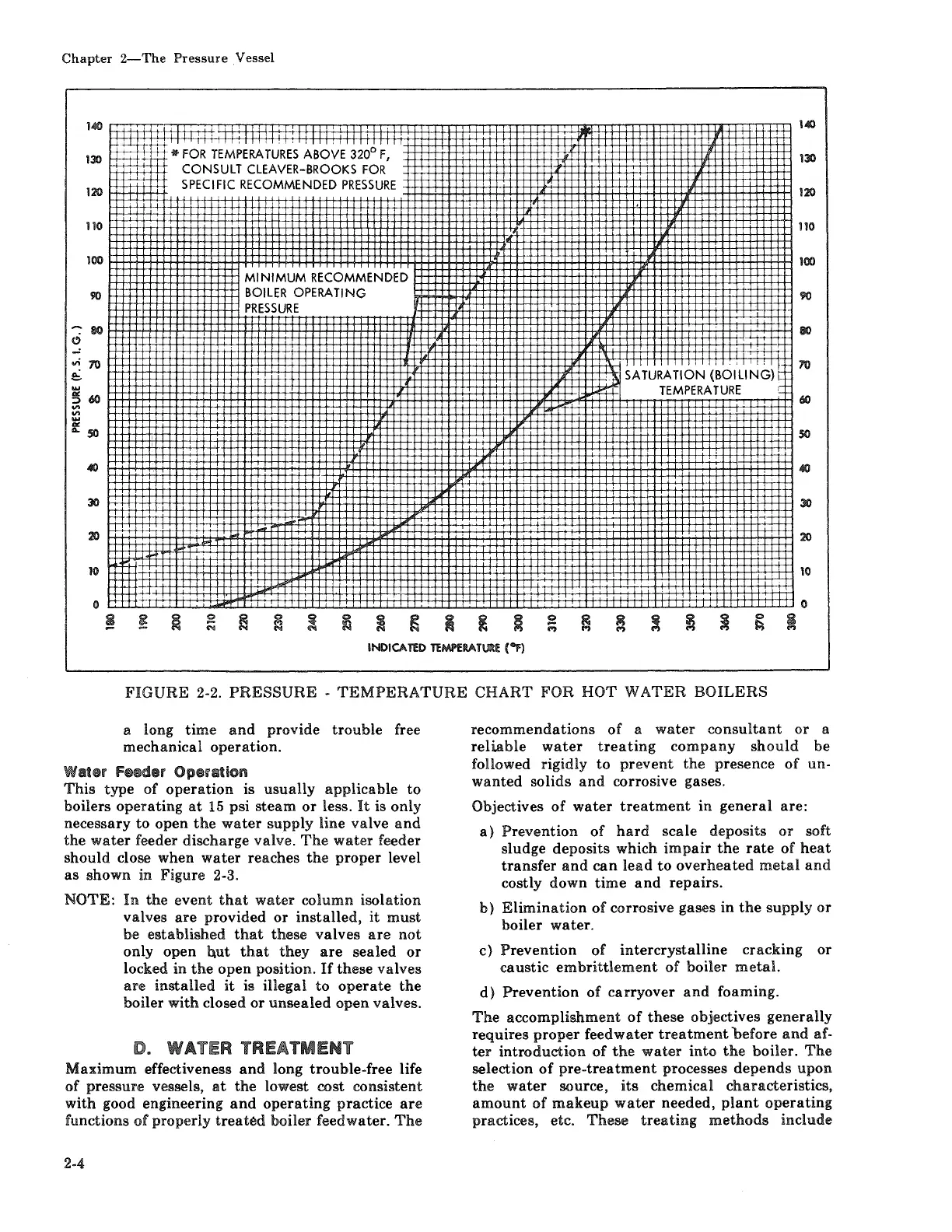
FIGURE
2-2.
PRESSURE
-
TEMPERATURE
CHART
FOR
HOT
WATER
BOILERS
a long
time
and
provide
trouble
free
mechanical
operation.
Wat~r
F~~d~r
Op~ration
This
type
of
operation
is
usually
applicable
to
boilers
operating
at
15 psi
steam
or
less.
It
is
only
necessary
to
open
the
water
supply
line
valve
and
the
water
feeder
discharge
valve.
The
water
feeder
should
close when
water
reaches
the
proper
level
as
shown
in Figure 2-3.
NOTE:
In
the
event
that
water
column
isolation
valves
are
provided
or
installed,
it
must
be
established
that
these
valves
are
not
only
open
'Qut
that
they
are
sealed
or
locked
in
the
open
position.
If
these
valves
are
installed
it
is
illegal
to
operate
the
boiler
with
closed
or
unsealed
open
valves.
D.
WATER TREATMENT
Maximum
effectiveness
and
long
trouble-free
life
of
pressure
vessels,
at
the
lowest cost
consistent
with
good engineering
and
operating
practice
are
functions
of
properly
treated
boiler
feed
water.
The
2-4
recommendations
of
a
water
consultant
or
a
reliable
water
treating
company
should
be
followed rigidly
to
prevent
the
presence
of
un-
wanted
solids
and
corrosive gases.
Objectives
of
water
treatment
in
general
are:
a)
Prevention
of
hard
scale
deposits
or
soft
sludge
deposits
which
impair
the
rate
of
heat
transfer
and
can
lead
to
overheated
metal
and
costly
down
time
and
repairs.
b)
Elimination
of
corrosive gases
in
the
supply
or
boiler
water.
c)
Prevention
of
intercrystalline
cracking
or
caustic
embrittlement
of
boiler
metal.
d)
Prevention
of
carryover
and
foaming.
The
accomplishment
of
these
objectives
generally
requires
proper
feed
water
treatment
before
and
af-
ter
introduction
of
the
water
into
the
boiler.
The
selection
of
pre-treatment
processes
depends
upon
the
water
source,
its
chemical
characteristics,
amount
of
makeup
water
needed,
plant
operating
practices,
etc.
These
treating
methods
include

Table of Contents

Related product manuals