EasyManua.ls Logo

Cleaver-Brooks CBH 40 - Boil-Out of a New Unit

Default Icon
75 pages
Print Icon
To Next Page IconTo Next Page
To Previous Page IconTo Previous Page
Loading...
Chapter
2-The
Pressure
Vessel
indicated
by
chemical
analysis
of
the
boiler
water.
Inspection
should
be
made
three
months
after
initial
starting
and
at
regular
6, 9
or
12
month
in-
tervals
thereafter.
The
frequency
of
further
periodic
inspections
will
depend
upon
the
internal
conditions
found.
If
any
unwanted
conditions
are
observed
water
consultant
or
water
treating
company
should
be
contacted
for
recommendations.
Any
sludge,
mud
or
sediment
found
will
have
to
be
flushed
out.
The
effectiveness
of
the
blowdown
practiced
on
steam
boilers
will be verified
and
scheduling
or
frequency
of
blowdown
may
have
to
be
revised.
The
need
for
periodic
draining
or
wash-
out
will also be
indicated.
Any
oil
or
grease
present
on
the
heating
surfaces
should
be
removed
promptly
by a
boil-out
with
an
alkaline
detergent
solution.
NOTE:
Temperature
of
initial
fill
of
water
for
hydrostatic
tests,
boil-out,
or
for
normal
operation
should
be
as
stated
in
the
ASME
Boiler
Code.
F.
BOil~OUT
OF
A
NEW
UNIT
The
internal
surfaces
of
a
newly
installed
boiler
may
have
oil,
grease
or
other
protective
coatings
used
in
manufacturing.
Such
coatings
must
be
removed
since
they
lower
the
heat
transfer
rate
and
could
cause
over
heating
of
a
tube.
Before
boiling
out
procedures
may
begin,
the
burner
should
be
ready
for
firing.
The
operator
must
be
familiar
with
the
procedure
outlined
under
burner
operation.
Your
water
consultant
or
water
treating
company
will
be
able
to
recommend
a
cleaning
or
boil-out
procedure.
In
the
event
such
service is
unavailable
or
is
yet
unselected,
the
following
information
may
be
of
assistance.
Suggested
procedure
for
boiling
out
new
units
is
as
follows:
1.
Tri-sodium
phosphate
and
caustic
soda
are
the
suggested
chemicals
for
cleaning
of
boilers.
The
quantities
will
vary
according
to
con-
ditions
but
an
amount
of
one
pound
of
each
chemical
per
50
gallons
of
water
is suggested.
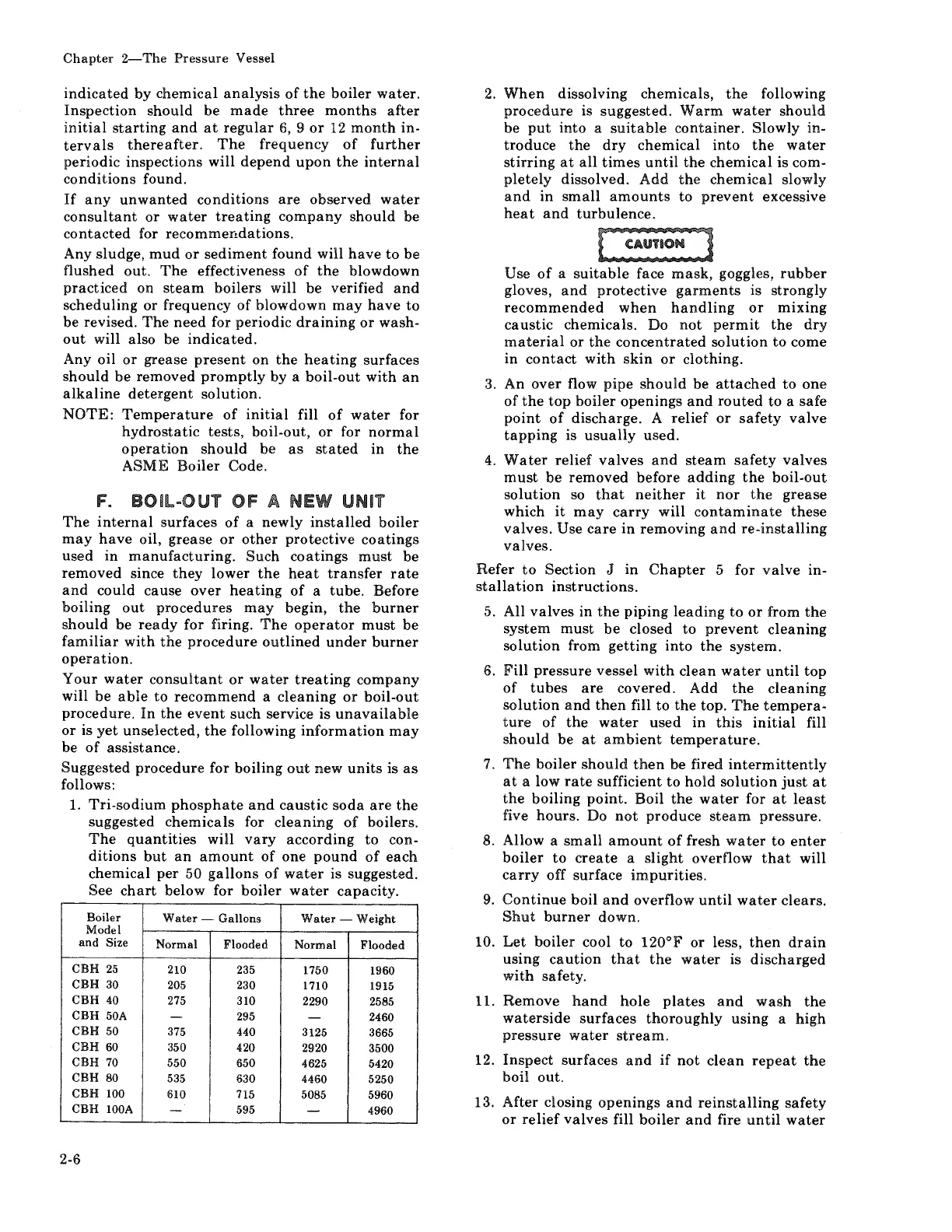
See
chart
below
for
boiler
water
capacity.
Boiler
Model
Water-
Gallons
Water-
Weight
and
Size
Normal
Flooded
Normal
Flooded
CBH
25
210
235
1750
1960
CBH
30
205 230
1710
1915
CBH
40
275
310
2290
2585
CBH
50A
- 295
- 2460
CBH
50
375
440
3125 3665
CBH
60
350
420
2920
3500
CBH
70
550
650
4625
5420
CBH
80
535
630
4460 5250
CBH
100
610
715 5085
5960
CBH
lOOA
-
595
-
4960
2-6
2.
When
dissolving
chemicals,
the
following
procedure
is
suggested.
Warm
water
should
be
put
into
a
suitable
container.
Slowly in-
troduce
the
dry
chemical
into
the
water
stirring
at
all
times
until
the
chemical
is com-
pletely
dissolved.
Add
the
chemical
slowly
and
in
small
amounts
to
prevent
excessive
heat
and
turbulence.
Use
of
a
suitable
face
mask,
goggles,
rubber
gloves,
and
protective
garments
is
strongly
recommended
when
handling
or
mixing
caustic
chemicals.
Do
not
permit
the
dry
material
or
the
concentrated
solution
to
come
in
contact
with
skin
or
clothing.
3.
An
over
flow
pipe
should
be
attached
to
one
of
the
top
boiler
openings
and
routed
to a
safe
point
of
discharge.
A
relief
or
safety
valve
tapping
is
usually
used.
4.
Water
relief
valves
and
steam
safety
valves
must
be
removed
before
adding
the
boil-out
solution
so
that
neither
it
nor
the
grease
which
it
may
carry
will
contaminate
these
valves.
Use
care
in
removing
and
re-installing
valves.
Refer
to
Section
J
in
Chapter
5
for
valve
in-
stallation
instructions.
5.
All
valves
in
the
piping
leading
to
or
from
the
system
must
be
closed
to
prevent
cleaning
solution
from
getting
into
the
system.
6.
Fill
pressure
vessel
with
clean
water
until
top
of
tubes
are
covered.
Add
the
cleaning
solution
and
then
fill
to
the
top.
The
tempera-
ture
of
the
water
used
in
this
initial
fill
should
be
at
ambient
temperature.
7.
The
boiler
should
then
be fired
intermittently
at
a low
rate
sufficient
to
hold
solution
just
at
the
boiling
point.
Boil
the
water
for
at
least
five
hours.
Do
not
produce
steam
pressure.
8.
Allow
a
small
amount
of
fresh
water
to
enter
boiler
to
create
a
slight
overflow
that
will
carry
off
surface
impurities.
9.
Continue
boil
and
overflow
until
water
clears.
Shut
burner
down.
10.
Let
boiler
cool to
120°F
or
less,
then
drain
using
caution
that
the
water
is
discharged
with
safety.
11.
Remove
hand
hole
plates
and
wash
the
waterside
surfaces
thoroughly
using
a
high
pressure
water
stream.
12.
Inspect
surfaces
and
if
not
clean
repeat
the
boil
out.
13.
After
closing
openings
and
reinstalling
safety
or
relief
valves
fill
boiler
and
fire
until
water

Table of Contents

Related product manuals