EasyManua.ls Logo

Cleaver-Brooks CBH 40 - Cleaning

Default Icon
75 pages
Print Icon
To Next Page IconTo Next Page
To Previous Page IconTo Previous Page
Loading...
-
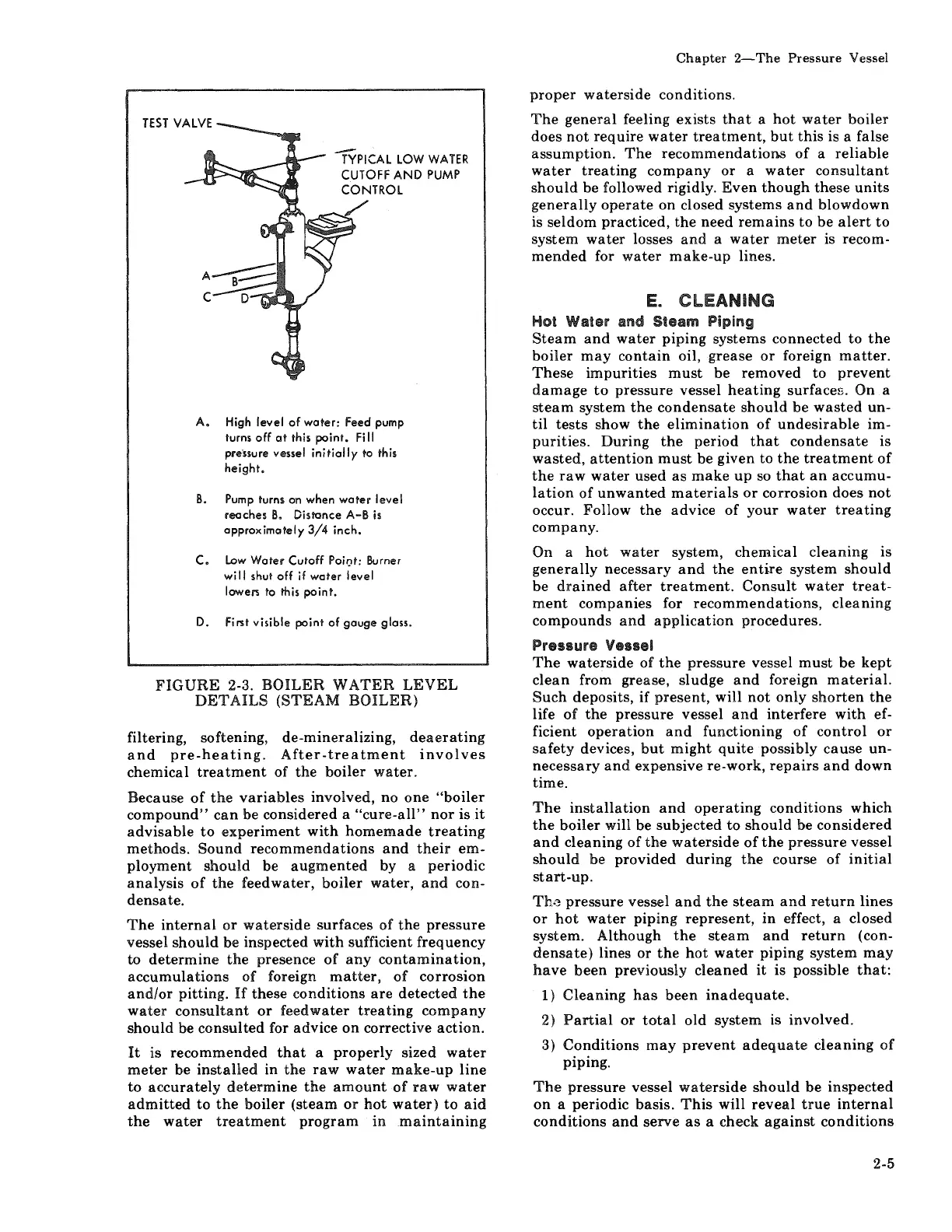
TYPICAL LOW
WATER
CUTOFF
AND
PUMP
CONTROL
/
~~
A.
High level
of
water:
Feed pump
turns
off
at
this
point.
Fi
II
pressure vessel
initially
to this
height.
B.
Pump turns on when
water
level
reaches
B.
Distance
A-B
is
approximately
3/4
inch.
C.
Low
Water
Cutoff
Poir;>t:
Burner
will
shut
off
if
water
level
Iowen
to this
point.
D.
Fint
visible
point
of
gouge
glass.
FIGURE
2-3.
BOILER
WATER
LEVEL
DETAILS
(STEAM
BOILER)
filtering, softening,
de-mineralizing,
deaerating
and
pre-heating.
After-treatment
involves
chemical
treatment
of
the
boiler
water.
Because
of
the
variables
involved,
no
one
"boiler
compound"
can
be
considered
a
"cure-all"
nor
is
it
advisable
to
experiment
with
homemade
treating
methods.
Sound
recommendations
and
their
em-
ployment
should
be
augmented
by a
periodic
analysis
of
the
feedwater,
boiler
water,
and
con-
densate.
The
internal
or
waterside
surfaces
of
the
pressure
vessel
should
be
inspected
with
sufficient
frequency
to
determine
the
presence
of
any
contamination,
accumulations
of
foreign
matter,
of
corrosion
and/or
pitting.
If
these
conditions
are
detected
the
water
consultant
or
feedwater
treating
company
should
be
consulted
for
advice
on
corrective
action.
It
is
recommended
that
a
properly
sized
water
meter
be
installed
in
the
raw
water
make-up
line
to
accurately
determine
the
amount
of
raw
water
admitted
to
the
boiler
(steam
or
hot
water)
to
aid
the
water
treatment
program
in
maintaining
Chapter
2-
The
Pressure
Vessel
proper
waterside
conditions.
The
general
feeling
exists
that
a
hot
water
boiler
does
not
require
water
treatment,
but
this
is a false
assumption.
The
recommendations
of
a
reliable
water
treating
company
or
a
water
consultant
should
be followed rigidly.
Even
though
these
units
generally
operate
on
closed
systems
and
blowdown
is
seldom
practiced,
the
need
remains
to
be
alert
to
system
water
losses
and
a
water
meter
is recom-
mended
for
water
make-up
lines.
E.
ClEANING
Hot
Water
and Steam
Piping
Steam
and
water
piping
systems
connected
to
the
boiler
may
contain
oil,
grease
or
foreign
matter.
These
impurities
must
be
removed
to
prevent
damage
to
pressure
vessel
heating
surfaces.
On
a
steam
system
the
condensate
should
be
wasted
un-
til
tests
show
the
elimination
of
undesirable
im-
purities.
During
the
period
that
condensate
is
wasted,
attention
must
be
given
to
the
treatment
of
the
raw
water
used
as
make
up
so
that
an
accumu-
lation
of
unwanted
materials
or
corrosion
does
not
occur.
Follow
the
advice
of
your
water
treating
company.
On
a
hot
water
system,
chemical
cleaning
is
generally
necessary
and
the
entire
system
should
be
drained
after
treatment.
Consult
water
treat-
ment
companies
for
recommendations,
cleaning
compounds
and
application
procedures.
Pressure Vessel
The
waterside
of
the
pressure
vessel
must
be
kept
clean
from
grease,
sludge
and
foreign
material.
Such
deposits,
if
present,
will
not
only
shorten
the
life
of
the
pressure
vessel
and
interfere
with
ef-
ficient
operation
and
functioning
of
control
or
safety
devices,
but
might
quite
possibly
cause
un-
necessary
and
expensive
re-work,
repairs
and
down
time.
The
installation
and
operating
conditions
which
the
boiler
will
be
subjected
to
should
be
considered
and
cleaning
of
the
waterside
of
the
pressure
vessel
should
be
provided
during
the
course
of
initial
start-up.
Th':!
pressure
vessel
and
the
steam
and
return
lines
or
hot
water
piping
represent,
in
effect, a closed
system.
Although
the
steam
and
return
(con-
densate)
lines
or
the
hot
water
piping
system
may
have
been
previously
cleaned
it
is
possible
that:
1)
Cleaning
has
been
inadequate.
2)
Partial
or
total
old
system
is
involved.
3)
Conditions
may
prevent
adequate
cleaning
of
piping.
The
pressure
vessel
waterside
should
be
inspected
on
a
periodic
basis.
This
will
reveal
true
internal
conditions
and
serve
as
a
check
against
conditions
2-5

Table of Contents

Related product manuals