EasyManua.ls Logo

Cleaver-Brooks CBH 40 - Water Gage Glass; Operating Controls

Default Icon
75 pages
Print Icon
To Next Page IconTo Next Page
To Previous Page IconTo Previous Page
Loading...
Chapter
5--Adjustment
and
Maintenance
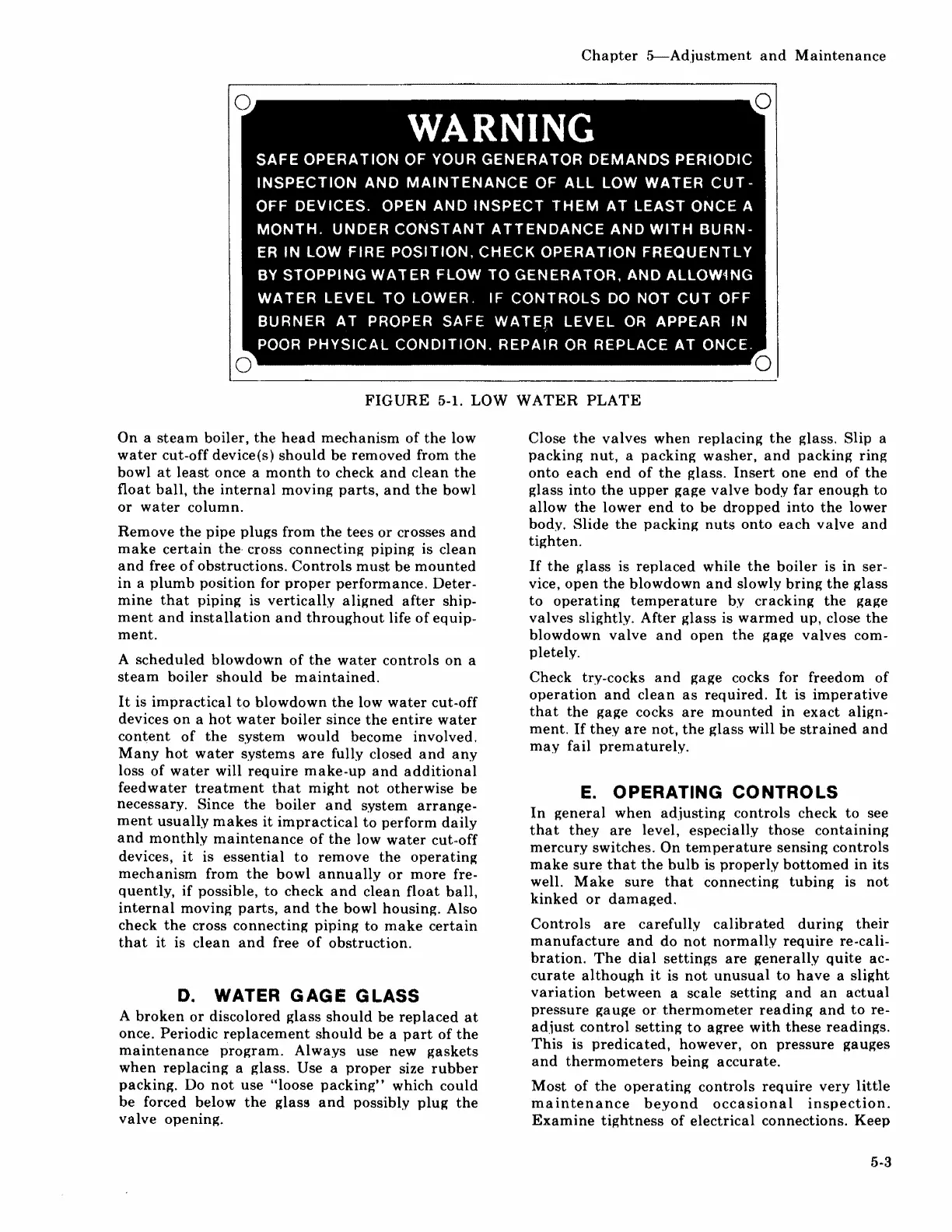
WARNING
SAFE
OPERATION
OF YOUR
GENERATOR
DEMANDS
PERIODIC
INSPECTION
AND
MAINTENANCE
OF
ALL
LOW
WATER
CUT-
OFF
DEVICES. OPEN
AND
INSPECT
THEM
AT
LEAST
ONCE A
MONTH.
UNDER
CONSTANT
ATTENDANCE
AND
WITH
BURN-
ER
IN LOW
FIRE
POSITION,
CHECK
OPERATION
FREQUENTLY
BY
STOPPING
WATER
FLOW
TO
GENERATOR,
AND ALLOW1NG
WATER
LEVEL
TO
LOWER. IF
CONTROLS
DO NOT
CUT
OFF
BURNER
AT
PROPER
SAFE
WATER
LEVEL
OR
APPEAR IN
-::
POOR
PHYSICAL
CONDITION.
REPAIR
OR
REPLACE
AT
ONCE.
FIGURE
5-l.
LOW
WATER
PLATE
On a
steam
boiler,
the
head
mechanism
of
the
low
water
cut-off device(s)
should
be removed from
the
bowl
at
least
once a
month
to
check
and
clean
the
float
ball,
the
internal
moving
parts,
and
the
bowl
or
water
column.
Remove
the
pipe
plugs
from
the
tees or crosses
and
make
certain
the
cross connecting piping is
clean
and
free
of
obstructions.
Controls
must
be
mounted
in
a
plumb
position for
proper
performance.
Deter-
mine
that
piping is
vertically
aligned
after
ship-
ment
and
installation
and
throughout
life
of
equip-
ment.
A
scheduled
blowdown
of
the
water
controls
on
a
steam
boiler
should
be
maintained.
It
is
impractical
to
blowdown
the
low
water
cut-off
devices
on
a
hot
water
boiler
since
the
entire
water
content
of
the
system
would
become involved.
Many
hot
water
systems
are
fully closed
and
any
loss of
water
will
require
make-up
and
additional
feedwater
treatment
that
might
not
otherwise
be
necessary. Since
the
boiler
and
system
arrange-
ment
usually
makes
it
impractical
to
perform
daily
and
monthly
maintenance
of
the
low
water
cut-off
devices,
it
is
essential
to
remove
the
operating
mechanism
from
the
bowl
annually
or
more
fre-
quently,
if possible,
to
check
and
clean
float
ball,
internal
moving
parts,
and
the
bowl housing. Also
check
the
cross
connecting
piping
to
make
certain
that
it
is
clean
and
free
of
obstruction.
D. WATER
GAGE
GLASS
A
broken
or
discolored glass
should
be
replaced
at
once.
Periodic
replacement
should
be a
part
of
the
maintenance
program.
Always use new
gaskets
when
replacing
a glass. Use a
proper
size
rubber
packing. Do
not
use "loose
packing"
which
could
be
forced below
the
glass
and
possibly
plug
the
valve
opening.
Close
the
valves
when
replacing
the
glass. Slip a
packing
nut,
a
packing
washer,
and
packing
ring
onto
each
end
of
the
glass.
Insert
one end of
the
glass into
the
upper
gage
valve
body
far
enough
to
allow
the
lower
end
to
be
dropped
into
the
lower
body.
Slide
the
packing
nuts
onto
each
valve
and
tighten.
If
the
glass is
replaced
while
the
boiler
is in ser-
vice,
open
the
blowdown
and
slowly
bring
the
glass
to
operating
temperature
by
cracking
the
gage
valves
slightly. After glass is
warmed
up, close
the
blowdown
valve
and
open
the
gage
valves
com-
pletely.
Check try-cocks
and
gage cocks for freedom
of
operation
and
clean
as
required.
It
is
imperative
that
the
gage cocks
are
mounted
in
exact
align-
ment.
If
they
are
not,
the
glass will
be
strained
and
may
fail
prematurely.
E.
OPERATING
CONTROLS
In
general
when
adjusting
controls
check
to
see
that
they
are
level,
especially
those
containing
mercury
switches. On
temperature
sensing
controls
make
sure
that
the
bulb
is
properly
bottomed
in its
well.
Make
sure
that
connecting
tubing
is
not
kinked
or
damaged.
Controls
are
carefully
calibrated
during
their
manufacture
and
do
not
normally
require
re-cali-
bration.
The
dial
settings
are
generally
quite
ac-
curate
although
it
is
not
unusual
to
have
a
slight
variation
between
a
scale
setting
and
an
actual
pressure
gauge
or
thermometer
reading
and
to
re-
adjust
control
setting
to
agree
with
these
readings.
This
is
predicated,
however,
on
pressure
gauges
and
thermometers
being
accurate.
Most
of
the
operating
controls
require
very
little
maintenance
beyond
occasional
inspection.
Examine
tightness
of
electrical
connections.
Keep

Table of Contents

Related product manuals