EasyManua.ls Logo

Cleaver-Brooks CBH 40 - Page 37

Default Icon
75 pages
Print Icon
To Next Page IconTo Next Page
To Previous Page IconTo Previous Page
Loading...
The
timer
resumes
operation.
When
the
dial
indi-
cator
reaches
the
start
or
dot
position
the
timer
and
blower
motor
will
be
de-energized.
The
lock-
out
switch
must
be
manually
re-set
before
opera-
tion
can
be
resumed.
(Refer
to
caution
above.)
18.
Pilot
but
no
main
flame.
If
the
pilot
flame
is
proven,
the
main
fuel
valve
cir-
cuit
is
energized
from
terminal
7.
The
pilot
flame
will
be
extinguished
10
seconds
later.
The
flame
detecting
circuit
will
break
within
4
seconds
to
drop
out
the
flame
relay
2K.
The
main
fuel
valve
circuit
is
de-energized
to
stop
the
flow
of
fuel.
The
blower
motor
continues
to
run.
The
lockout
switch
will
trip
approximately
30
seconds
later
and
relay
lK
will
be
de-energized.
The
flame
failure
light
and
alarm
bell
(optional)
are
energized.
The
timer
resumes
operation.
When
the
dial
indi-
cator
reaches
the
start
or
dot
position
the
timer
and
blower
motor
will
be
de-energized.
The
lock-
out
switch
must
be
manually
reset
before
operation
can
be
resumed.
(Refer
to
caution
above.)
C. Loss
of
flame.
If
a
flame
outage
occurs
during
normal
operation
and/or
the
flame
is no
longer
sensed
by
the
de-
tector,
the
flame
relay
2K
will
trip
within
4 se-
conds
to
de-energize
the
fuel
valve
circuit
and
shut
off fuel flow.
The
blower
motor
continues
opera-
tion.
Approximately
30
seconds
later
the
lockout
switch
will
trip
to
de-energize
master
relay
lK.
The
flame
failure
light
and
alarm
bell
(optional)
are
energized.
The
timer
resumes
operation.
When
the
dial
indi-
cator
reaches
the
start
or
dot
position
the
timer
and
blower
motor
will
be
de-energized.
The
lock-
out
switch
must
be
manually
reset
before
operation
can
be
resumed.
(Refer
to
caution
above.)
If
the
burner
will
not
start,
or
upon
a
safety
lock-
out,
the
trouble
shooting
section
in
the
operating
manual
and
the
technical
bulletin
should
be
re-
ferred
to
for
assistance
in
pinpointing
problems
that
may
not
be
readily
apparent.
Familiarity
with
the
programmer
and
other
controls
in
the
system
can
be
obtained
by
studying
the
contents
of
the
manual
and
this
bulletin.
Knowledge
of
the
system
and
its
controls
will
make
troubleshooting
much
easier
in
the
event
it
is necessary.
Costly
down
time
or
delays
can
be
prevented
by
systematic
checks
of
the
actual
operation
against
the
normal
sequence
to
determine
the
stage
at
which
performance
de-
viates
from
normaL
Following
a
routine
may
pos-
sibly
eliminate
overlooking
an
obvious
condition,
often
one
that
is
relatively
simple
to
correct.
Remember
that
this
is a
safety
device
and
for
the
most
part
it
is
doing
its
job
when
it
shuts
down
or
refuses
to
operate.
Never
attempt
to
circumvent
any
of
the
safety
features.
Chapter
3-Sequence
of
Operation
Preventive
maintenance
and
scheduled
inspection
of
all
components
should
be
followed.
Periodic
checking
of
the
relay
to
see
that
a
safety
lockout
will
occur
under
conditions
of
failure
to
ignite
either
pilot
or
main
flame,
or
from loss
of
flame
is
recommended.
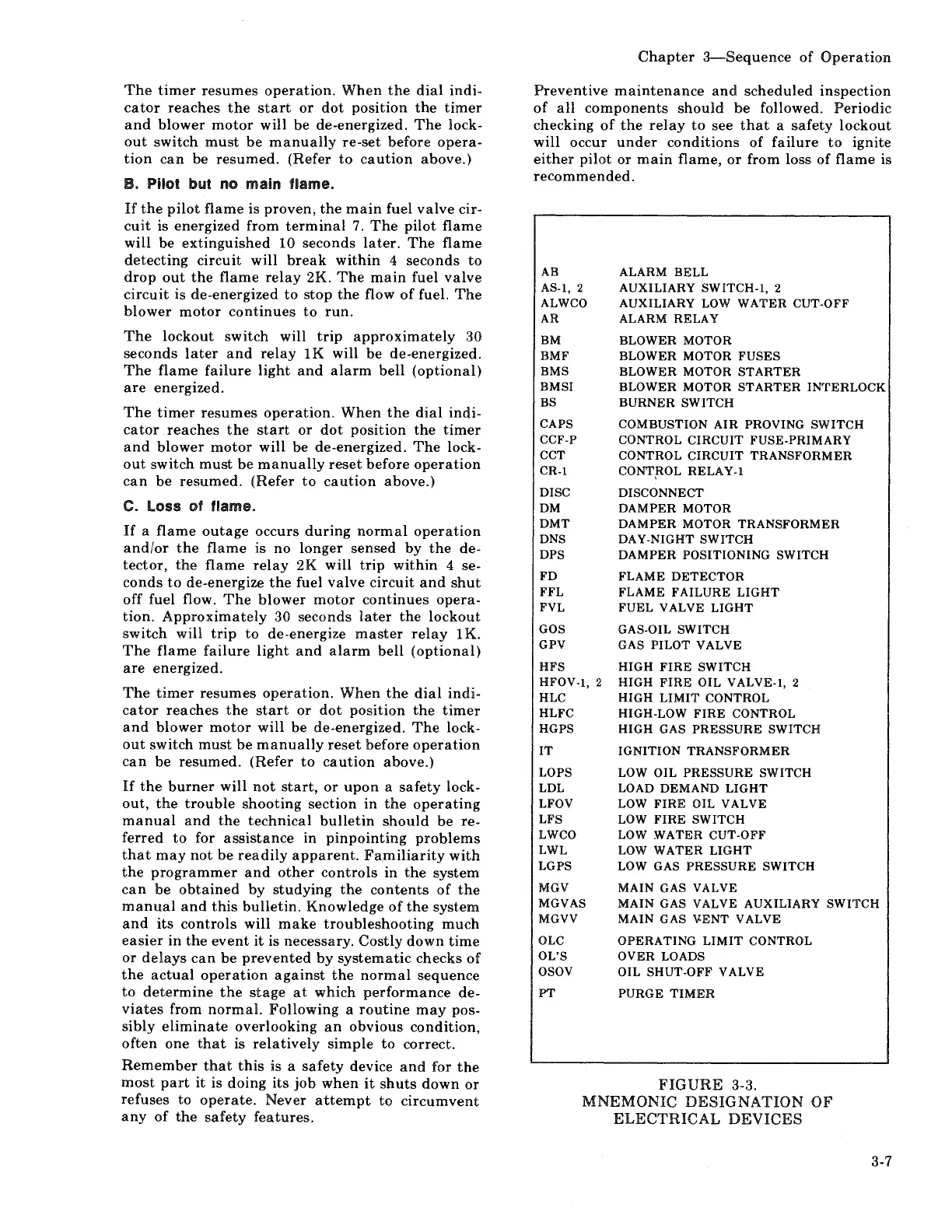
AB
ALARM
BELL
AS-I, 2
AUXILIARY
SWITCH-I,
2
ALWCO AUXILIARY LOW
WATER
CUT-OFF
AR ALARM RELAY
BM
BLOWER
MOTOR
BMF
BLOWER
MOTOR
FUSES
BMS
BLOWER
MOTOR
STARTER
BMSI
BLOWER
MOTOR
STARTER
INTERLOCK
BS
BURNER
SWITCH
CAPS COMBUSTION
AIR
PROVING
SWITCH
CCF-P CONTROL
CIRCUIT
FUSE-PRIMARY
CCT CONTROL
CIRCUIT
TRANSFORMER
CR-I
CONTfWL
RELAY-I
DISC DISCONNECT
DM
DAMPER
MOTOR
DMT
DAMPER
MOTOR
TRANSFORMER
DNS DAY-NIGHT
SWITCH
DPS
DAMPER
POSITIONING
SWITCH
FD
FLAME
DETECTOR
FFL
FLAME
FAILURE
LIGHT
FVL
FUEL
VALVE
LIGHT
GOS GAS-OIL
SWITCH
GPV GAS
PILOT
VALVE
HFS
HIGH
FIRE
SWITCH
HFOV-I, 2
HIGH
FIRE
OIL
VALVE-I, 2
HLC
HIGH
LIMIT
CONTROL
HLFC
HIGH-LOW
FIRE
CONTROL
HGPS
HIGH
GAS
PRESSURE
SWITCH
IT
IGNITION
TRANSFORMER
LOPS LOW
OIL
PRESSURE
SWITCH
LDL LOAD
DEMAND
LIGHT
LFOV LOW
FIRE
OIL VALVE
LFS
LOW
FIRE
SWITCH
LWCO
LWL
LGPS
LOW
WATER
CUT-OFF
LOW
WATER
LIGHT
LOW GAS
PRESSURE
SWITCH
MAIN
GAS VALVE MGV
MGVAS
MGVV
MAIN
GAS VALVE AUXILIARY
SWITCH
MAIN
GAS V:ENT VALVE
OLC
OL'S
osov
PT
OPERATING
LIMIT
CONTROL
OVER
LOADS
OIL
SHUT-OFF
VALVE
PURGE
TIMER
FIGURE
3-3.
MNEMONIC
DESIGNATION
OF
ELECTRICAL
DEVICES
3-7

Table of Contents

Related product manuals