EasyManua.ls Logo

Cleaver-Brooks CBH 40 - Page 55

Default Icon
75 pages
Print Icon
To Next Page IconTo Next Page
To Previous Page IconTo Previous Page
Loading...
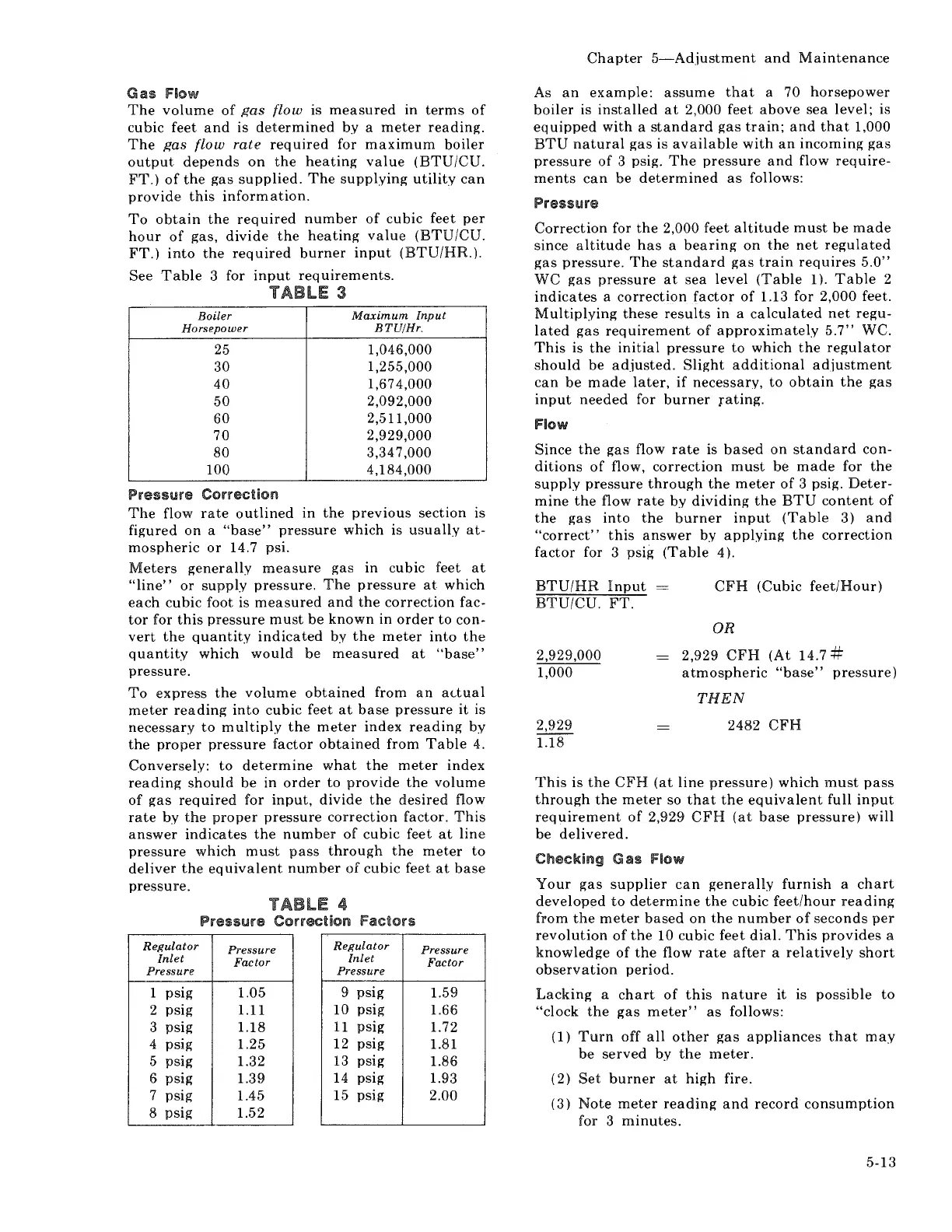
Gas
flow
The
volume
of
!{as
flow
is
measured
in
terms
of
cubic
feet
and
is
determined
by
a
meter
reading.
The
!{as
flow
rate
required
for
maximum
boiler
output
depends
on
the
heating
value
(BTU/CU.
FT.)
of
the
gas
supplied.
The
supplying
utility
can
provide
this
information.
To
obtain
the
required
number
of
cubic
feet
per
hour
of
gas,
divide
the
heating
value
(BTU/CU.
FT.)
into
the
required
burner
input
(BTU/HR.).
See
Table
3 for
input
requirements.
TABLE
3
Boiler
Maximum
Input
Horsepower
BTU/Hr.
25
1,046,000
30
1,255,000
40
1,674,000
50
2,092,000
60
2,511,000
70
2,929,000
80
3,34 7,000
100
4,184,000
Pressure
Correction
The
flow
rate
outlined
in
the
previous
section
is
figured
on
a
"base''
pressure
which
is
usually
at-
mospheric
or
14.7
psi.
Meters
generally
measure
gas
in
cubic
feet
at
"line"
or
supply
pressure.
The
pressure
at
which
each
cubic
foot
is
measured
and
the
correction
fac-
tor
for
this
pressure
must
be
known
in
order
to
con-
vert
the
quantity
indicated
by
the
meter
into
the
quantity
which
would
be
measured
at
"base"
pressure.
To
express
the
volume
obtained
from
an
actual
meter
reading
into
cubic
feet
at
base
pressure
it
is
necessary
to
multiply
the
meter
index
reading
by
the
proper
pressure
factor
obtained
from
Table
4.
Conversely:
to
determine
what
the
meter
index
reading
should
be
in
order
to
provide
the
volume
of
gas
required
for
input,
divide
the
desired
flow
rate
by
the
proper
pressure
correction
factor.
This
answer
indicates
the
number
of
cubic
feet
at
line
pressure
which
must
pass
through
the
meter
to
deliver
the
equivalent
number
of
cubic
feet
at
base
pressure.
Regulator
Inlet
Pressure
1
psig
2
psig
3
psig
4
psig
5
psig
6
psig
7
psig
8
psig
TABLE
4
Pressure
Correction
factors
Pressure
Factor
Regulator
Inlet
Pressure
1.05
9
psig
1.11
10
psig
1.18
11
psig
1.25
12
psig
1.32
13
psig
1.39
14
psig
1.45
15
psig
1.52
Pressure
Factor
1.59
1.66
1.72
1.81
1.86
1.93
2.00
Chapter
5-Adjustment
and
Maintenance
As
an
example:
assume
that
a 70
horsepower
boiler
is
installed
at
2,000
feet
above
sea
level;
is
equipped
with
a
standard
gas
train;
and
that
1,000
BTU
natural
gas
is
available
with
an
incoming
gas
pressure
of
3 psig.
The
pressure
and
flow
require-
ments
can
be
determined
as
follows:
Pressure
Correction
for
the
2,000
feet
altitude
must
be
made
since
altitude
has
a
bearing
on
the
net
regulated
gas
pressure.
The
standard
gas
train
requires
5.0"
WC
gas
pressure
at
sea
level
(Table
1
).
Table
2
indicates
a
correction
factor
of
1.13
for
2,000 feet.
Multiplying
these
results
in
a
calculated
net
regu-
lated
gas
requirement
of
approximately
5.7"
we.
This
is
the
initial
pressure
to
which
the
regulator
should
be
adjusted.
Slight
additional
adjustment
can
be
made
later,
if
necessary,
to
obtain
the
gas
input
needed
for
burner
rating.
flow
Since
the
gas
flow
rate
is
based
on
standard
con-
ditions
of
flow,
correction
must
be
made
for
the
supply
pressure
through
the
meter
of
3 psig.
Deter-
mine
the
flow
rate
by
dividing
the
BTU
content
of
the
gas
into
the
burner
input
(Table
3)
and
"correct"
this
answer
by
applying
the
correction
factor
for 3
psig
(Table
4
).
BTU/HR
Input
BTU/CU.
FT.
2,929,000
1,000
2,929
1.18
CFH
(Cubic
feet/Hour)
OR
2,929
CFH
(At
14.7 #
atmospheric
"base"
pressure)
THEN
2482
CFH
This
is
the
CFH
(at
line
pressure)
which
must
pass
through
the
meter
so
that
the
equivalent
full
input
requirement
of
2,929
CFH
(at
base
pressure)
will
be
delivered.
Checking
Gas
flow
Your
gas
supplier
can
generally
furnish
a
chart
developed
to
determine
the
cubic
feet/hour
reading
from
the
meter
based
on
the
number
of
seconds
per
revolution
of
the
10
cubic
feet
dial.
This
provides
a
knowledge
of
the
flow
rate
after
a
relatively
short
observation
period.
Lacking
a
chart
of
this
nature
it
is
possible
to
"clock
the
gas
meter"
as
follows:
(1)
Turn
off
all
other
gas
appliances
that
may
be
served
by
the
meter.
( 2)
Set
burner
at
high
fire.
(3)
Note
meter
reading
and
record
consumption
for 3
minutes.
5-13

Table of Contents

Related product manuals