1.3.3 Transmit Full Automatically
Fully automatic transmitting mode, that is, once the operation is started, there is no need the MCU (and
not) to participate in the switching state. The MCU can only obtain the chip working state by the preset
interrupt, and perform the required operation. It should be noted that before entering the full automatic
transmitting, the MCU must first fill in the data to be transmitted in the STBY state, and configure the package
format, the FIFO working mode, the interrupt and IO.
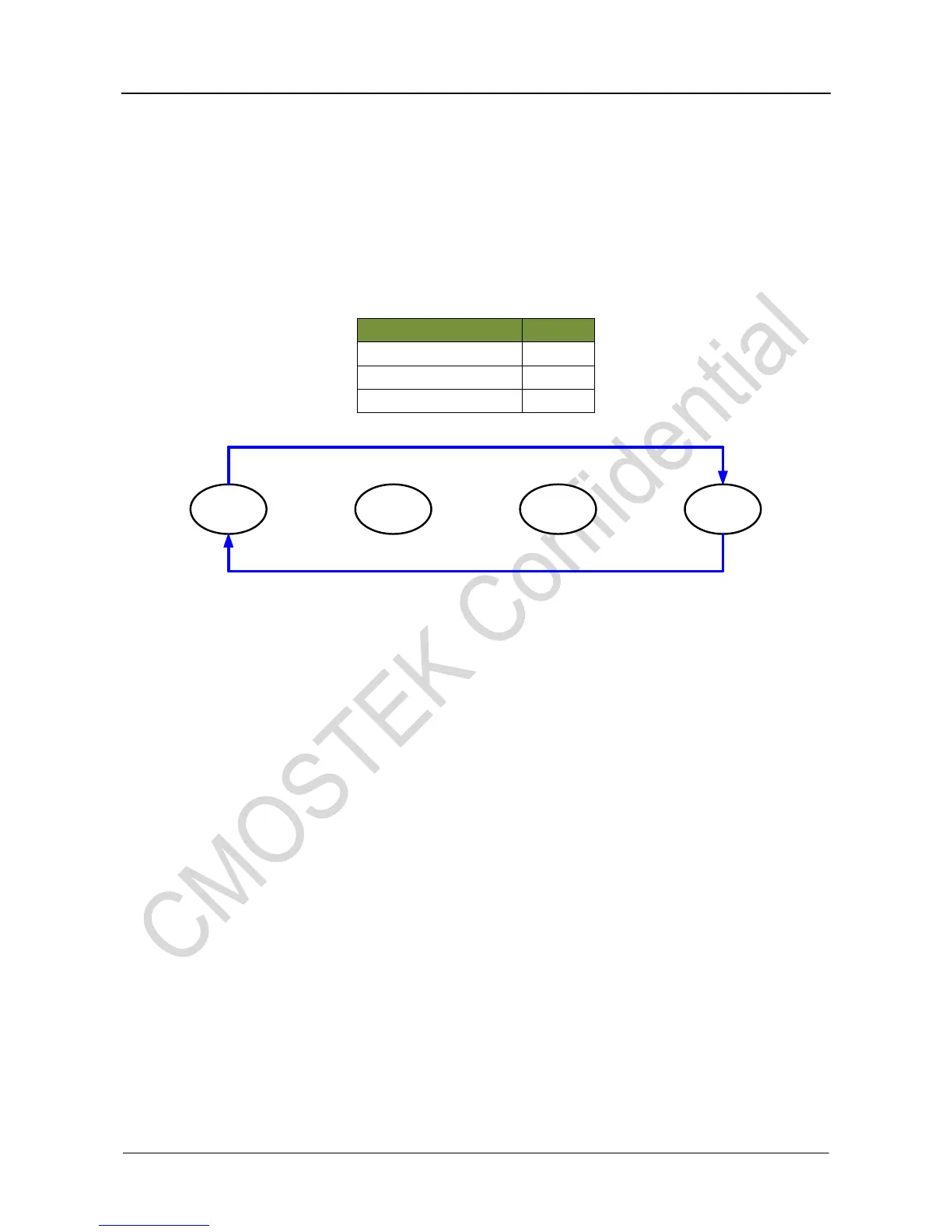
Table 11. Transmit Full Automatically
SLEEP_TIMER_EN = 1, TX_DC_EN = 1
SLEEP STBY TFS TX
TX_TIMER_EN = 1, TX_EXIT_STATE = 0
Figure 9. Transmitter Transmits Full Automatically
1.4 Enter and Exit from Duty-Cycle Mode
1.4.1 Enter Duty-Cycle Mode
After the chip initialization is completed, you can configure the related register to enter the desired
Duty-Cycle mode in the configuration stage. After completing the configuration in the STBY and then manually
entering the SLEEP, the chip will officially begin to operate in accordance with the configuration.
1.4.2 Exit from Duty-Cycle Mode
For non full-automatic Duty-Cycle mode, the system always stops in a certain status and waits for the
MCU operation. The MCU can switch the system back to STBY, and then reconfigure several related registers
according to the configuration process introduced earlier, and then you can exit from the Duty-Cycle mode.
For full-automatic Duty-Cycle mode, whether it is TX or RX, the MCU does not accurately know the chip
operating status, so there must be a 100% reliable mechanism to make the chip to stop running and switch
back to the manual control mode.
Assuming CMT2300A starts the full-automatic Duty-Cycle operation after the initialization configuration
introduced above, the MCU can exit safely by operating the following register bits:


 To Next Page